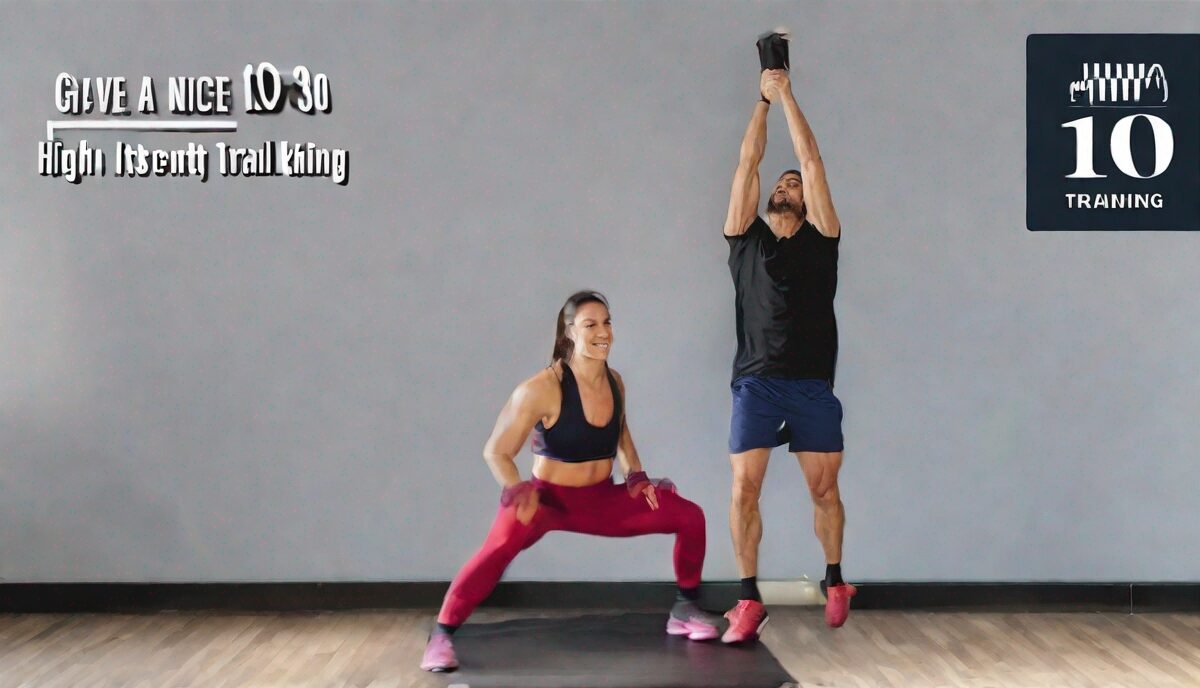
What is 10-20-30 High Intensity Interval Training?
10-20-30 HIIT is a type of interval training that alternates bursts of high intensity exercise with periods of rest. It gets its name from the timing of its intervals. You do 10 seconds of hard work, followed by 20 seconds of easier work, then 30 seconds of rest. This cycle then repeats for a set amount of time.
The Benefits of 10-20-30 HIIT
Studies show that 10-20-30 training offers many of the same benefits as longer HIIT workouts, but in shorter total time. It can:
- Burn more fat and calories in less time
- Build aerobic fitness
- Improve heart health
- Support sustainable weight loss
The short intervals and recovery periods also make the workout more accessible for beginners compared to longer HIIT formats.
How to Do 10-20-30 HIIT
To do 10-20-30 HIIT:
- Warm up for 5-10 minutes.
- Do 10 seconds of intense exercise like sprints, burpees, or jumping jacks.
- Follow with 20 seconds of easier exercise like jogging in place.
- Then take 30 seconds to fully recover. Walk in place or stand still.
- Repeat the 10-20-30 cycle for a set time, usually 20-30 minutes.
- Cool down for 5-10 minutes.
You can adapt almost any cardio exercise into a 10-20-30 workout. Mix up moves each interval to keep it interesting and train different muscles.
Sample 10-20-30 HIIT Workouts
Here are two sample 10-20-30 interval training sessions you can try:
Beginner Workout
- 10 seconds high knees
- 20 seconds march in place
- 30 seconds recovery
Repeat for 20 minutes total
Advanced Workout
- 10 seconds burpees
- 20 seconds jog in place
- 30 seconds recovery
Repeat for 30 minutes total
Optimizing Physiological Adaptations: The Science of Recovery
While the 10-20-30 method is celebrated for its efficiency, the secret to its efficacy lies in the 20-second “moderate” phase. Unlike traditional HIIT, which often utilizes passive rest, the 20-second window is designed to flush metabolic byproducts like lactate from the muscles while keeping the heart rate elevated. To maximize this, you must treat the 20-second segment not as a break, but as active recovery. If you stop moving entirely during this phase, you miss the opportunity to train your body to process lactic acid under duress, which is the cornerstone of improved athletic endurance. Maintain a rhythmic, light movement—such as a slow shuffle or rhythmic marching—to ensure blood flow remains constant, preventing the blood pooling that can cause dizziness after an explosive 10-second sprint.
Designing Progressive Overload for Long-Term Gains
To avoid the dreaded fitness plateau, you must manipulate the variables of your 10-20-30 sessions as you adapt. Progressive overload in this context does not just mean “working harder.” Start by increasing the intensity of the 10-second burst by adding external resistance, such as holding a pair of light dumbbells while performing mountain climbers or wearing a weighted vest during sprints. As your cardiovascular capacity expands, focus on the quality of the 20-second phase. Transition from a slow jog to a brisk, purposeful stride, effectively narrowing the gap between your “hard” and “easy” intensities. By the third or fourth week, you might also introduce “density training” by shortening the 30-second recovery period to 25 seconds, forcing your cardiovascular system to recover in a tighter window without sacrificing the integrity of the 10-second explosive output.
Integrating Strength-Cardio Hybridization
The 10-20-30 format is uniquely suited for hybrid training, where you can blend explosive power movements with endurance-based recovery. Instead of using the same exercise for the entire session, construct a circuit that alternates the focus. For example, use the 10-second window for high-impact power moves like box jumps or plyometric push-ups, then use the 20-second window for low-impact, high-tension movements like planks or isometric wall sits. This approach allows you to tax the anaerobic system while simultaneously building muscular endurance in the core and stabilizers. By rotating the focal point of the intervals, you reduce repetitive strain on specific joints, allowing you to train more frequently without the typical overuse injuries associated with high-intensity work.
Mastering the Mental Game: Managing Perceived Exertion
The success of 10-20-30 training relies heavily on your ability to accurately gauge Rate of Perceived Exertion (RPE). During the 10-second burst, your effort should be at an RPE of 9 or 10—you should feel as though you could not maintain that pace for even a second longer. If you finish the 10-second burst and feel you have “gas in the tank,” you are likely under-training. Conversely, the 20-second phase should feel like a relief, but not a total shutdown. Mental fatigue often sets in around the 15-minute mark, where the brain attempts to throttle your physical output to conserve energy. To combat this, utilize “chunking” strategies: focus solely on completing the current 60-second block, rather than the entire 20-minute duration. Visualizing the completion of a single cycle provides a micro-reward that keeps the nervous system primed for the next explosive burst.
Equipment-Based Variations for Advanced Athletes
While bodyweight exercises are effective, integrating specific equipment can amplify the stimulus of the 10-20-30 method. Using a stationary bike or an elliptical allows for a more controlled transition between intensities, as you can adjust the resistance levels instantly between the 10-second sprint and the 20-second cruise. For runners, performing this protocol on a treadmill requires caution; since the belt speed takes a few seconds to adjust, consider keeping the treadmill at a consistent high speed and performing your “easy” 20 seconds by jumping onto the side rails (if experienced) or using a “straddle” technique. Alternatively, battle ropes provide an excellent upper-body focus for the 10-second burst, where the sheer muscular demand creates an immediate spike in heart rate that is difficult to replicate with lower-body movements alone.
Strategic Scheduling and Periodization
Treating every 10-20-30 session as a “max effort” day is a fast track to central nervous system (CNS) fatigue. To sustain these workouts over months, employ a periodization model. Dedicate two days a week to “High-Intensity” 10-20-30 sessions where you push for maximum output, and one day to a “Volume” session, where you focus on perfect form and consistent pacing rather than absolute speed. During the Volume session, aim to keep your heart rate within a steady “aerobic zone” during the 20-second recovery, rather than allowing it to plummet. This balance ensures that your mitochondria—the cellular powerhouses—are being trained in both their capacity to recover quickly and their ability to sustain moderate work, creating a more well-rounded metabolic profile than high-intensity sessions alone.
FAQ
Is 10-20-30 HIIT good for weight loss?
Yes, the high intensity intervals in 10-20-30 HIIT can boost your metabolism and burn more calories per session compared to steady state cardio. This can support sustainable fat loss over time.
How often should you do 10-20-30 workouts?
For beginners, aim for 2-3 10-20-30 workouts per week. Rest days are important to prevent overtraining. More advanced exercisers can do them 4-5 times per week.
What equipment do you need for 10-20-30 training?
No equipment is necessary. You can do 10-20-30 workouts at home or outdoors using just bodyweight exercises. Adding a jump rope can help make cardio intervals more challenging.
Is 10-20-30 HIIT safe?
As with any HIIT workout, 10-20-30 training is intense. Make sure you warm up properly and listen to your body. Modify moves as needed and stop if you feel pain or dizziness.
Who should not do 10-20-30 HIIT?
People with certain health conditions like heart disease, high blood pressure, joint injuries, and pregnancy may need to avoid intense interval training. Consult a doctor before starting any new workout program.
Related posts:
 15-Minute No-Equipment HIIT
 HIIT Workouts Explained: Everything You Need to Know
 Audio Workout Apps Taking Over the Gym Scene
 How to Change Your Fitness Routine to Avoid Plateau
 Carrie Underwood’s Secret Weapon: Why Tabata Training Rules Her Routine
 The Brutal Assault Bike Workout That Torches Calories in Minutes
 Interval Running: The Training Method That Changes Everything
 Quick Cardio Fix: Tracy Anderson’s 7-Minute Heart-Pumping Workout Video