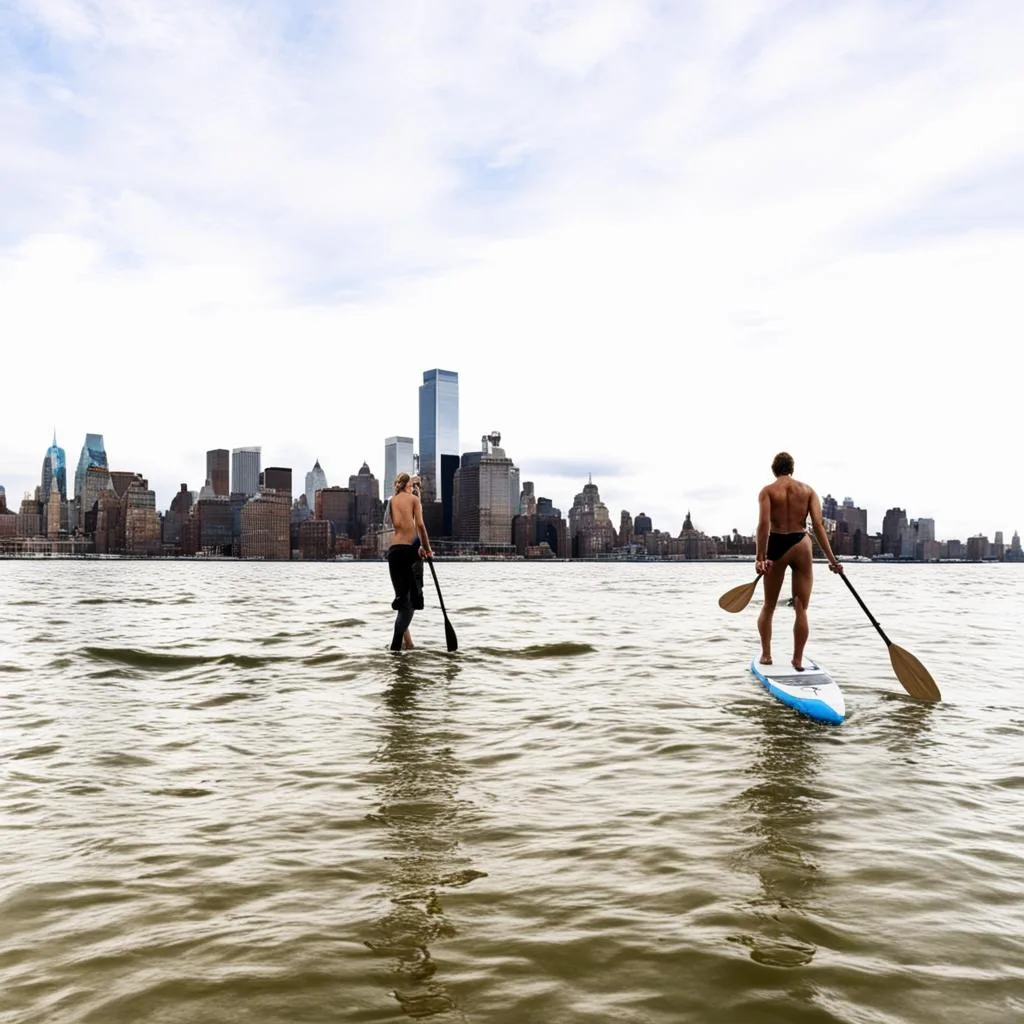
As I gently glided across the smooth waters of the Hudson River, paddle in hand, I was overcome with a sense of peace. The city skyline twinkled in the distance as I embraced the tranquility of the moment.
Appreciate the present
Paddleboarding taught me the value of being fully present. As I focused on balancing and taking in my surroundings, worries about the past and future melted away.
Nature restores us
There’s something rejuvenating about being out on the water, enveloped by nature. I could feel my stress levels dropping with each ripple of my paddle blade.
Little things matter
I was awed by the small details – a heron gracefully taking flight, sunlight dancing on the water. It reminded me not to overlook the little moments of beauty all around us.
Be adventurous
As I wobbled a bit, trying to get the hang of steering my board, I was thrilled by this new challenge. Paddleboarding stoked my sense of adventure and made me want to continue pushing my boundaries.
Quiet the inner critic
At first, I chided myself each time my board tipped. But eventually I quieted that inner critic by offering myself encouragement instead.
Patience is key
Mastering paddleboarding requires falling – a lot! But with patience and persistence, I got better with time. This lesson in patience taught me I can learn any new skill if I stick with it.
Alone time is underrated
As an extrovert, I’m often surrounded by people. Paddling solo helped me rediscover the joy of my own company. I relished having quiet time with my thoughts.
Small actions matter
With each dip of my paddle I propelled myself forward. It reminded me of the power we have to create ripples of positive change through small, consistent acts.
We’re all connected
I felt a sense of kinship with the other paddleboarders. The Hudson connected us, just as our shared humanity transcends surface differences.
Life is about balance
In paddleboarding as in life, success requires continually adjusting to maintain equilibrium. This sport reinforced that when things feel off-kilter, little corrections can help me find my footing.
Mastering the Hudson’s Tidal Rhythm
While the Hudson may look like a standard river, it is technically a tidal estuary, often referred to by its Mohican name, Mahicantuck, or “the river that flows both ways.” This means that for twice a day, the current flows north toward Albany, and for another two periods, it ebbs south toward the Atlantic. Understanding this cycle is the difference between a meditative glide and an exhausting struggle against an invisible treadmill. Before you even set foot on your board, you must become a student of the tide charts. If you launch during the peak of an ebb tide while trying to paddle north, you will find yourself stationary despite your best efforts. I learned that the river has its own schedule, and fighting it is a losing battle. The goal is to time your departure so you are “riding the conveyor belt” in the direction of your destination.
There is an added layer of complexity known as the “slack water” period—the brief window where the tide transitions and the water becomes eerily still. This is the golden hour for beginners. However, you must also account for wind-against-tide conditions. When a strong southern wind hits a receding northern current, the surface of the Hudson transforms into a series of steep, short-period waves known as “fetch.” These aren’t the long, rolling swells of the ocean; they are jagged and unpredictable. To navigate these, I had to learn to keep my knees soft and my gaze fixed on the horizon rather than the turbulent water beneath my feet. This physiological adjustment allows your lower body to act as a shock absorber while your upper body remains a stable platform for paddling. If you find yourself caught in a heavy current, the safest strategy is to paddle at an angle toward the shore rather than trying to fight the flow head-on, utilizing the slower-moving water near the piers and bulkheads where friction reduces the current’s velocity.
Navigating the Commercial Corridor and Wake Management
The Hudson is not a secluded mountain lake; it is a bustling marine highway. Sharing the water with NY Waterway ferries, massive container ships, and the occasional cruise liner requires a shift in perspective. The first rule of the river is the “Rule of Tonnage”: the larger vessel always has the right of way because it lacks the maneuverability to avoid you. Ferries, in particular, move much faster than they appear from the shore. I quickly realized that a ferry leaving a slip at Pier 79 can reach mid-river in a matter of seconds. Maintaining a wide berth—at least 200 to 300 feet—is not just polite; it is a safety necessity. You must also be aware of the “blind zone” in front of large ships, which can extend for hundreds of yards where the captain cannot see a low-profile object like a paddleboarder.
Then there is the matter of wakes. A passing tugboat can create a three-foot swell that travels long distances before reaching you. When a large wake approaches, the instinct is to turn away from it, but that is how most paddlers end up in the water. Instead, I learned to turn the nose of the board directly into the wake, or at a 45-degree angle, and drop into a lower stance—sometimes even a high kneel—to lower my center of gravity. Taking a wake broadside (parallel to the board) is a recipe for an immediate capsize. There is a specific rhythm to it: as the board rises over the crest of the wake, you plant your paddle deep into the water to create a “third leg” of stability. This active bracing technique transforms a potential disaster into a moment of focused athleticism. Communication is also vital; carrying a whistle and a waterproof VHF radio tuned to Channel 13 (the bridge-to-bridge frequency) allows you to hear the intentions of commercial captains and, in an emergency, signal your position to the Coast Guard or nearby vessels.
The Urban Toolkit: Gear for High-Stakes Paddling
Paddling in an urban environment like the Hudson demands a more specialized gear list than a casual afternoon at a pond. One of the most critical pieces of equipment I integrated into my routine is the quick-release waist leash. In a river with heavy currents and potential underwater obstructions (like old pier pilings or debris), a traditional ankle leash can be dangerous. if your board gets caught on one side of a piling and the current pulls you to the other, the tension can make it impossible to reach your ankle to release the leash. A waist-mounted release allows you to decouple from the board instantly with a simple tug at your midsection. This is a non-negotiable safety item for anyone venturing into moving water.
Visibility is another hurdle. Against the backdrop of the Manhattan skyline or the Jersey City docks, a lone paddler is nearly invisible to larger boats. I began wearing high-visibility neon vests and attaching a powerful LED white light to the deck of my board, even during daylight hours. Additionally, the Hudson is a “working river,” meaning the water quality can fluctuate. I carry a small dry bag with a dedicated “clean kit” containing hand sanitizer and a fresh water rinse for my face. While the Hudson is significantly cleaner than it was decades ago, urban runoff after a heavy rain can introduce bacteria. Knowing which reaches of the river are safest—and checking the Riverkeeper water quality maps before heading out—became as much a part of my preparation as checking the weather. Finally, I invested in a high-quality fiberglass or carbon fiber paddle. The Hudson’s weight and resistance mean that a heavy aluminum paddle will lead to shoulder fatigue within thirty minutes, whereas a lightweight, responsive blade allows for the high-cadence strokes needed to cross a shipping lane quickly.
Refining the Power Stroke for River Resistance
On the Hudson, your stroke cannot be lazy. To move efficiently against the wind and tide, I had to move beyond the “arm paddle” and embrace the power of the core. The secret lies in the “catch” phase of the stroke. I learned to reach as far forward as possible, stacking my shoulders and plunging the entire blade into the water before applying any backward pressure. This ensures that you are pulling the board past the paddle rather than just pulling the paddle through the water. By engaging the obliques and lats, you distribute the workload across your largest muscle groups, preventing the forearm and bicep burnout that plagues many beginners. On windy days, I adopt a “choke down” grip, moving my hands lower on the paddle shaft to reduce the leverage the wind has against me, effectively shortening my stroke but increasing its frequency.
The Hudson also taught me the importance of the “J-stroke” and the “draw stroke.” In a river, you often need to move laterally to avoid a piece of driftwood or to align yourself with a dock without turning the nose of the board. The draw stroke—reaching out to the side and pulling the water toward the board—allows for precise sideways movement. Conversely, the J-stroke involves a slight flick of the wrist at the end of a forward stroke, acting as a rudder to keep the board tracking straight without having to switch sides every two seconds. This efficiency is crucial when you are trying to maintain a straight line across a cross-current. Mastering these technical nuances turned paddleboarding from a series of frantic corrections into a fluid, rhythmic dance with the river’s energy.
The Hudson’s Microclimates and Seasonal Strategy
The weather on the Hudson is rarely uniform. Because the river acts as a wind tunnel between the Palisades and the Manhattan skyscrapers, the conditions at the George Washington Bridge can be radically different from those at the Statue of Liberty. I learned to dress for the water temperature, not the air temperature—a rule often ignored until the first cold-water immersion. In the spring, the air might be a balmy 70 degrees, but the water, fed by snowmelt from the Adirondacks, can still be a lethal 45 degrees. This necessitates a 3/2mm or 4/3mm wetsuit or a full drysuit. Cold shock is a real threat on the Hudson; the sudden gasp reflex upon hitting cold water can lead to drowning in seconds, regardless of swimming ability.
As summer peaks, the challenge shifts to heat and reflection. The sun bounces off the glass buildings and the water surface simultaneously, creating a “double-oven” effect. I learned to utilize wide-brimmed hats with chin straps (essential for the river’s gusts) and to apply zinc-based sunblock to the underside of my chin and nose to prevent reflection burns. Autumn brings the most stable conditions, with crisp air and calmer winds, but it also brings shorter days. This is when I began carrying a deck-mounted navigation light. According to USCG regulations, a paddleboard is considered a vessel, and if you are out after sunset, you must have a flashlight or lantern ready to exhibit in time to prevent a collision. Watching the sunset behind the Statue of Liberty is a spiritual experience, but navigating back to a dark pier in the twilight requires a high degree of situational awareness and the right illumination.
Logistics: Launching in the Concrete Jungle
Finding a place to launch a 12-foot board in the most densely populated city in the country is a logistical puzzle. You cannot simply pull over on the West Side Highway and jump in. I had to research specific access points like Pier 26 in Tribeca, Pier 84 in Midtown, or the Hoboken Cove in New Jersey. Each of these locations has its own set of rules and “vibe.” For instance, some piers are managed by non-profit boathouses that offer free public paddling but require you to stay within a designated embayment. To venture out into the main channel, many of these organizations require a “level check” to prove you have the strength and skill to handle the current. I learned to respect these gatekeepers; they possess institutional knowledge of the river’s hazards that no guidebook can replicate.
Beyond the official launches, there are the “wild” spots—small rocky beaches or boat ramps that require a bit of a hike. Transporting a board through the city taught me the value of an inflatable SUP (iSUP). While hard boards offer slightly better performance, the ability to carry my board in a backpack on the PATH train or in an Uber made the river accessible in ways I hadn’t imagined. I also learned to account for the “industrial edge.” Unlike a sandy beach, the Hudson’s edges are often jagged bulkheads, rusted rebar, and slippery boat ramps covered in algae. Carrying a pair of thick-soled neoprene booties became essential for protecting my feet during the launch and recovery process. These logistics might seem daunting, but they add a layer of accomplishment to the journey. Every successful launch feels like a hard-won victory over the urban environment.
Environmental Stewardship and the Invisible Ecosystem
Paddling the Hudson provides a front-row seat to an ecosystem in recovery. I started noticing things that land-dwellers miss: the prehistoric-looking Atlantic sturgeon breaching the surface, the schools of striped bass darting beneath my fins, and the occasional harbor seal popping its head up near the Verrazzano Bridge. However, this beauty comes with a responsibility. The Hudson is prone to Combined Sewer Overflows (CSOs). During heavy rain, the city’s sewer system can become overwhelmed, discharging untreated water into the river. I learned to wait at least 48 to 72 hours after a significant rainstorm before heading out. This isn’t just about personal hygiene; it’s about understanding the delicate balance of an urban waterway.
FAQ
What is paddleboarding?
Paddleboarding involves standing upright on a board and using a long paddle to propel yourself across the water – oceans, lakes, rivers, and more!
Is paddleboarding hard to learn?
Paddleboarding takes some practice, especially finding your balance. But with proper instruction and persistence, most people are able to stand up within an hour.
What should I wear while paddleboarding?
Wear a swimsuit or quick-dry shorts and rash guard. Proper footwear like water shoes will protect your feet. Don’t forget sun protection!
Can I take my dog paddleboarding?
Many rental companies prohibit pets, but you can bring dogs on boards meant for pets if they can stand still. Always have them wear a life jacket for safety.
Where are good paddleboarding spots near me?
Rivers, lakes, bays, and oceans often allow paddleboarding. Search for rentals and tours near you. Calm, protected areas are best for beginners.
Related posts:
 The Ranch Opens New Wellness Destination in Hudson Valley
 Stress-Free NYC: Hidden Havens Where Manhattan Melts Away
 Kate Hudson’s At-Home Workouts for a Fit and Fabulous Lifestyle
 Creative Salad Board Ideas
 Understanding Stroke and Emotions
 Understanding Stroke and Emotions
 Kate Hudson’s Quarantine Experience: Lessons Learned and Silver Linings
 Brush Stroke Genius: The Nail Art Technique Anyone Can Master