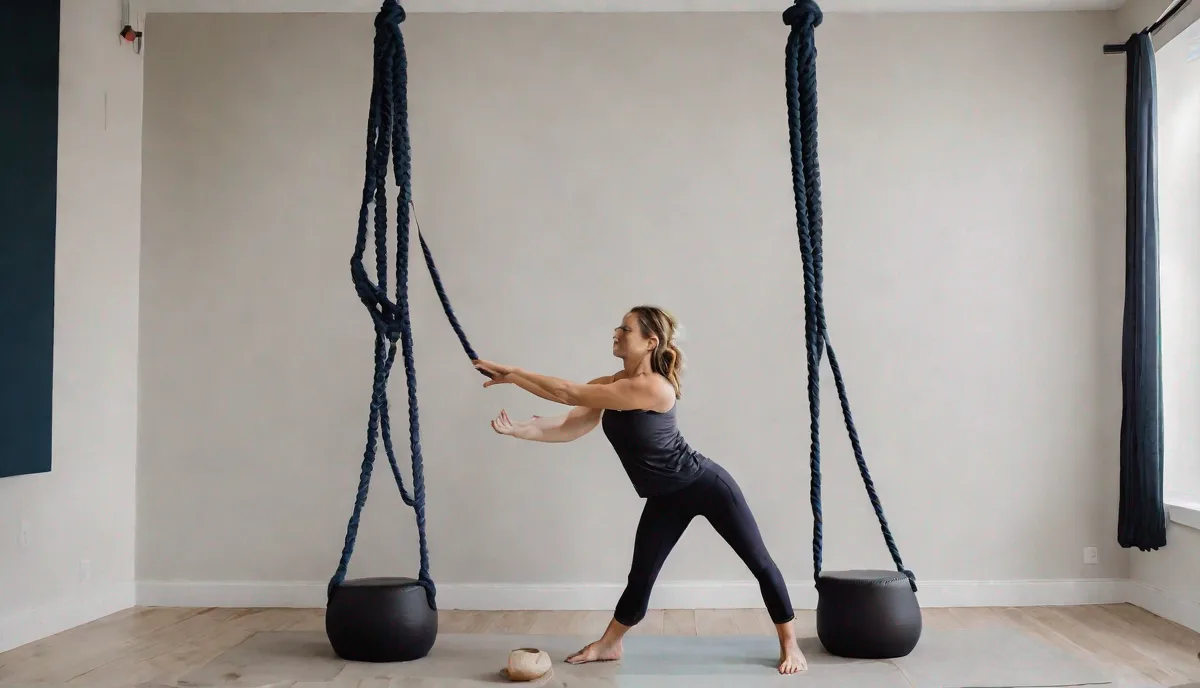
Slow Down and Focus on Your Alignment
One of the most valuable things a yoga rope wall can provide is the opportunity to really slow down and tune into your alignment. When suspended in the ropes, you are forced hold poses longer and pay closer attention to your form.
Rather than rushing through vinyasas to keep up with the class, you can take your time finding the little adjustments that make a pose feel good in your body. The ropes provide stability and support, so you can breathe deeply into areas of tightness or strain.
Safely Explore Inversions and Arm Balances
Inversions like handstands require strength, flexibility, and balance that can take years to develop. But with the help of a yoga rope wall, you can start exploring these postures earlier and more safely.
The ropes allow you to take weight off your hands and feet as needed. You can use them for support while working towards lifting up into full expressions of the poses. It allows you find the edge of your ability without risking injury from falling.
Relieve Back and Shoulder Tension
When suspended in a reclined or inverted pose, the ropes provide traction and decompression for the spine. This can relieve built up tension in your back and shoulders.
Gently stretching and elongating tight muscles while being fully supported encourages circulation. And the stimulation of pressure points may help dissipate knots and adhesions.
Deepening Proprioceptive Awareness Through Tactile Feedback
The rope wall serves as a sophisticated sensory tool, offering constant tactile feedback that the skin and nervous system often miss during a traditional mat practice. When you loop a rope around your pelvis or shoulders, the resistance creates a tangible “edge” for your body to push against. This is particularly useful for students who struggle with proprioception—the internal sense of where the body is in space. By feeling the tension of the rope, you can micro-adjust your pelvic tilt in poses like Adho Mukha Svanasana (Downward-Facing Dog) or refine the rotation of your femur in standing postures.
Consider the practice of “active hanging.” When you hold the ropes to assist in a deep forward fold, you are not merely dangling; you are engaging the muscles of the core and back to stabilize against the rope’s pull. This creates a closed-loop system of feedback where your brain receives instant information about muscle engagement. If you are leaning too far forward or collapsing in the lumbar spine, the shift in rope tension immediately alerts you, allowing for real-time correction that would otherwise remain unnoticed until the end of a session.
Refining Spinal Traction and Intervertebral Space
While standard yoga poses rely on gravity to create space, the rope wall uses mechanical leverage to achieve targeted traction. For individuals with sedentary lifestyles, the constant compression of the spine through sitting can lead to localized stiffness. By utilizing the rope wall to perform a supported hanging traction, you can effectively create negative pressure within the intervertebral discs. This is not about aggressive pulling, but rather using your own body weight as a counter-lever to gently “open” the vertebrae.
For example, in a standing backbend variation using the ropes at hip height, you can lean back while keeping the ropes taut. This allows the thoracic spine to extend without the typical “crunching” sensation often felt in the lower back during unassisted camel pose. The key is in the placement of the ropes: placing them slightly higher allows for a deeper stretch in the lats and serratus anterior, which indirectly relieves the downward pressure on the lumbar spine. This mechanical “unloading” is a game-changer for those dealing with chronic postural fatigue.
Targeting Myofascial Release in the Hip Capsule
The hip joint is notoriously difficult to stretch safely, as the surrounding musculature—the glutes, psoas, and piriformis—often guard against deep movement. The rope wall acts as a stationary “partner” that holds you in a position of passive stretch, allowing the nervous system to downregulate its protective guarding response. By looping the ropes around the upper thighs while in a supine position, you can leverage your body weight to create a sustained, gentle traction on the hip capsule.
This is particularly effective for those with tight hip flexors. By setting the ropes at a height that allows your legs to hang just off the floor, you can breathe into the deep hip tissues for several minutes. Unlike a standard pigeon pose, which can put significant torque on the knee joint, the rope wall allows the femur to hang in a neutral position, ensuring the stretch is localized to the hip musculature rather than the vulnerable ligaments of the knee. This sustained, supported release is often more effective for long-term mobility gains than dynamic, bouncing stretches.
Building Functional Core Stability via Isometric Loading
The rope wall transforms traditional core work from a series of rhythmic crunches into a series of intense, functional isometric holds. When you suspend your legs or torso using the ropes, your deep stabilizer muscles—specifically the transverse abdominis and the multifidus—must fire continuously to prevent you from swinging or losing alignment. This is a form of “unstable surface training” that forces the core to integrate with the limbs in ways that floor-based practice cannot replicate.
Try placing your feet in the ropes and moving into a plank position. The micro-movements required to keep the ropes from swaying require significant recruitment of the stabilizers. This builds a type of “functional core” strength that is essential for everyday movements like lifting, carrying, or maintaining posture during long periods of standing. Because the ropes are independent, they also expose left-right imbalances; you will quickly notice if one side of your core is overcompensating for the other, allowing you to address these asymmetries with surgical precision.
Enhancing Shoulder Girdle Mobility and Scapular Control
The shoulders are often the most restricted area in a yoga practitioner’s body, especially for those who spend hours at a computer. The rope wall provides a unique way to access the rotator cuff and the muscles surrounding the scapula by using the ropes as a pulley system. By holding the ropes and leaning away, you can control the exact angle and intensity of the stretch in the pectoralis minor and the subscapularis.
Furthermore, the ropes provide a safe environment to practice scapular retraction and depression. Many students struggle to find the “down and back” feeling of the shoulder blades in poses like Chaturanga. By using the rope wall as a guide, you can lean into the ropes and practice sliding your shoulder blades down your back while under tension. This builds the muscle memory necessary to execute these movements on the mat without the ropes, effectively training your body to maintain a stable, protected shoulder position during even the most demanding vinyasa flows.
Advanced Asana Refinement through Mechanical Leverage
For advanced practitioners, the rope wall is less about support and more about mechanical refinement. Consider poses like Eka Pada Rajakapotasana (King Pigeon) or Natarajasana (Dancer’s Pose). These poses require a delicate balance of backbending, hip opening, and shoulder flexibility. Using the rope wall, you can secure your foot in a loop and use the rope to pull your heel closer to your body while your hands are free to focus on reaching for the foot or balancing. This “assisted bind” allows you to work on the final expression of the pose without the fear of cramping or losing balance.
Additionally, the rope wall can be used to “deconstruct” complex arm balances. If you are working toward a transition from Bakasana (Crow Pose) to a headstand, you can use the ropes to support your hips or legs, allowing you to practice the transition phase repeatedly without the fatigue of failing the lift. By breaking the movement into smaller, supported segments, you develop the necessary neural pathways and muscular endurance to eventually execute the move unassisted. The rope wall effectively turns a “hit or miss” pose into a scalable, manageable skill-building exercise.
FAQ
What is a yoga rope wall?
A yoga rope wall is a grid of nylon support ropes that students can use to explore yoga postures. The ropes provide stability, traction, and assistance with alignment in poses.
How can a rope wall help my practice?
A rope wall enables you to slow down, tune into alignment, safely work towards arm balances or inversions, and release back and shoulder tension. It allows beginners to explore more advanced poses with appropriate support.
What skills do I need to start using a rope wall?
No prior experience is necessary. As long as you are comfortable being gently suspended off the ground, a rope wall can benefit students of all levels. More advanced students can use it to deepen their practice.
Will using a rope wall help me progress faster?
It won’t necessarily make you progress faster. But it can help build essential strength and flexibility more safely. And the feedback it provides can positively impact your entire practice over time.
What should I wear to practice on a rope wall?
Wear comfortable stretchy clothing that allows ropes to make contact with your skin for grip. Leggings and a form-fitting top generally work best.
Related posts:
 How to Master the Jump Rope Like a Pro
 This at-home yoga rope wall is what fitness fantasies are made of
 Skip the Gym! Here Are 15 Rope Exercises You Can Do Anywhere
 Beginner’s Jump Rope Workout
 Master Chair Pose Without Falling Over: A Yoga Guide for Real People
 Battle Ropes Workout Guide
 Lindsay Ellingson’s Stress-Relieving Yoga Move
 Infinity Rope: Weighted Jump Rope Review