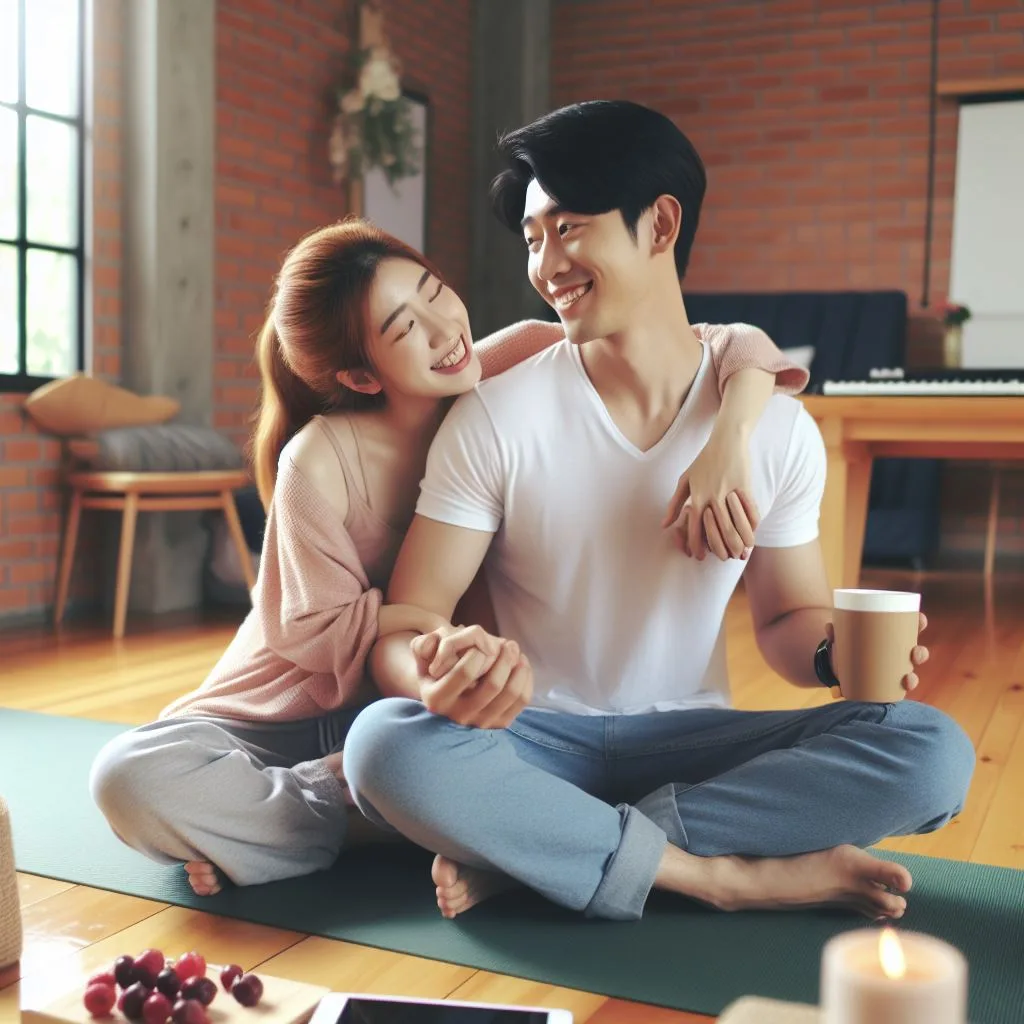
Promote Bonding and Intimacy
Yoga can be a fun, shared activity that brings you and your boyfriend closer together. Trying new poses and taking deep breaths in unison promotes bonding. Plus, the calm and upbeat nature of yoga can make you feel more loving and connected. Yoga relaxes the nervous system, which helps heighten intimacy.
Improve Health and Wellness
Yoga helps reduce stress, increase flexibility, build muscle strength, improve circulation and boost energy levels. If your boyfriend has back pain, yoga can help ease tension and improve posture. The breathing and meditation aspects also aid mental health and focus. Overall, yoga boosts health and wellbeing for both of you.
Try Something New Together
Stepping out of your comfort zone together forges mutual understanding and respect. Most yoga studios offer beginner-friendly classes that ease you into poses and philosophy gently. Learning something new together—coordinating movements, regulating breathing, holding postures—builds teamwork. It creates shared memories and inside jokes!
Appreciate Some Peaceful Me Time
Life gets hectic juggling work, family, friends and responsibilities. Yoga class offers a sanctuary for quieting the mind and enjoying some calm togetherness. The slower pace lets you appreciate each other’s company without distractions. Sneaking in rejuvenating me time maintains perspective.
Optimizing Athletic Performance and Cross-Training Synergy
For men who are already active in traditional sports, weightlifting, or high-intensity interval training (HIIT), yoga serves as the ultimate cross-training tool. Most athletic endeavors focus on concentric muscle contractions—shortening the muscle to generate power. Over time, this leads to chronically tight muscle fibers and a restricted range of motion. By bringing your boyfriend to yoga, you are introducing him to eccentric loading and isometric holds that lengthen the fascia and improve muscle elasticity. For instance, a man who squats heavy weights often suffers from tight hip flexors and a limited range in the ankles. Yoga poses like Anjaneyasana (Low Lunge) and Malasana (Yogi Squat) specifically target these areas, allowing for a deeper, safer squat in the weight room. This synergy doesn’t just prevent injury; it unlocks power. A more flexible muscle can exert force over a longer distance, meaning his golf swing, his sprint, or his overhead press will likely see measurable improvements. Transitioning from the high-adrenaline environment of a gym to the controlled, mindful environment of a yoga studio helps the body recover faster by shifting from the sympathetic nervous system (fight or flight) to the parasympathetic nervous system (rest and digest), which is where actual muscle repair occurs.
Targeted Anatomical Benefits for the Typical Male Physique
While yoga is universal, the male anatomy often presents specific challenges that a regular practice can address with surgical precision. Men typically carry more mass in their upper bodies, leading to tight pectorals and rounded shoulders—often exacerbated by desk work or driving. This “hunched” posture can lead to tension headaches and reduced lung capacity. Through heart-opening poses like Bhujangasana (Cobra) or Setu Bandha Sarvangasana (Bridge Pose), your boyfriend can counteract this kyphotic curve, opening the chest and improving respiratory efficiency. Another common area of concern is the posterior chain, specifically the hamstrings and the lower back. Because many men have a natural tendency toward an anterior pelvic tilt, they may experience chronic lower back twinges. Yoga teaches the subtle art of pelvic tucking and core engagement. By focusing on the “bandhas” or internal energy locks, he learns to support his spine from the inside out. This isn’t just about stretching; it’s about structural realignment. In a class setting, he will learn how to engage the transverse abdominis—the deepest layer of core muscle—which acts as a natural weight belt, protecting his spine during daily activities like lifting groceries or moving furniture.
Navigating the Ego Trap and Cultivating Mental Resilience
One of the most profound reasons to bring your boyfriend to yoga is the psychological shift it requires. In many traditional male-dominated spaces, the goal is to compete, dominate, or “crush” a workout. Yoga flips this script. It demands a level of humility, especially when he finds himself struggling with a pose that looks effortless for others. This is a masterclass in managing the ego. When he hits a wall in a balancing pose like Vrksasana (Tree Pose), he is forced to confront frustration without the outlet of aggression. This builds a specific type of mental resilience known as “equanimity”—the ability to remain calm and composed under stress. You might notice that after a few weeks of practice, his reactions to external stressors, like traffic jams or work deadlines, become more measured. He learns that falling out of a pose isn’t a failure, but simply a part of the process. This shift from a results-oriented mindset to a process-oriented mindset can be revolutionary for men who feel the constant pressure to perform. It provides a safe space to be a beginner again, fostering a sense of playfulness that is often lost in adulthood.
Practical Partner Drills and Supportive Adjustments
While the existing practice focuses on individual growth, attending class together opens the door for partner-based exploration that can be continued at home. In many restorative or workshop-style classes, instructors may demonstrate how to provide gentle, supportive adjustments. For example, in a seated forward fold (Paschimottanasana), you can sit back-to-back, using the weight of your bodies to help each other find a deeper, more relaxed stretch. This physical cooperation requires a high level of communication and trust. You have to check in: “Is this too much?” or “Can you lean back a bit more?” This dialogue builds a unique form of non-verbal and verbal intimacy that is grounded in mutual care. Another excellent partner drill is the “Double Tree” pose, where you stand side-by-side, inner arms wrapped around each other’s waists for balance. This requires you to find a shared center of gravity, physically manifesting the concept of supporting one another. These exercises turn the yoga mat into a laboratory for your relationship, where you can practice being each other’s support system in a literal, physical sense.
Mastering Breathwork for High-Pressure Stress Management
While the physical postures (asanas) get the most attention, the breathwork (pranayama) is perhaps the most practical tool your boyfriend will take away from a yoga class. Many men are “chest breathers,” taking shallow breaths that signal the brain to remain in a state of low-level anxiety. Yoga teaches the art of diaphragmatic breathing, or “belly breathing.” Techniques such as Ujjayi Pranayama (Victorious Breath) create a slight constriction in the throat that slows the breath down and builds internal heat. This isn’t just for the mat; it’s a biological hack for the nervous system. If your boyfriend has a high-pressure job or deals with social anxiety, the ability to trigger a relaxation response through a specific breathing pattern is a superpower. He can use “Box Breathing” (inhaling, holding, exhaling, and holding for equal counts) during a stressful meeting to lower his heart rate and clear his mind. By attending class with you, he gains a guided environment to practice these techniques until they become second nature. You are essentially giving him a toolkit for emotional regulation that can prevent burnout and improve his overall quality of life.
Developing Proprioception and Spatial Awareness
Yoga significantly enhances proprioception—the body’s ability to sense its location, movements, and actions. For many men, physical movement is often focused on external targets: hitting a ball, lifting a weight, or reaching a destination. Yoga directs the focus inward, asking the practitioner to feel the alignment of their pinky toe or the engagement of their shoulder blades. This heightened spatial awareness has practical applications in preventing the “clumsiness” that can lead to domestic accidents or sports injuries. It improves balance and coordination by strengthening the stabilizer muscles around the joints—muscles that are often neglected in traditional gym routines. For instance, standing balances like Warrior III require the foot to make micro-adjustments constantly. This strengthens the tendons and ligaments in the ankles and knees. As men age, maintaining this sense of balance is crucial for long-term mobility. By starting a practice now, your boyfriend is essentially investing in his future physical independence, ensuring his joints remain lubricated and his nervous system remains sharply tuned to his physical presence.
FAQ
Is yoga too feminine for guys?
Not at all! While more women practice yoga, plenty of men attend classes too. Yoga strengthens and stretches all bodies equally. And the mental health benefits apply to everyone.
What if my boyfriend can’t touch his toes?
No problem! Yoga meets students where they are. Beginner classes focus on proper alignment over flexibility. Over time, his range of motion will improve. Be patient and listen to his body.
Which yoga style is best for beginners?
Hatha and Vinyasa yoga offer an accessible starting point. The slower pace helps you learn the basics: proper breathing, foundational poses, relaxation techniques. Avoid intense styles like Hot Yoga or Power Yoga in the beginning.
What should my boyfriend wear to yoga class?
Comfortable athletic wear like t-shirts, shorts and sweatpants work well. Avoid loose clothing that could cause tripping hazards. Bikram yoga rooms get very warm, so shorts and tank tops help. Yoga is often practiced barefoot.
Can we share a yoga mat?
Sharing might seem romantic, but individual mats really work best. You both need room to move smoothly between poses. Separate mats let you fully enjoy the experience together while respecting personal space.
Related posts:
 Master Chair Pose Without Falling Over: A Yoga Guide for Real People
 Why Your Boyfriend Secretly Loves Your Glossier Shopping Trips
 Lindsay Ellingson’s Stress-Relieving Yoga Move
 Yoga Tips for Beginners
 Remembering Bill Cunningham: The Fashion Icon Who Changed Everything
 Saturday Morning Thoughts: Boy Back to School Residential
 I Dragged My Boyfriend to Barre Class—and He Loved It
 Instagram’s Period Yoga Phenomenon