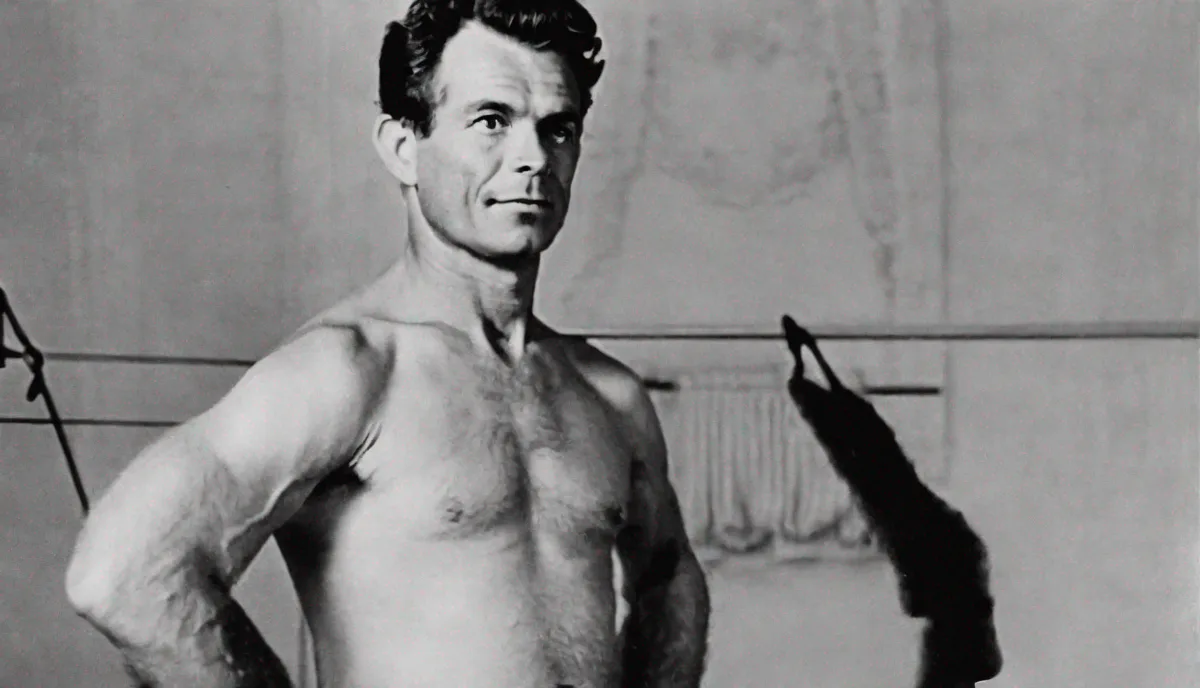
Early Life Overcoming Illness
Joseph Pilates was born in Germany in 1880. As a sickly child suffering from asthma, rickets and rheumatic fever, he was determined to overcome his physical limitations. From a young age, Joseph dedicated himself to building his body’s strength and flexibility through self-experimentation and a regular exercise routine.
Training as a Circus Performer and Anatomist
As a teenager, Joseph trained as a circus performer, gymnast and boxer. He studied Eastern and Western forms of exercise including yoga and ancient Greek and Roman fitness regimens. Joseph also studied anatomy and the workings of muscles and joints.
Developing His Method in WWI Internment Camp
During World War I, Joseph was interned along with other German nationals in a camp in Lancaster. There, he began refining a system of exercises that could be done on a mat without equipment, for people of all abilities. Joseph taught wrestling and self-defense techniques to camp detainees and local law enforcement.
Moving to the US and Opening the First Studio
Joseph immigrated to the United States in 1926 and opened his first Pilates studio in New York in the same year. His method, which he called “Contrology”, focused on core strength, flexibility, precision and breath. It attracted many dancers who found it improved their technique and control.
Legacy of Teaching His Method
Joseph promoted his technique extensively until his death in 1967 at age 87. He taught many second generation teachers who went on to spread knowledge of the Pilates method. Today Pilates is practiced worldwide in studios, gyms, homes and physical therapy offices.
The Mechanics of Contrology: Understanding the Apparatus
While the mat work is the soul of the practice, Joseph Pilates was a prolific inventor of apparatus designed to act as a physical therapist and personal trainer combined. His machines, such as the Universal Reformer, the Cadillac, and the Wunda Chair, were engineered to provide resistance and support, effectively bridging the gap between rehabilitation and high-performance conditioning. The Reformer, in particular, utilized a system of springs and pulleys to provide variable resistance, allowing the body to work against gravity in ways that a floor-based routine could not. This was not merely about building “bulk,” but about training the deep postural muscles—the transverse abdominis, multifidus, and pelvic floor—to stabilize the spine while the limbs moved in space. For the modern practitioner, these machines act as tactile feedback mechanisms, forcing the user to maintain alignment and precision that the body would otherwise abandon under fatigue.
The Intersection of Breath and Neuromuscular Efficiency
Joseph Pilates often emphasized that the lungs should be used like a bellows, forcing the air out to fully oxygenate the blood and engage the deep core muscles. He viewed breathing as a cleansing process, a way to expel “stale” air and stimulate the circulatory system. In a modern context, this rhythmic breathing is synonymous with the activation of the parasympathetic nervous system. By coordinating inhalation and exhalation with specific movements, practitioners are not just exercising muscles; they are training the nervous system to remain calm under the stress of physical exertion. This synchronization is the secret behind the “flow” of a Pilates session, where the transition between movements becomes as important as the movements themselves, preventing the jerky, inefficient muscle recruitment patterns often seen in traditional weightlifting.
Pilates as a Tool for Rehabilitation and Injury Prevention
Long before Pilates became a global fitness phenomenon, it was a clinical tool. Joseph’s work during the internment years involved assisting those with mobility issues, and later, his New York studio became a hub for injured dancers from the nearby New York City Ballet. He understood the concept of “compensatory movement”—how a weak ankle might lead to a tight hip, which eventually manifests as chronic back pain. By focusing on the “powerhouse” (the torso, hips, and lower back), Joseph ensured that the limbs were supported by a stable foundation. Today, physical therapists utilize these same principles to correct pelvic tilt, shoulder impingement, and spinal misalignments. The genius of the method lies in its ability to isolate weak, underactive muscles without over-stressing the joints, making it an ideal modality for those recovering from surgery or suffering from degenerative conditions.
The Evolution of the Method: Classical vs. Contemporary
The Pilates world is often divided between the “Classical” approach—which adheres strictly to the original order and repertoire established by Joseph—and “Contemporary” Pilates, which integrates modern biomechanics and physical therapy research. Classical teachers argue that the original sequence, known as the “order,” was designed to warm up the body, challenge it, and then cool it down in a specific, progressive manner. Conversely, contemporary instructors might modify exercises to accommodate specific pathologies or to add variety. Both schools of thought trace their lineage back to the “Elders,” the original students who trained directly under Joseph and his wife, Clara. Understanding this divide is essential for any student; while the classical method offers a disciplined, meditative structure, the contemporary method provides flexibility for those with physical limitations who need a more tailored approach to movement.
Beyond the Mat: The Philosophy of Total Body Health
Joseph Pilates was not just interested in fitness; he was interested in “Total Body Health.” He believed that a sedentary lifestyle was a precursor to physical and mental decline. He encouraged his students to lead a life that included fresh air, adequate rest, and proper spinal hygiene. In his book, Return to Life Through Contrology, he outlined a lifestyle where the body was treated as a machine that required maintenance, not just for the sake of aesthetics, but for the sake of longevity. He famously stated that if your spine is stiff at 30, you are old, but if it is flexible at 60, you are young. This perspective shifts the focus of Pilates from a vanity-driven workout to a life-long maintenance protocol, emphasizing the importance of daily movement to counteract the “tech neck” and postural collapse caused by modern desk-bound work.
The Role of Clara Pilates in Shaping the Legacy
It is impossible to discuss the history of Pilates without acknowledging Clara Pilates, Joseph’s wife and a nurse by trade. While Joseph was the visionary and the “half-naked” performer who captured attention, Clara was the practical, nurturing force who adapted his exercises for people of all fitness levels. She was often the one teaching the sessions in the New York studio, refining the cues, and softening the intensity of Joseph’s sometimes aggressive approach. Many historians believe that the accessibility of the Pilates method, and its long-term success, is due in large part to Clara’s influence. She bridged the gap between Joseph’s rigorous, athletic background and the needs of the average person, ensuring the method was not just for circus performers but for anyone seeking relief from pain and improved vitality.
Practical Applications for Modern Desk Workers
For the modern office worker, the principles of Pilates offer a direct antidote to the physical toll of sitting for eight hours a day. The focus on scapular stabilization helps combat rounded shoulders, while the emphasis on core engagement encourages an upright, neutral spine. Simple exercises like the “pelvic curl” or “thoracic rotation” can be performed in short intervals to reset the body’s alignment. Joseph’s insistence on precision over quantity means that even ten minutes of focused, high-quality movement is more effective than an hour of mindless, repetitive gym work. By integrating these micro-movements into a workday, practitioners can mitigate the risks of chronic musculoskeletal disorders, proving that Joseph’s century-old methods are perhaps more relevant today than they were in the 1920s.
FAQ
What illness did Joseph Pilates have as a child?
As a child, Joseph Pilates suffered from asthma, rickets and rheumatic fever.
Where did Joseph Pilates develop his method of exercise?
Joseph developed the beginnings of his exercise method while interned at a camp in Lancaster during World War I.
What was Joseph’s original name for his exercise system?
Originally Joseph called his method “Contrology”.
Who did Joseph first teach his exercises to?
At the internment camp, Joseph first taught wrestling, self-defense and his exercise system to fellow internees and local law enforcement.
How old was Joseph Pilates when he died?
Joseph Pilates died in 1967 at the age of 87.
Related posts:
 Saturday Morning Thoughts: Boy Back to School Residential
 Top 10 New York City Boot Camps For Summer
 Pilates for Older Runners: Improving Strength and Flexibility
 Pilates: The Secret to Core Strength and Stability
 Elevate Your Coffee Game with the Sleek and Stylish Fellow Clara French Press
 The Fascinating Story of How Pilates Went from Obscurity to Today’s Mind-Body-Boutique Craze
 Remembering Bill Cunningham: The Fashion Icon Who Changed Everything
 PHA Bodyweight Workout: Efficient Fitness Anywhere, Anytime