Introduction
Life can often feel overwhelming. Our to-do lists grow endlessly while our energy and motivation seem to shrink. During difficult times, it’s easy to lose our sense of meaning and purpose. That’s why practices like activity scheduling can be so helpful – they guide us back to what really matters.
The Benefits of Activity Scheduling
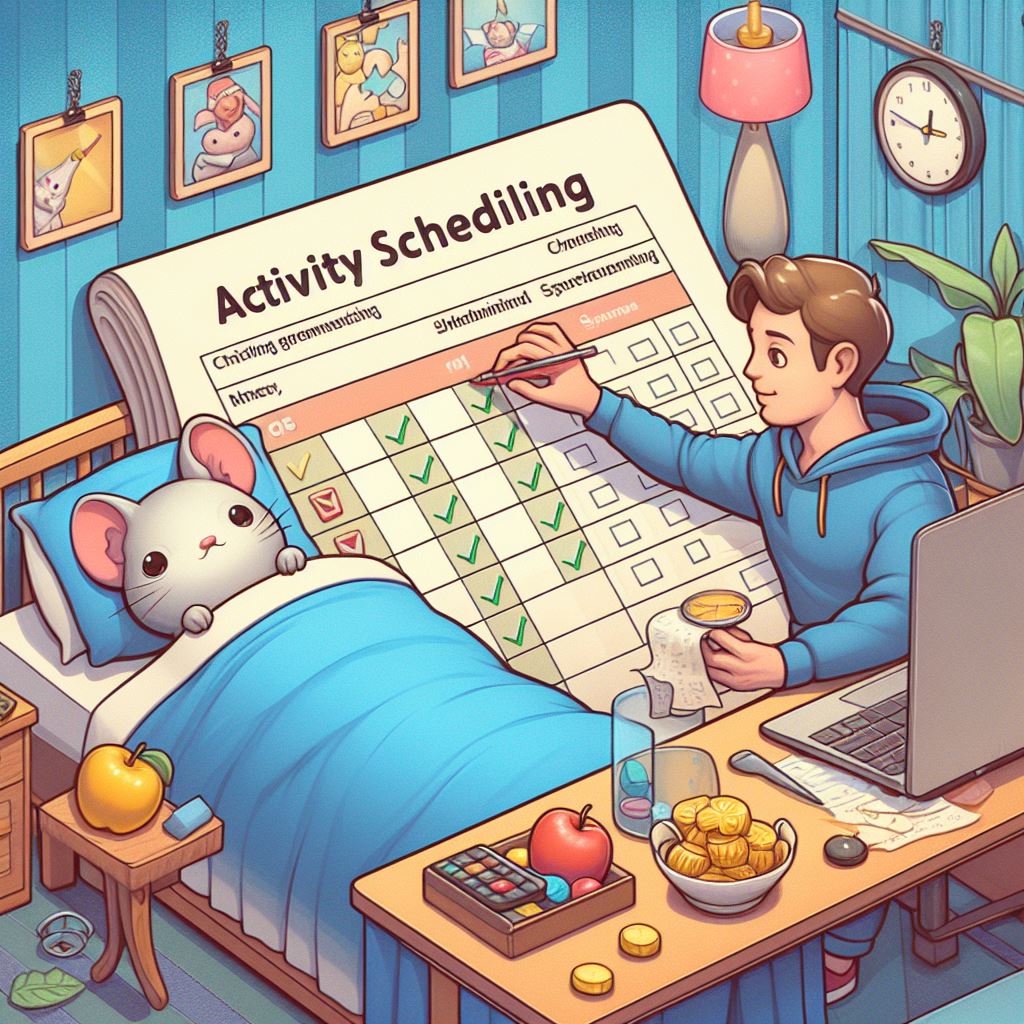
Activity scheduling is a type of therapy worksheet used in Cognitive Behavioral Therapy (CBT) to help improve mood and motivation. By thoughtfully planning activities aligned with our values, activity scheduling has many benefits:
- Provides a sense of control and reduces anxiety
- Helps overcome avoidance and procrastination
- Structures time and brings routine
- Boosts mood through engagement in meaningful activities
Creating Your Activity Schedule
The first step is to identify activities that align with your personal values – things that provide a sense of meaning, purpose, enjoyment. Next, block off time for these activities in your calendar. Be sure to include a balance of necessary tasks and fun, nourishing activities. Scheduling restorative practices like meditation, journaling and time with loved ones is just as important!
Making Activity Scheduling Work For You
Activity scheduling takes some trial and error. Notice when you start slipping back into old patterns of avoidance. Adjust your schedule over time, experimenting with types of activities and durations that leave you feeling engaged and energized. Perfection isn’t the goal – be flexible and compassionate with yourself along the way.
The Science of Behavioral Activation: Beyond Motivation
To truly understand why activity scheduling works, one must look at the psychological concept of Behavioral Activation (BA). Often, we operate under the false assumption that we must feel motivated before we can act. BA flips this script, suggesting that action precedes motivation. When we are depressed or anxious, our brains often enter a cycle of avoidance, where inactivity leads to low mood, which in turn fuels more inactivity. By scheduling activities, you are not just managing time; you are systematically interrupting this negative feedback loop. Even when your brain insists you lack the energy to engage, the act of completing a scheduled task releases small amounts of dopamine and mastery-based reinforcement. Think of your schedule as a laboratory: you are testing the hypothesis that action can influence emotion, rather than waiting for emotion to dictate your capacity for action.
Categorizing Activities: The Mastery vs. Pleasure Matrix
Not all activities serve the same purpose in a balanced life. When populating your schedule, it is vital to distinguish between two key categories: mastery and pleasure. Pleasure activities are those that provide immediate enjoyment or sensory satisfaction, such as listening to music, taking a warm bath, or eating a favorite meal. Mastery activities, conversely, are tasks that require effort but result in a sense of accomplishment or competence, such as balancing a budget, finishing a work report, or finally organizing that junk drawer. A common mistake is to over-index on pleasure, which can lead to guilt, or over-index on mastery, which leads to burnout. Aim to track your activities on a scale of 0-10 for both ‘Pleasure’ and ‘Mastery’ after completing them. Over time, this data helps you identify which specific tasks move the needle on your mood, allowing you to build a more evidence-based schedule.
The Art of Micro-Scheduling for Low-Energy Days
When you are in the depths of a depressive episode or an anxiety spiral, the prospect of a full-day schedule can feel paralyzing. This is where micro-scheduling becomes an essential tool. Instead of blocking out ‘exercise’ for an hour, break it down into ‘put on sneakers’ and ‘walk for five minutes.’ By lowering the barrier to entry, you make the activity ‘too small to fail.’ If you find yourself consistently avoiding your scheduled items, it is rarely a failure of willpower; it is a failure of task granularity. If a task feels daunting, ask yourself: what is the smallest, most non-threatening version of this task I can perform? By stacking these micro-tasks, you build momentum without triggering the ‘fight or flight’ response that often accompanies overwhelming to-do lists.
Anticipating Obstacles: The ‘If-Then’ Planning Strategy
A schedule is only as good as its ability to survive contact with reality. To make your plan robust, employ ‘If-Then’ planning, also known as implementation intentions. For every critical activity on your list, identify a potential obstacle and a corresponding action. For example, ‘If I feel too tired to go to the gym after work, then I will commit to doing ten minutes of gentle stretching at home.’ By pre-deciding your response to common hurdles—such as fatigue, unexpected social invitations, or sudden work demands—you remove the need for stressful, in-the-moment decision-making. This cognitive offloading allows you to stick to your values even when your environment becomes chaotic, turning potential derailments into pre-planned pivots.
The Role of Environmental Design in Schedule Adherence
Your physical environment acts as a silent partner to your activity schedule. If you schedule ‘reading’ but your book is buried under a pile of laundry, or ‘exercise’ but your yoga mat is hidden in a closet, you are placing friction between your intent and your action. Effective scheduling involves optimizing your surroundings to support your goals. This might mean laying out your work clothes the night before, keeping your journal on your nightstand, or setting a digital alarm that explicitly labels the transition between tasks. By reducing ‘friction costs’—the mental energy required to start a task—you make it significantly easier to follow through on your commitments. Consider your schedule not just as a list of times, but as a map for navigating your physical space throughout the day.
Tracking and Tuning: The Weekly Review Ritual
The most successful activity schedulers treat their weekly review as a non-negotiable appointment. Spend twenty minutes every Sunday or Monday morning analyzing the previous week’s data. Look for trends: Did you consistently move your ‘leisure’ blocks to later in the day? Did you notice that you felt most productive during mid-morning hours? Use this information to refine your schedule for the week ahead. If you missed a recurring task, don’t simply judge yourself; ask if the task was realistic, if it was scheduled at the wrong time of day, or if it lacked a clear ‘why.’ Treat your schedule as a living document that evolves with your changing needs, stressors, and seasonal energy fluctuations. This iterative process turns activity scheduling from a rigid chore into a sophisticated tool for self-discovery.
Beyond the Worksheet: Integrating Mindfulness and Presence
While scheduling is a logical, cognitive tool, its ultimate aim is to bring you into the present moment. A common trap is to treat the schedule as a ‘conveyor belt’ where you mindlessly move from one box to the next. To combat this, intentionally practice ‘transition rituals’ between scheduled items. This could be as simple as taking three deep breaths, closing your eyes for one minute, or physically clearing your workspace before starting a new activity. These micro-breaks prevent the ‘cognitive residue’ of one task from bleeding into the next, allowing you to approach each scheduled activity with a fresh, focused mind. When you fully engage with the present task, the quality of the experience increases, which in turn reinforces the value of the schedule itself, creating a positive, self-sustaining loop of intentional living.
FAQ
What is activity scheduling?
Activity scheduling is a CBT worksheet to help improve mood by planning activities aligned with personal values and needs. It provides structure, routine and a sense of control.
How does activity scheduling work?
You start by identifying meaningful, enjoyable activities to include in your schedule across a variety of life areas over the course of a week. Block off time for these activities as you would appointments.
What activities should I schedule?
Aim for balance across necessary tasks, fun leisure activities, self-care, relationships, learning and growth. Tailor activities to your values, needs and current situation.
How often should I update my schedule?
Review your schedule weekly to see what’s working and what adjustments need to be made. Be flexible and don’t get attached to perfection.
What if I don’t follow my schedule?
Gently notice if old patterns like avoidance or overscheduling are creeping back in. Reflect on what you need more or less of. Then revise your schedule accordingly – no judgment!
Related posts:
 Time Management Activities
 What is Hedonism? A Philosophy of Pleasure
 Simple Pleasures
 Time Hacks That Actually Work: Your Guide to Getting Hours Back in Your Day
 Feeling Lazy
 Take This Quiz to Find Your Perfect Planner Based on Your Personality
 Pomodoro Technique: The Time Management Game-Changer
 Behavioral Activation Therapy: The CBT Depression Treatment