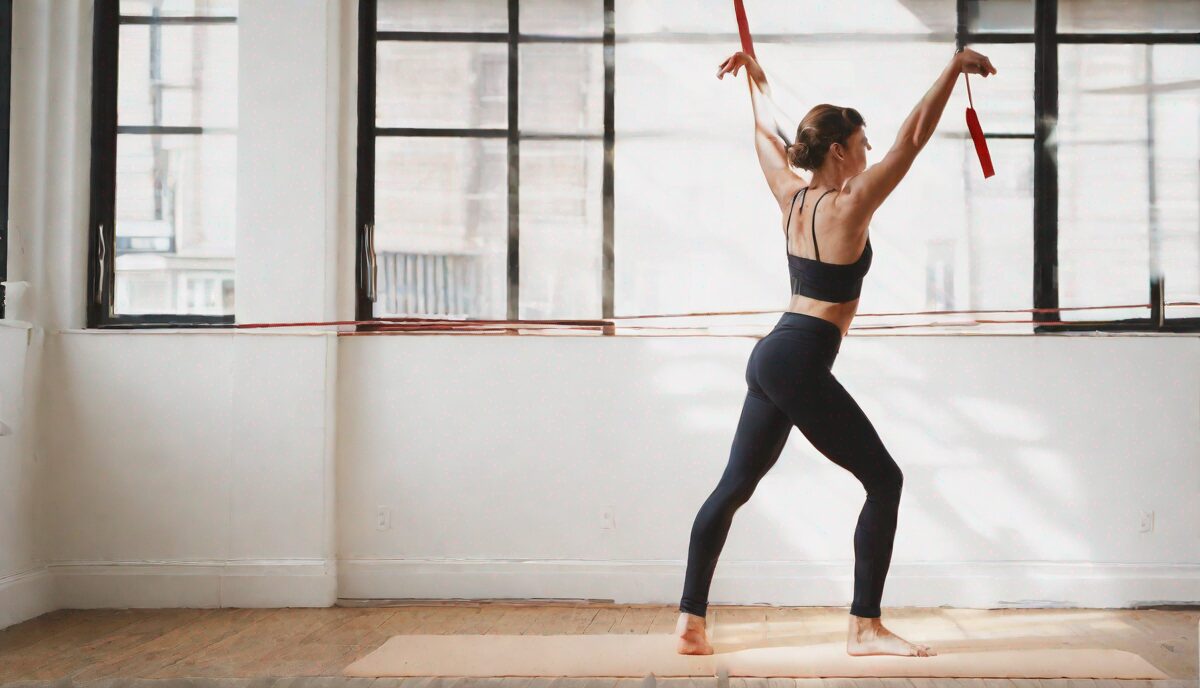
Finding Your Own Path in Barre
Barre is a wonderful form of exercise that blends ballet, Pilates, and yoga. It builds core strength, flexibility, balance, and posture. However, not all barre workouts are suitable for everyone. We all have unique bodies, abilities, injuries, and conditions to consider.
Key takeaways
- Lower heels to flat feet and ensure knees track over toes to reduce joint stress.
- Use a neutral spine or tall diagonal instead of a C-curve for diastasis recti or disc issues.
- Use fists or dumbbells during planks to keep wrists neutral and avoid painful extension.
- Prioritize quality over quantity by using isometric holds and micro-movements during chronic pain flare-ups.
- Use the barre for stability and yoga blocks to improve alignment and bring the floor closer.
The great news is barre can be adapted and modified to meet your needs! Rather than struggling to fit a rigid, one-size-fits-all approach, you can tailor your practice. This allows you to reap the benefits while avoiding strain or discomfort.
Listen to Your Body
Check in with your body often during class. Notice areas of tightness, weakness, fatigue, discomfort, or pain. Bring awareness to your breath and stress levels. Tune into these signals, and modify movements accordingly. There is no need to push through pain or do anything that doesn’t feel right.
Common Modifications
Here are some common ways to modify barre exercises:
- Reduce range of motion
- Hold onto the barre for balance or support
- Reduce number of reps
- Do the movement seated rather than standing
- Use lighter weights or resistance bands
- Skip jumps, hops or explosive motions
Consider Your Needs
Those with injuries, medical conditions, or less mobility may benefit from additional modifications such as:
- Avoiding certain postures
- Using props like blocks or chairs
- Doing chair barre routines
Pregnant students can also tailor barre safely. Consult your doctor first and listen to your body.
Talk to Your Instructor
Don’t be shy about speaking up before or during class! Let your instructor know if you are new, have injuries or conditions, or need to modify. Most instructors happily provide options and alternatives. Never feel badly about doing what is right for you.
Progress at Your Own Pace
Barre provides wonderful benefits, but you may need to build strength and stamina over time. Advance slowly, taking care not to overdo it. With consistency and self-compassion, you will be amazed at the progress you can make.
Protecting the Knees and Ankles in High-Repetition Sets
In a typical barre class, the knees and ankles endure significant repetitive stress, particularly during the thigh series where heels are often raised in a high relevé. If you experience clicking, sharp pain, or a grinding sensation in your patella, the first modification to implement is lowering your heels. Working with a “flat foot” or a “low demi-pointe” (where heels are only an inch off the floor) reduces the shear force on the knee joint while still engaging the calves and quadriceps. This is especially vital for those recovering from meniscus tears or dealing with chronic patellofemoral pain syndrome.
Another critical adjustment involves the degree of external rotation, often referred to as “turnout.” Many students attempt to force a 180-degree turnout from the feet, which causes the knees to track inward (valgus stress) and puts immense pressure on the medial collateral ligament (MCL). To modify, always ensure your knees are tracking directly over your second and third toes. If you find your arches collapsing or your knees dipping inward during a grand plié, narrow your stance and reduce the angle of your turnout. True turnout should originate from the hip sockets, not the ankles. If your hips are tight, a parallel position (toes pointing straight forward) is a perfectly valid and often safer alternative that still effectively targets the outer glutes and quads.
For those with ankle instability or a history of sprains, the “wobble” in high relevé can be hazardous. Instead of striving for maximum height, focus on pressing the ball of the foot firmly into the mat, distributing weight evenly between the big toe and the pinky toe. If the balance feels precarious during center-floor work, don’t hesitate to move closer to the barre. Using the barre isn’t a sign of weakness; it is a tool for alignment. Lightly resting one or both hands on the wood allows you to focus on the muscular contraction in the thighs rather than struggling to stay upright, which often leads to compensatory tension in the neck and shoulders.
Navigating Core Work with Diastasis Recti and Lower Back Sensitivity
The “C-curve” is a staple of barre abdominal work, where the spine is rounded into a scoop. While effective for some, this position can be detrimental for individuals with Diastasis Recti (separation of the abdominal muscles) or herniated discs. If you notice a “coning” or “doming” effect in your midsection during core exercises, it is a signal that your transverse abdominis is not effectively managing intra-abdominal pressure. To modify, transition from a rounded C-curve to a “tall diagonal” or a neutral spine. Instead of hollowing out the belly, focus on keeping the spine long and the ribcage knitted together, using a small pilates ball or a rolled-up towel behind the sacrum for tactile support.
Lower back pain often stems from an exaggerated lumbar arch or an inability to stabilize the pelvis during leg extensions. In exercises like “waterski” or “flat back” at the barre, the tendency is to dump weight into the lower spine. To protect this area, emphasize a slight posterior pelvic tilt—think of pulling your hip bones toward your lower ribs. If you are performing floor work that involves lifting both legs (like a double leg lift), modify by keeping one foot on the floor or by placing your hands in a diamond shape under your tailbone. This provides a physical wedge that prevents the back from arching off the mat, ensuring the work stays in the deep core rather than the spinal extensors.
For those with acute lower back issues, avoid twisting motions that involve “crunching” or rapid rotation. Instead of a full oblique twist, focus on isometric holds. For example, in a side plank, keep the bottom knee on the mat to shorten the lever and reduce the load on the quadratus lumborum. This modification allows you to build the necessary lateral stability without risking a flare-up of sciatic pain or muscle spasms.
Wrist and Shoulder Adaptations for Weight-Bearing Positions
Barre frequently incorporates planks, push-ups, and “all-fours” glute work, which can be grueling for those with carpal tunnel syndrome or wrist tendonitis. If placing your palms flat on the floor causes sharp pain, try the “fist-for-wrist” modification. By making a tight fist and balancing on your knuckles (with wrists straight), you eliminate the 90-degree extension that causes compression. Alternatively, you can use a pair of hexagonal dumbbells as handles; gripping the weights keeps the wrists in a neutral, stacked position. If these adjustments still don’t provide relief, most weight-bearing exercises can be performed on the forearms (a “low plank” or “forearm tabletop”), which shifts the load to the stronger muscles of the upper back and serratus anterior.
Shoulder impingement or rotator cuff sensitivities also require specific tailoring. During the light-weight sculpting series, many instructors encourage holding the arms at shoulder height for extended periods. If this creates a pinching sensation, lower your arms to a 45-degree angle or keep the elbows slightly bent. The goal is to engage the deltoids and triceps without jamming the humerus into the acromion process. If overhead movements are painful, simply keep the weights at chest level or perform the movements with “empty hands.” The resistance provided by gravity and the intentional tension you create in your own muscles (self-resistance) can be just as effective as using two-pound weights.
In positions like “reverse plank” or “tricep dips” off the edge of the barre or a chair, the shoulders are often in a vulnerable, internally rotated position. To modify, reduce the range of motion significantly. Instead of a deep dip, focus on a tiny “pulse” at the top of the movement. If the pressure is too great, stand facing away from the barre, place your hands behind you on the rail, and simply lean forward slightly to stretch the chest and engage the triceps without bearing your full body weight.
Spinal Alignment Variations for Scoliosis and Hyperlordosis
Standard barre cues often revolve around “tucking the tailbone,” but this cue is not universal and can actually be counterproductive for certain spinal curvatures. For individuals with hyperlordosis (an exaggerated inward curve of the lower back), a gentle tuck is often necessary to find a neutral pelvis. However, for those with a naturally flat back or posterior pelvic tilt, further tucking can lead to compressed discs and a loss of the spine’s natural shock-absorbing capabilities. If you fall into the latter category, ignore the “tuck” cue and focus on maintaining a small, natural gap between your lower back and the floor (or a vertical alignment when standing).
Students with scoliosis may find that their bodies feel asymmetrical during lateral work. For instance, a side-body stretch or an oblique crunch might feel significantly more restricted on one side than the other. In these cases, it is important to modify the range of motion to match the “tighter” side rather than forcing the restricted side to match the more mobile one. Use a mirror to check if your shoulders are level; if one hip tends to hitch up during the standing leg series, consciously lower it to keep the pelvis level. This might mean your leg doesn’t lift as high, but the structural integrity of the exercise will be much higher, preventing long-term imbalances.
During “round back” segments at the barre—where you sit on the floor with your back against the barre’s uprights—the pressure on the spinous processes can be uncomfortable for those with a prominent spine or scoliosis. A thick yoga mat or a specialized barre pad placed between your back and the wall can provide the necessary cushioning. If the seated position causes hip flexor gripping, try sitting on a yoga block or a firm cushion to elevate the hips, which allows the pelvis to tilt forward more easily and releases tension in the psoas.
Managing Balance and Proprioception Challenges
Balance is a skill that fluctuates daily based on hydration, inner ear health, and even sleep quality. For those dealing with vertigo or Benign Paroxysmal Positional Vertigo (BPPV), the rapid transitions from standing to floor work in barre can trigger dizziness. To modify, move between levels more slowly than the rest of the class. If a sequence involves lowering the head below the heart (like a standing forward fold), keep your head elevated and gaze forward instead. In any balance-heavy move, such as a “stork pose” or “arabesque,” keep your gaze fixed on a non-moving point (a drishti) on the wall at eye level, rather than looking down at the floor or in the mirror, which can be visually overstimulating.
Proprioception—the sense of where your body is in space—can be compromised by neurological conditions or simply by being a beginner. If you struggle with the “mind-muscle connection” in barre, use the barre itself as a constant point of contact. Even keeping just the fingertips of one hand on the rail provides the brain with continuous feedback about your vertical alignment. If the standard “heels together, toes apart” (first position) feels unstable, widen your base. A wider stance increases your center of gravity and provides a more stable foundation, allowing you to focus on the muscular engagement of the glutes and inner thighs without the fear of falling.
For those with sensory processing sensitivities, the loud music and fast-paced cues of a typical barre class can be overwhelming. Modifications here aren’t just physical; they are environmental. Ask the instructor if you can set up your mat in a corner or near a door for more personal space. If the music is a barrier, consider using high-quality earplugs designed for musicians, which lower the decibel level without muffling the instructor’s voice. Taking the “visual” out of the equation by closing your eyes during isometric holds can also help deepen the proprioceptive feel of the muscle “burn,” provided you have a hand on the barre for safety.
Strategies for Chronic Pain and Energy Pacing
For practitioners living with conditions like fibromyalgia, rheumatoid arthritis, or chronic fatigue syndrome, the high-intensity nature of barre requires a strategic approach to energy pacing. The “all-or-nothing” mindset is the biggest hurdle. Instead of trying to complete every repetition, aim for “quality over quantity.” If the class is doing 32 repetitions of a leg lift, you might choose to do 8 slow, controlled reps, then hold the position isometrically for the remainder of the set. Isometric holds (holding still while the muscle is contracted) are often less taxing on the joints and nervous system than repetitive eccentric and concentric movements, yet they still build significant strength.
During a flare-up, the “micro-movement” is your best friend. In barre, we often pulse in a one-inch range of motion. If that feels like too much, reduce it to a quarter-inch. The muscular engagement remains, but the mechanical stress on the connective tissues is minimized. It is also helpful to monitor your “internal thermometer.” If you feel your body temperature rising too quickly or your heart rate spiking in a way that triggers fatigue, take a proactive break. You don’t have to wait for the instructor to cue a child’s pose; you can simply stand in a neutral parallel position and focus on deep, diaphragmatic breathing until you feel ready to rejoin.
Temperature management is another subtle but effective modification. If you have arthritis, your joints might feel stiff and painful in a heavily air-conditioned studio. Wearing leg warmers or long leggings can help keep the synovial fluid in the joints warm and viscous, making movement more fluid. Conversely, if heat is a trigger for your condition, choose a spot under a fan and keep a cold water bottle nearby. Tailoring the environment to your body’s needs is just as important as tailoring the exercises themselves.
Leveraging Props for Precision and Alignment
Props in barre are frequently viewed as tools to make an exercise harder, but they are equally effective as supportive aids for alignment. The small inflatable ball (overball), for instance, is an excellent tool for those who struggle with “inner thigh recruitment.” Placing the ball between the inner thighs during a squat or a bridge series provides a physical object to squeeze against, which automatically engages the pelvic floor and deep abdominals. This is a vital modification for anyone dealing with pelvic organ prolapse or incontinence, as it encourages the co-contraction of the core and the adductors.
Yoga blocks can be used to “bring the floor to you.” In a standing split or a low lunge stretch at the end of class, placing blocks under the hands prevents the back from rounding and keeps the chest open. This is particularly helpful for individuals with tight hamstrings who might otherwise strain their lower back trying to reach the floor. Similarly, a yoga strap can be used during the final stretching segment to reach the foot in a hamstring stretch, allowing the head, neck, and shoulders to remain relaxed on the mat rather than straining upward.
FAQ
What if I can’t do certain moves?
That’s completely OK! Not everyone has the same range of motion or flexibility. Listen to your body and modify the movement to a range that feels safe and comfortable for you.
Will modifications prevent progress?
Not at all. Meeting your body where it’s at and moving in ways that feel good will allow you to progress safely over time at your own pace.
How do I tell the instructor I need to modify?
Most instructors want you to enjoy class and move in ways that support your body. Don’t be afraid to raise your hand to ask about options or alternatives that would work better for you.
What if other students make me feel self-conscious?
Remind yourself that every body and ability level is different. Students who judge others or make them feel badly should be ashamed. Do what feels right for you with confidence.
I’m pregnant – can I still do barre?
Yes! Always check with your doctor first, but barre can be adapted for pregnant students. Use modifications as needed, drink lots of water, and listen closely to your body.
Related posts:
 Is Lululemon Turning Its Attention to Barre Workouts?
 I Tried 3 of L.A.’s Newest, Hottest Barre Studios—These Are My Favorites
 What’s Really Behind the Booming Barre Trend? We Investigate
 Barre During Life Transitions
 I Dragged My Boyfriend to Barre Class—and He Loved It
 This Classic Barre Workout Strengthens and Tones
 20-Minute Barre Workout for a Full-Body Burn
 Barre Babes: 5 Vintage Shots of Celebs Pulsing and Plie-ing Way Before Barre Was a Thing