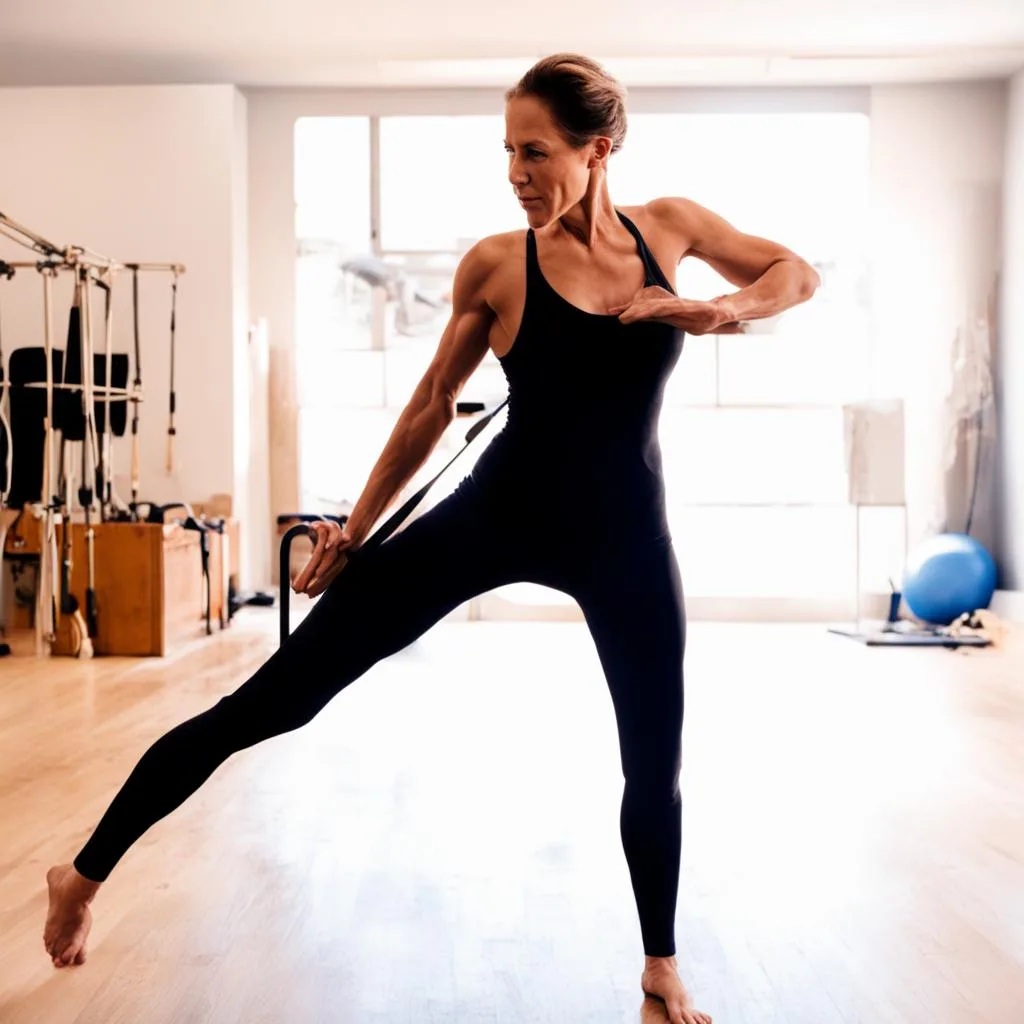
The Benefits of Combining Pilates and Walking
Fitness guru Brooke Siler suggests combining Pilates exercises with your walking routine to enhance strength, balance, and coordination. This innovative approach interweaves the mind-body focus of Pilates with the cardiovascular benefits of walking for a full-body workout.
Key takeaways
- Practice lateral thoracic breathing to maintain constant core engagement without restricting your oxygen intake while walking.
- Articulate your feet through the full gait cycle, using a heel-to-toe rolling motion to strengthen arches and ankles.
- Maintain the Pilates Box by keeping shoulders and hips aligned, using scapular stability to prevent torso twisting.
- Use internal resistance, imagining you are moving through thick substance, to engage muscles without needing external weights.
Core Strength On The Go
Walking alone tones your legs, glutes, and core muscles to some degree, but strategically engaging those muscle groups as you walk can take that toning to the next level. By consciously contracting your core as you walk, just as you would during a Pilates Hundred exercise, you increase muscle activation in your abs and back for better strength and posture.
Enhanced Balance And Stability
Many Pilates moves challenge your stability and balance. By mimicking those motions while you walk – such as lifting one leg in front of you or extending a leg behind in a kick – you improve coordination. Focusing on balance and alignment engages more muscles to help you walk taller.
Injury Prevention
Combining Pilates and walking can aid injury prevention by strengthening muscles and improving alignment. Pilates’ focus on precise movements enhances body awareness and helps identify imbalances or weaknesses. Addressing those areas makes you less prone to strains or falls during everyday activities like walking.
Convenient And Accessible
You can combine Pilates and walking almost anywhere without equipment or a studio. All you need is enough space to walk around while doing standing or walking versions of Pilates exercises that target various muscle groups. That makes this fusion fitness accessible at home, outdoors, while traveling – wherever your walk takes you!
Mastering Lateral Thoracic Breathing on the Move
In traditional Pilates, the breath is the engine of the movement, and translating this to a walking routine requires a shift from standard diaphragmatic or shallow chest breathing to lateral thoracic breathing. When walking, most people either let their bellies expand fully or take short, panicked breaths in the upper chest. To implement Brooke Siler’s approach, you must learn to breathe into the sides and back of your ribcage. This technique allows you to maintain a constant contraction of the deep abdominal muscles—the Powerhouse—without restricting your oxygen intake. Imagine your ribcage is an accordion; as you inhale through the nose, the ribs should expand outward to the left and right, filling the lungs without the abdomen spilling forward. As you exhale forcefully through pursed lips, the ribs knit back together, and the navel pulls deeper toward the spine.
To practice this while walking, begin by establishing a rhythm. Try inhaling for four counts (four steps) and exhaling for four counts. This synchronization prevents the breath from becoming erratic as your heart rate rises. A common edge case occurs when walking uphill; the natural tendency is to gasp, which deactivates the core. In these moments, shorten the breath cycle to two counts but maintain the lateral expansion. This constant engagement of the transverse abdominis provides a protective internal girdle for the lower back, ensuring that every step you take is supported by a stable center rather than relying solely on the hip flexors.
Foot Articulation: Bringing Reformer Footwork to the Pavement
One of the most overlooked aspects of Pilates is the intricate focus on the feet, often seen in the “Footwork” series on the Reformer. When walking, you can replicate these benefits by focusing on the articulation of the foot through every phase of the gait cycle. Instead of simply clopping your feet onto the pavement, visualize the “peeling” motion used in a Pilates Roll-Up. As your leading foot moves forward, the heel should strike the ground with control, followed by a conscious roll through the outer edge of the foot, the ball of the foot, and finally a powerful push-off from the big toe. This sequence engages the intrinsic muscles of the arches and strengthens the ankles, which are vital for long-term mobility.
You can further integrate Pilates principles by focusing on the “tripod” of the foot: the heel, the base of the big toe, and the base of the little toe. Ensure that weight is distributed evenly across these three points as you transition from one step to the next. For those dealing with overpronation (rolling inward) or supination (rolling outward), this mental focus acts as a corrective exercise in real-time. To increase the challenge, imagine you are walking through a thick substance like wet sand or peanut butter. This creates “internal resistance,” a core Pilates concept where you use your own muscle tension to create a workout, rather than relying on external weights. This resistance forces the hamstrings and glutes to engage more deeply with every stride, mimicking the pull of the Reformer springs.
The Pilates Box: Maintaining Upper-Body Integrity and Alignment
Siler often emphasizes “The Box,” the rectangular frame formed by the two shoulders and the two hip bones. In a standard walk, the shoulders often slump forward or the torso twists excessively, breaking this frame and leaking energy. To maintain the Box while walking, you must focus on scapular stability. Imagine your shoulder blades are sliding down into your back pockets, creating a long, elegant neck. This doesn’t mean pinning the shoulders back rigidly; rather, it’s about finding a wide, open collarbone that allows the arms to swing naturally from the shoulder socket without pulling the torso out of alignment.
As you walk, observe the relationship between your ribs and your hips. The goal is to keep the distance between the bottom of the ribcage and the top of the pelvis consistent on both sides. If you find yourself “hiking” a hip with each step, you are losing core control. To correct this, visualize a plumb line dropping from the crown of your head through the center of your pelvis. Every step should be an extension of this vertical axis. For an added challenge, perform the “Spine Twist” variation: while keeping the lower body facing forward and the hips square (the bottom of the Box), gently rotate the upper ribcage and shoulders (the top of the Box) slightly toward the leading leg. This small, controlled rotation engages the obliques and improves spinal mobility, all while maintaining the integrity of your gait.
Powerhouse Propulsion: Engaging the Deep Core and Pelvic Floor
While the existing focus on core strength is vital, a deeper dive into the “Powerhouse” reveals that true Pilates walking is powered by the pelvic floor and the deep stabilizers, not just the visible “six-pack” muscles. To achieve this, you must master the sensation of “zipping up.” Imagine a zipper starting at the pubic bone and pulling upward toward the navel. This internal lift engages the pelvic floor and the lower abdominals, providing a base of support for the spine. This is particularly important for walkers who experience lower back pain; by lifting the torso out of the hips, you decompress the lumbar vertebrae.
To test this engagement, try the “Staccato Exhale” drill: take three short, sharp exhales as you take three steps, pulling the navel in deeper with each puff of air. You should feel a tightening in the deep waist, almost like a corset being laced. This engagement should be dynamic, not static. As your leg swings forward, the psoas and hip flexors should work in concert with the lower abs. If you feel a “clunking” in the hip, it’s often a sign that the Powerhouse has disengaged. Focus on the “up and in” feeling to create space in the hip socket, allowing the leg to swing freely and efficiently. This transition from passive walking to active, Powerhouse-led propulsion transforms a simple stroll into a functional core session.
Navigating Inclines and Variable Terrain with Pilates Precision
Walking on flat pavement is one thing, but hills and uneven trails offer a unique opportunity to apply Pilates principles of balance and eccentric control. When approaching an incline, the common mistake is to lean forward from the waist, which puts undue pressure on the lower back and shuts down the glutes. Instead, adopt the Pilates “long lean.” Maintain a straight line from your ears to your shoulders to your hips, and lean the entire “Box” forward from the ankles. This shift in the center of gravity forces the posterior chain—the glutes and hamstrings—to do the heavy lifting, much like the “Bottom Lift” or “Bridge” exercises on the mat.
Descending a hill requires even more Pilates control. Here, you focus on eccentric strength—the ability of the muscles to lengthen under tension. Instead of letting gravity pull you down, use your core to “brake” your descent. Keep a slight bend in the knees to avoid jarring the joints, and focus on the “Tendon Stretch” concept: feel the calf muscles lengthening as the heel reaches for the ground. On uneven terrain like grass or gravel, the “Internal Girdle” becomes your best friend. The micro-adjustments required to stay upright on an unstable surface are exactly what Pilates aims to train. By keeping the mind focused on the center, you allow the extremities to react more quickly to slips or trips, significantly reducing the risk of ankle sprains.
Integrating the Arm Series: Resistance Training Without Weights
In Brooke Siler’s philosophy, the arms are never just “along for the ride.” To fully integrate Pilates into your walk, you can perform a standing version of the Pilates Arm Series. Start with “Chest Expansion.” As you walk, reach your arms down by your sides, palms facing back. On an exhale, press the arms back several inches past the hips, squeezing the triceps and opening the chest, then return them to the midline. This movement should be resisted, as if you are pushing through heavy springs or water. This engages the posterior deltoids and the muscles between the shoulder blades, countering the “forward-head” posture common in desk workers.
Another effective move is “The Boxing Series.” While maintaining a steady gait and a quiet torso, extend one arm forward at shoulder height while the other pulls back, elbow bent. The key here is to keep the shoulders down and the “Box” stable. The movement should come from the back, not just the elbows. If you find your torso swaying from side to side, reduce the range of motion. This coordination of upper-body movement with lower-body locomotion is a hallmark of Pilates, requiring the brain to map out complex patterns while the core maintains the center. By the end of a session, your arms should feel as though they’ve had a workout equivalent to using light hand weights, simply through the use of self-imposed resistance and precision.
The Principle of Flow: Seamless Transitions and Rhythmic Gait
Flow is one of the six fundamental principles of Pilates, and in the context of walking, it refers to the seamless transition between different levels of intensity and different focused movements. A Pilates walk should not feel like a series of disjointed exercises; it should be a continuous stream of motion. To achieve this, avoid stopping to “do” an exercise. Instead, layer the focus over your natural stride. For example, you might spend five minutes focusing entirely on foot articulation, then seamlessly transition into five minutes of lateral breathing, followed by a series of arm presses, all without breaking your pace.
To enhance this flow, pay attention to your “Centerline.” In Pilates, we often work from the midline of the body outward. Imagine a line drawn down the center of the path you are walking. Your feet should land on either side of this line, neither crossing over it (which causes the hips to sway) nor stepping too wide (which loses the connection to the adductors or inner thighs). By keeping your movement tight to the centerline, you conserve energy and increase the efficiency of your gait. This rhythmic, focused approach turns the walk into a moving meditation. The transition from the end of your walk back to “normal” life should also be mindful; as you slow down, don’t let the Powerhouse go. Maintain that sense of lift and length even as you reach your destination, carrying the Pilates “posture” with you throughout the rest of your day.
Frequently Asked Questions
What muscles does Pilates walking target?
Pilates walking targets all major muscle groups including abs, glutes, legs, back, arms and shoulders depending on the specific exercises you integrate.
How is this different from regular walking?
Unlike regular walking, Pilates walking strategically engages specific muscles with focused movements inspired by mat Pilates exercises to increase strength, stability and body awareness.
What are some sample Pilates walking exercises?
Examples of Pilates walking exercises include lifting knees to engage abs, calf raises for leg strength, rotating the upper body across the midline to challenge stability, or pulse squats to tone glutes and quads.
Can I do this indoors or outdoors?
The fusion of Pilates and walking can be done indoors or outdoors. Make sure to have enough space around you to walk freely and perform exercises without obstruction.
How long should a Pilates walking session last?
Aim for 30-45 minutes of continuous walking while integrating Pilates exercises throughout for a complete routine. Focus on quality movements rather than quantity.
Related posts:
 Kate Hudson’s Safe Pilates Moves for Pregnancy
 Silent Walking Meditation
 Pilates for Older Runners: Improving Strength and Flexibility
 Master Chair Pose Without Falling Over: A Yoga Guide for Real People
 Benefits of Walking Backwards
 Stretches to Relieve Foot Pain
 Pilates: The Secret to Core Strength and Stability
 PHA Bodyweight Workout: Efficient Fitness Anywhere, Anytime