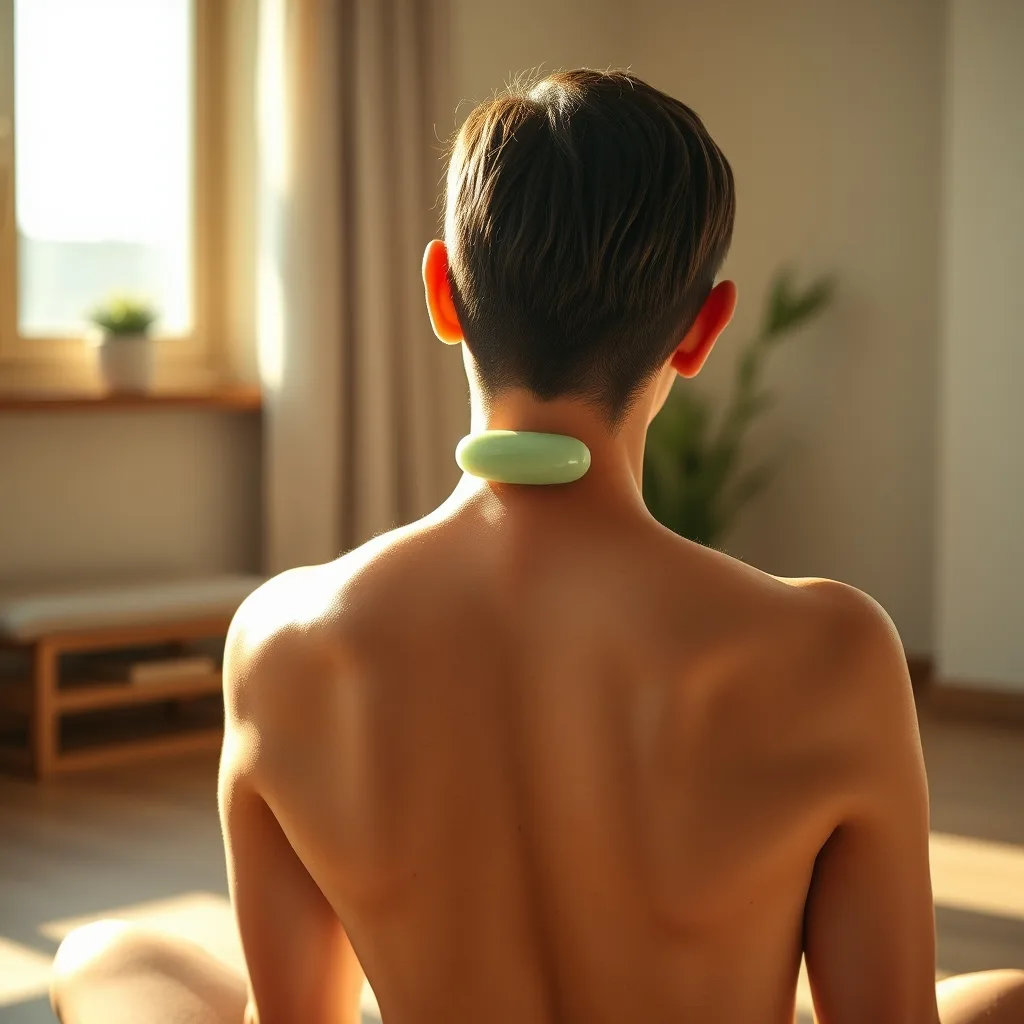
In our increasingly digital world, the physical toll of hours spent hunched over laptops and smartphones is becoming harder to ignore. We often find ourselves dealing with “tech neck,” rounded shoulders, and a persistent tightness in the upper back that seems resistant to traditional stretching. While many people have turned to Gua Sha as a facial rejuvenation technique, this ancient Traditional Chinese Medicine (TCM) practice is gaining significant traction as a tool for bodywork. But can a simple stone tool really help realign your spine and improve your posture? The answer lies in the complex relationship between our muscles, our fascia, and our nervous system.
Key takeaways
- Use Gua Sha to release fascial adhesions that physically lock the body into a slumped or rounded alignment.
- Focus on the pectoral muscles to reduce the internal rotation that causes rounded shoulders and a concave chest.
- Select heavier tools made of Bian stone or stainless steel for the deep pressure required for postural bodywork.
- Practice instrument-assisted movement by applying Gua Sha while actively stretching the target muscle for better results.
- Treat the hip flexors to correct pelvic tilt, providing a stable base that supports better neck and shoulder alignment.
Gua Sha, which translates to “scraping redness,” involves using a smooth-edged tool to stroke the skin with intentional pressure. While it might look like a modern skincare trend, it has been used for centuries to treat chronic pain, inflammation, and respiratory issues. When applied to the neck, shoulders, and back, Gua Sha works as a form of manual therapy that targets the soft tissues responsible for holding us upright. By understanding how this practice interacts with the body’s structural integrity, we can utilize it as a powerful ally in the quest for better posture.
Understanding the Role of Fascia in Posture
To understand how Gua Sha affects posture, we must first look at fascia. Fascia is a continuous web of connective tissue that surrounds every muscle, bone, nerve, and organ in the body. Think of it as a biological “wetsuit” that provides structure and support. When we maintain poor postural habits—such as leaning forward to read a screen—our fascia begins to adapt to that position. Over time, it becomes thick, dehydrated, and restrictive, effectively “locking” our bones into a slumped alignment.
This is where Gua Sha becomes transformative. The mechanical action of scraping the skin creates a shearing force on the underlying fascia. This pressure helps to break up adhesions—areas where the fascia has become stuck to the muscle or other layers of tissue. By releasing these adhesions, Gua Sha restores fluidity and elasticity to the connective tissue, allowing the muscles to return to their optimal length. When the fascia is supple, it is much easier for the body to maintain an upright position without the constant feeling of being pulled forward by tight chest muscles or restricted neck tissues.
How Gua Sha Targets Muscle Tension and Blood Flow
Posture isn’t just about bones; it’s about the balance of muscle tension across the joints. In cases of poor posture, such as Upper Crossed Syndrome, certain muscles become overactive and tight (like the upper trapezius and levator scapulae), while others become weak and inhibited (like the deep neck flexors and rhomboids). Gua Sha serves as a potent tool for down-regulating those overactive, hypertonic muscles.
When you use a Gua Sha tool on a tight muscle knot, or “trigger point,” you are stimulating microcirculation. Research has shown that Gua Sha can increase surface microcirculation by up to four hundred percent. This massive influx of fresh, oxygenated blood helps to flush out metabolic waste products like lactic acid that accumulate in chronically tight muscles. As the muscle receives more nutrients and oxygen, it can finally relax. This relaxation is crucial for posture because it removes the constant “tug-of-war” that keeps your shoulders hiked toward your ears.
The Anterior Chain: Releasing the Pectoral Pull
While much of the focus on posture naturally gravitates toward the back and neck, the primary architect of the “slumped” look is often found on the front of the body. The pectoral muscles, specifically the pectoralis major and the deeper pectoralis minor, act as powerful internal rotators of the humerus. When these muscles become chronically shortened due to prolonged typing or driving, they exert a constant forward pull on the shoulders. Gua Sha is exceptionally effective at addressing this “anterior dominance” by lengthening the muscle fibers and the overlying fascia that keeps the chest locked in a concave position.
To effectively use Gua Sha for pectoral release, one must target the attachment points near the sternum and the coracoid process of the scapula. Unlike the thicker muscles of the back, the chest area is sensitive and requires a nuanced approach. Using a tool with a long, slightly curved edge, apply a lubricant and stroke from the center of the chest outward toward the shoulder. This outward motion mimics the natural expansion of the ribcage during deep breathing. As the tool moves over the pectoralis minor—a small, triangular muscle that sits under the larger pec major—it helps to release the downward pull on the shoulder blade. When this muscle relaxes, the scapula can finally retract and sit flat against the ribcage, instantly making the individual appear taller and more open.
An often-overlooked edge case in pectoral Gua Sha is the treatment of the subclavius, a tiny muscle located directly under the collarbone. This muscle can fix the clavicle downward, limiting the mobility of the entire shoulder complex. Using the smaller “horn” or “notch” of a Gua Sha tool to gently stroke along the underside of the clavicle can improve the mechanics of the shoulder girdle. This structural release is essential because if the front of the body remains tight, no amount of strengthening the back muscles will permanently fix posture; the “tug-of-war” will always be won by the shortened anterior chain.
Tool Ergonomics and Material Science for Structural Work
The efficacy of a Gua Sha treatment for posture is significantly influenced by the material and shape of the tool used. While facial Gua Sha often utilizes delicate rose quartz or light jade, postural work—which involves denser muscle groups and thicker fascial planes—requires tools with more “heft” and specific edge geometries. For structural realignment, many practitioners prefer Bian stone or medical-grade stainless steel. Bian stone is valued in Traditional Chinese Medicine for its reported ability to emit ultrasonic pulses and infrared rays, which may penetrate deeper into the musculature to vibrate the fascia at a cellular level.
Stainless steel tools, often associated with the Graston Technique (a modern Western evolution of Gua Sha), offer a unique advantage: resonance. When a steel tool passes over an area of fibrotic tissue or a “knot,” the vibration is amplified through the tool and felt clearly by the person holding it. This allows for a more diagnostic approach to posture, helping the user pinpoint exactly where the fascial adhesions are most severe. For example, when working on the rhomboids between the shoulder blades, a steel tool can help identify the precise “gritty” patches where the muscle has become stuck to the ribs, allowing for more targeted pressure.
The shape of the tool also dictates the depth of the work. A “S-shaped” tool or a “large wing” tool provides longer strokes suitable for the long muscles of the spine (the erector spinae), while a tool with a “comb” edge can be used to create multi-directional friction over the sacrum or the base of the skull. When choosing a tool for postural correction, weight is a benefit; a heavier tool allows the practitioner to use the weight of the stone or metal to provide pressure, rather than relying solely on hand strength. This ensures a more consistent, deep-shearing force that is necessary to remodel the stubborn, collagenous fibers of long-standing postural distortions.
Proprioceptive Re-education and the Nervous System
One of the most profound, yet least discussed, benefits of Gua Sha for posture is its impact on proprioception—the body’s internal sense of where its limbs and joints are located in space. Chronic poor posture often leads to “sensory-motor amnesia,” a state where the brain loses the ability to accurately feel the position of the spine. Because the brain is no longer receiving clear signals from the overstretched back muscles, it defaults to the slumped position as the new “normal.” Gua Sha serves as a powerful neurological “wake-up call” for these dormant tissues.
The act of scraping the skin stimulates a high density of mechanoreceptors, including Ruffini endings and Pacinian corpuscles, which are sensitive to pressure and lateral stretch. By flooding the nervous system with sensory input from the back and neck, Gua Sha “lights up” these areas in the brain’s primary somatosensory cortex. This increased neural feedback allows the individual to “feel” their back again. It is common for people to report that after a session, they find it much easier to sit up straight not because they are forcing it, but because they are suddenly aware of the slouch and have the sensory clarity to correct it.
Furthermore, Gua Sha can influence the autonomic nervous system. The repetitive, rhythmic strokes have a down-regulating effect on the sympathetic nervous system (the fight-or-flight response). Since many postural issues are exacerbated by stress—manifesting as hiked shoulders and a guarded, forward-leaning stance—the parasympathetic shift induced by Gua Sha allows the muscles to let go of defensive tension. This creates a window of opportunity where the body is neurologically “plastic,” making it the ideal time to perform corrective exercises or stretches that reinforce a new, more aligned postural blueprint.
Addressing Lower Cross Syndrome: The Hip-Spine Connection
Posture is a kinetic chain, meaning an issue at the base of the spine will inevitably travel upward. Many people struggling with “tech neck” are also suffering from Lower Cross Syndrome, characterized by an anterior pelvic tilt, tight hip flexors, and a hyper-extended lower back. If the pelvis is tilted forward, the upper body must compensate by rounding the shoulders to maintain balance. To truly fix posture with Gua Sha, one must look below the waist, specifically at the hip flexors and the iliotibial (IT) band.
The psoas and iliacus muscles are deep hip flexors that, when tight, pull the lumbar spine into an exaggerated arch. While the psoas is too deep to be reached directly by Gua Sha, the tool can be used on the superficial attachment points around the anterior superior iliac spine (the bony hip points). By scraping the area where the hip flexors meet the pelvis, you can reduce the tension that keeps the pelvis locked in a forward tilt. Additionally, working the lateral line of the leg—the IT band and the tensor fasciae latae (TFL)—can help stabilize the pelvis from the side.
A specific technique for this involves the “J-stroke.” Using the curved edge of the tool, create a hook-like motion around the greater trochanter (the bony bump on the side of your hip). This helps to release the fascial “gathering” that often occurs in people who sit for long periods. When the hips are released, the pelvis can return to a neutral position, providing a stable foundation for the spine. This “bottom-up” approach ensures that the improvements made to the neck and shoulders are not immediately undone by a misaligned base.
The “Scrape and Stretch” Protocol: Dynamic Integration
To maximize the postural benefits of Gua Sha, the practice should ideally be moved from a passive treatment to a dynamic one. This is often referred to as “instrument-assisted movement.” Instead of scraping a muscle while it is relaxed and shortened, the technique involves applying Gua Sha while the muscle is being actively lengthened. This combination of mechanical shearing and active stretching is far more effective at remodeling the fascia than either practice alone.
For example, to address rounded shoulders, an individual can perform a “doorway stretch” (placing the arms on the doorframe and leaning forward) while a partner applies Gua Sha to the pectoral muscles. As the muscle is put under tension, the Gua Sha tool helps to “iron out” the specific adhesions that are preventing the muscle from reaching its full length. Another effective dynamic application is for the levator scapulae—the muscle that runs from the neck to the shoulder blade and is often responsible for “stiff neck.” By slowly tilting the head away from the side being scraped, the user can feel the tool catch on the fibers that are most restricted, providing a much deeper and more functional release.
This protocol also applies to the thoracic spine. A common postural hurdle is “thoracic kyphosis,” or the stiffening of the middle back. By performing “cat-cow” yoga movements or thoracic rotations while applying Gua Sha to the paraspinal muscles, the user can break up the stiffness in the intercostal muscles (between the ribs). This not only improves posture but also increases lung capacity, as the ribcage becomes more mobile. The goal is to teach the body that this new, expanded range of motion is safe and accessible, bridging the gap between temporary relief and permanent structural change.
Deciphering the “Sha”: Petechiae as a Diagnostic and Healing Tool
One of the most distinctive aspects of Gua Sha is the appearance of “sha”—the small red or purple spots (petechiae) that rise to the surface of the skin during treatment. In the context of posture, these marks are more than just a side effect; they are a diagnostic map of where the body is holding the most significant postural stress. The color and location of the sha provide critical information about the state of the underlying tissue.
When scraping along the upper trapezius or the rhomboids, the areas that produce the darkest, most concentrated sha are typically the areas where blood flow has been most restricted by chronic muscle contraction. In TCM, this is referred to as “blood stasis.” From a physiological perspective, these marks represent the extravasation of blood from the capillaries into the interstitial space. This process triggers an anti-inflammatory and immune response, as the body works to clear the old blood and metabolic waste. As the sha fades over 2-5 days, the body replaces the old, stagnant fluid with fresh, nutrient-rich blood, which is essential for the repair of overused postural muscles.
It is important to note that sha is not a bruise. A bruise is caused by trauma to the capillaries from a blunt force, whereas sha is the result of pressure-induced surface microcirculation that specifically targets areas of congestion. For the postural student, tracking where the sha appears can be enlightening. If the sha consistently appears more heavily on one side of the spine than the other, it indicates a functional scoliosis or a lateral pelvic shift that needs to be addressed. As posture improves and the tissues become healthier and more vascularized, the amount of sha produced during a session will naturally decrease, serving as a visual marker of progress.
Contraindications and the “Less is More” Paradox
While Gua Sha is a powerful tool for postural correction, it must be used with respect for the body’s limits. There is a common misconception that “more pain equals more gain,” but in the realm of fascial work, excessive force can actually trigger a protective guarding response from the nervous system, causing the muscles to tighten further. The goal is to provide enough pressure to create a shearing effect on the fascia without causing the body to “braced” against the tool. If the person being treated is tensing up or holding their breath, the pressure is too high.
There are also specific anatomical areas to avoid. One should never scrape directly over bony prominences, such as the vertebrae of the spine or the point of the shoulder, as this can cause periosteal inflammation (painful inflammation of the bone’s outer layer). Instead, focus on the “valleys” of muscle between the bones. Furthermore, Gua Sha should be avoided on the front of the neck over the carotid sinus, on any area with broken skin, or on individuals taking blood-thinning medications. Those with very thin or “papery” skin, often found in elderly populations, should use extremely light pressure or avoid the practice entirely to prevent skin tearing.
Hydration is another critical, yet often forgotten, component of a successful postural Gua Sha routine. Fascia is primarily composed of water and collagen; when it is dehydrated, it becomes brittle and prone to “sticking.” Scraping dehydrated fascia is like trying to stretch a dry sponge—it’s more likely to tear than to glide. Drinking ample water before and after a session ensures that the released metabolic waste is flushed out of the system and that the newly “opened” fascial layers can rehydrate effectively. This fluid exchange is what gives the muscles their “springiness” back, allowing for a more effortless and resilient upright posture that lasts long after the session has ended.
Addressing the “Tech Neck”: A Gua Sha Approach
The term “tech neck” refers to the strain placed on the cervical spine when the head is tilted forward for extended periods. For every inch your head moves forward, it gains ten pounds of perceived weight for the muscles of the neck and upper back to support. Gua Sha is particularly effective for this area because it can reach the small, intricate muscles at the base of the skull, known as the suboccipitals.
To address tech neck, Gua Sha should be applied to the back of the neck and the tops of the shoulders. By scraping
Related posts:
 Managing Hip Pain from Sitting
 Stretch Your Way to a Pain-Free Upper Back: A Step-by-Step Guide
 Face the Facts: Why Your Posture Is Aging Your Features
 Could Fascia Manipulation Be The Next Big Thing In Pain Relief?
 5 Shoulder Exercises That’ll Remedy Rounded Shoulders Fast
 Why Gua Sha Is Replacing Cupping As Celebs’ Tool Of Choice For Chronic Pain
 Desk Yoga for Back Pain Relief
 Gemstones in Skincare