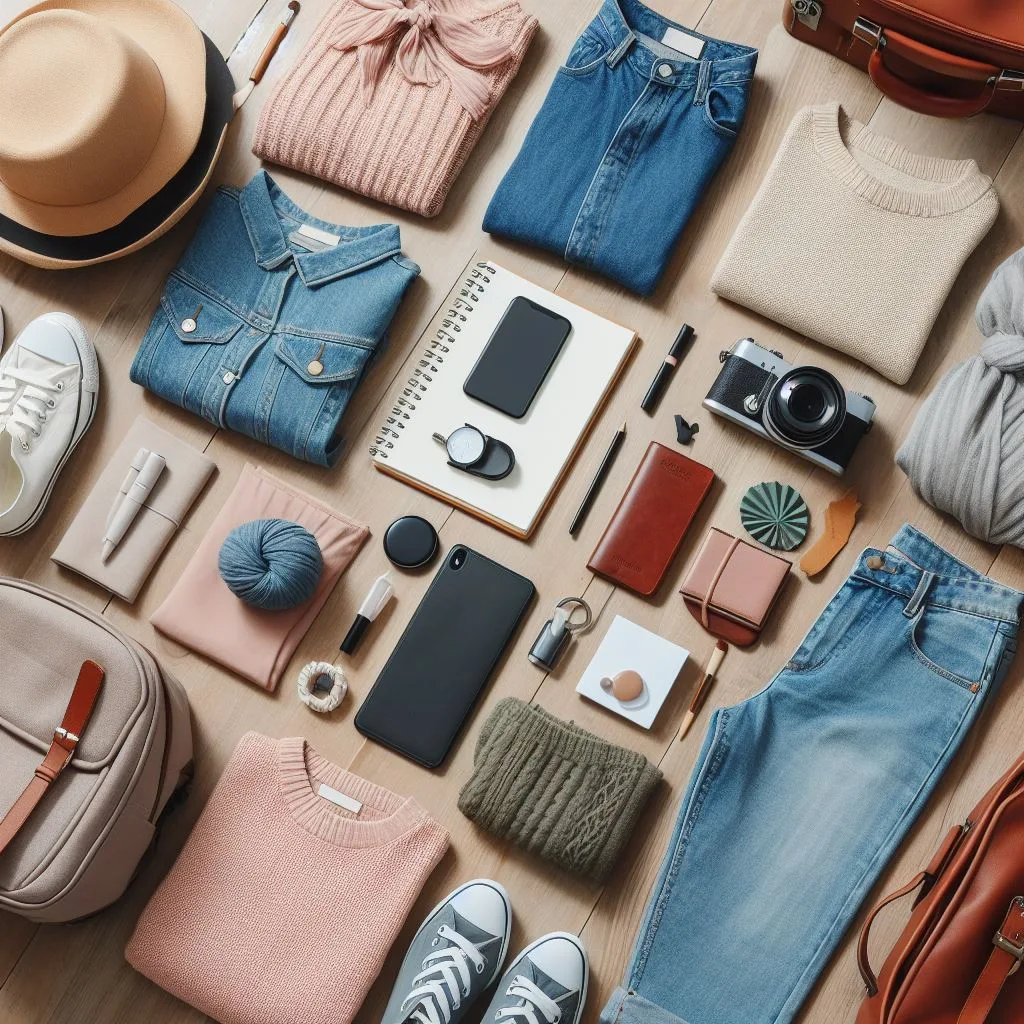
Traveling light is a philosophy that many have embraced in recent years. It’s about simplicity, freedom, and the joy of discovering the world unencumbered by a heavy suitcase. A capsule wardrobe is a perfect companion for the minimalist traveler. It’s a small, versatile collection of clothing that can be mixed and matched to create a variety of outfits for any occasion. In this article, we’ll guide you through creating your capsule wardrobe for your next travel adventure.
Key takeaways
- Select 12 to 15 versatile items that coordinate well using a consistent color scheme.
- Prioritize wrinkle-resistant, quick-drying fabrics to simplify laundry and maintenance during your travels.
- Utilize layering techniques with lightweight jackets and knits to adapt to varying temperatures.
- Limit footwear to two comfortable pairs, one casual and one dressier option, to save luggage space.
- Use accessories like scarves and jewelry to refresh your look without adding bulk to your suitcase.
Why Choose a Capsule Wardrobe for Travel?
A capsule wardrobe not only makes packing a breeze but also ensures you travel with intention. It reduces decision fatigue, saves time, and allows you to focus on the experiences rather than what to wear each day. Plus, it’s an excellent strategy for those keen on sustainable living.
Essentials of a Capsule Wardrobe
- Neutral basics that can be layered
- Statement pieces to add interest
- Accessories to change up the look
- Quality over quantity
Building Your Capsule Wardrobe
Start with a color scheme to ensure all items coordinate. Include versatile pieces like a little black dress, a comfortable pair of jeans, and a classic white shirt. Opt for wrinkle-resistant and easy-to-care-for fabrics.
Packing for Different Climates
Layering is key when traveling to places with varying temperatures. A lightweight jacket, a cozy knit, and thermal undergarments can prepare you for cold weather without taking up too much space.
Footwear for the Minimalist Traveler
Shoes take up the most room, so limit yourself to two pairs: one casual, one that can be dressed up. Ensure they’re broken in and comfortable for walking long distances.
Advanced Fabric Science for the Minimalist Pack
While the existing advice to choose wrinkle-resistant fabrics is a solid starting point, the truly seasoned minimalist traveler looks deeper into the molecular structure of their clothing. The goal is to find materials that not only resist creases but also manage moisture and inhibit bacterial growth, allowing for multiple wears between washes. Merino wool stands as the undisputed king of this category. Unlike traditional sheep’s wool, Merino fibers are exceptionally fine, meaning they don’t itch. More importantly, they contain lanolin, which has natural antimicrobial properties. You can often wear a Merino wool t-shirt for five or six days of active sightseeing without it developing a noticeable odor, a feat impossible for cotton or standard polyester.
Beyond Merino, consider the rise of Tencel (Lyocell). Derived from wood pulp, Tencel is more absorbent than cotton, softer than silk, and cooler than linen. It is particularly effective for travel to humid tropical climates where moisture management is the primary concern. For those who prefer synthetic blends, look for garments treated with silver-ion technology. These treatments physically disrupt the cell walls of odor-causing bacteria. When building your capsule, aim for a “technical-natural” hybrid approach: use Merino for your base layers and socks, Tencel for your mid-day shirts, and high-denier nylon or recycled polyester for your outerwear. This combination ensures that your limited wardrobe remains fresh and functional regardless of the environment.
The Art of Multi-Functional Garment Engineering
In a minimalist wardrobe, every item must earn its place by performing at least two, and ideally three, distinct roles. This goes beyond simple color coordination; it involves choosing garments with specific architectural features. For instance, a high-quality linen button-down shirt is a triple-threat: it functions as a formal top when tucked into trousers, a breathable sun-shield when worn open over a tank top, and a lightweight layer for cool evenings. Similarly, a large, high-quality silk or modal scarf is perhaps the most underrated tool in the traveler’s arsenal. It can serve as an emergency head covering for visiting religious sites, a makeshift pillow for long bus rides, a sarong for the beach, or an extra layer of insulation around the neck during a chilly flight.
Edge cases often dictate the success of a capsule. What happens if you are invited to a spontaneous upscale dinner or a business meeting? This is where the “unstructured blazer” or the “ponte knit dress” shines. An unstructured blazer lacks the heavy internal padding of a traditional suit jacket, allowing it to be rolled tightly into a packing cube without losing its shape. When donned, it instantly elevates a simple t-shirt and chinos to business-casual status. For women, a ponte knit fabric offers the stretch and comfort of leggings but the structural weight of formal tailoring. By prioritizing these “chameleon” pieces, you eliminate the need for specialized outfits that would otherwise sit unused for 90% of your trip.
Mastering the Laundry Ecosystem in Transit
To successfully travel with only 12 to 15 items for weeks or even months, you must transition from a “weekly wash” mindset to a “constant cycle” mindset. This requires a portable laundry ecosystem. Instead of relying on expensive hotel services or hunting for laundromats in every city, equip your capsule with a few ounces of concentrated biodegradable soap or dissolvable laundry sheets. The most efficient method for the minimalist is the “sink-and-towel” technique. After washing an item in the sink, do not wring it out, as this can damage the fibers and cause permanent stretching. Instead, lay the wet garment flat on a clean hotel towel, roll the towel up tightly like a sleeping bag, and stand on it. The towel absorbs the vast majority of the moisture, significantly cutting down on air-drying time.
For those traveling in regions with high humidity where air-drying is slow, consider the “dry bag” method. A small, lightweight dry bag (commonly used for kayaking) can function as a portable washing machine. Fill it with water, soap, and your clothes, then shake vigorously for two minutes. This provides the mechanical agitation necessary to clean deeply soiled items like hiking socks or workout gear. Additionally, always carry a lightweight, braided elastic travel clothesline. These lines do not require clothespins; you simply tuck the corners of your garments into the braids. By integrating these small habits into your nightly routine, your 15-item wardrobe will feel as bottomless as a walk-in closet at home.
Adapting the Capsule for High-Performance and Business Environments
Minimalist travel is often associated with casual backpacking, but it is equally applicable to the corporate traveler. The challenge here is maintaining a sharp, professional silhouette without the bulk of multiple suits. The secret lies in the “broken suit” strategy. Choose a blazer and trousers in complementary but different colors—for example, a navy jacket and charcoal grey tech-chinos. This allows you to wear them together as a sophisticated ensemble, or separately for more casual interactions. Modern “tech-chinos” are a revelation for this; they look like traditional cotton twill but are infused with elastane and treated with DWR (Durable Water Repellent) finishes, making them stain-resistant and incredibly stretchy for long flights.
Footwear in a professional capsule requires a specific balance. While the existing article suggests two pairs, the business traveler should ensure the “dressier” option is a hybrid shoe. Look for leather uppers with EVA (ethylene-vinyl acetate) outsoles. These shoes provide the aesthetic of a classic Oxford or Chelsea boot but offer the cushioning and weight of a running shoe. This allows you to walk miles across a convention center or city streets without needing a separate pair of athletic sneakers. By focusing on high-performance materials that mimic traditional textiles, you can move from the boardroom to a mountain trail without looking out of place in either.
Strategic Packing Geometry and Compression
The physical arrangement of your capsule wardrobe is just as important as the items themselves. To maximize space and prevent the “bottom-of-the-bag” crush, employ a combination of zone-based packing and compression. Packing cubes are essential, but they should be used strategically. Assign one cube for your “ever-ready” items (underwear and socks), one for your core tops, and a third for your bottoms. This creates a modular system where you can find any item without disturbing the rest of your pack. For bulky items like a puffer jacket or a heavy knit sweater, use a manual compression bag. These bags allow you to roll out the air through a one-way valve, reducing the volume of the item by up to 50%.
For items prone to wrinkling, such as a linen blazer or a silk blouse, use the “bundle wrapping” method. This involves wrapping your garments around a central “core” (usually a pouch containing your socks and underwear). Because the clothes are wrapped in wide, sweeping curves rather than folded with sharp edges, the tension of the wrap prevents creases from forming. Furthermore, pay attention to weight distribution. Place your heaviest items—usually your second pair of shoes and your toiletry kit—at the bottom of your bag, closest to your back. This keeps the center of gravity stable, making even a fully packed minimalist bag feel significantly lighter during long transits.
Navigating Cultural Nuances and Dress Codes
A truly versatile capsule wardrobe accounts for the cultural expectations of your destination. Minimalist packing often leans toward shorts and tank tops for warm weather, but many cultures prioritize modesty, especially when visiting religious or historical sites. To address this without adding weight, include a pair of ultra-lightweight, wide-leg trousers made from Tencel or hemp. These are often cooler than shorts because they allow for better airflow and protect the skin from direct sun, while also meeting the dress requirements for cathedrals, mosques, and temples.
Color choice also plays a role in cultural integration. While bright colors are excellent for visibility, a minimalist capsule built on a foundation of navy, olive, or charcoal allows you to blend into urban environments more easily, which can be a safety advantage. If you find your neutral palette feels too drab for a festive destination, use the “accessory pivot.” A single vibrant pocket square, a localized piece of jewelry purchased at your destination, or a colorful watch strap can transform your look to match the local energy. This approach ensures you are always appropriately dressed, whether you are at a street market in Marrakech or a high-end gallery in Paris, all within the constraints of your original 15 items.
The Seasonal Pivot: Transitioning Between Extremes
One of the most difficult challenges for the minimalist traveler is a trip that spans radically different climates—for example, flying from the humid heat of Southeast Asia to the tail-end of a European winter. The solution is not to pack more, but to utilize “invisible layers.” Silk or ultra-fine synthetic thermals are the secret weapon here. A pair of thermal leggings and a long-sleeve base layer weigh less than a single t-shirt and can be worn under your standard chinos and button-down to provide a massive boost in thermal retention.
Outerwear should be limited to a “shell and loft” system. Instead of a heavy wool overcoat, bring a thin, waterproof/breathable rain shell and a lightweight down or synthetic insulated vest. Worn separately, the shell handles tropical rain and the vest handles cool evenings. Worn together, they trap a significant amount of body heat, equivalent to a much heavier winter jacket. This modularity is the essence of the capsule philosophy: you aren’t packing for a specific temperature, but rather creating a toolkit that can be adjusted in real-time to meet whatever conditions you encounter on the ground.
FAQs about Capsule Wardrobes for Travel
How many items should be in a capsule wardrobe for travel?
An ideal capsule wardrobe for travel should have around 12-15 items, excluding underwear and accessories.
What should I do if my capsule wardrobe feels too limiting?
Accessories are your best friend! Scarves, hats, and jewelry can completely transform an outfit.
How do I handle laundry while traveling with a capsule wardrobe?
Choose quick-drying fabrics and consider doing a small load of laundry mid-trip or using hotel laundry services.
Can a capsule wardrobe work for extended travel?
Absolutely! It’s all about choosing the right pieces. The longer the trip, the more important it is to have a well-thought-out wardrobe.
Is a capsule wardrobe cost-effective?
Yes, investing in a few quality pieces that last longer and work harder for you is more cost-effective in the long run.