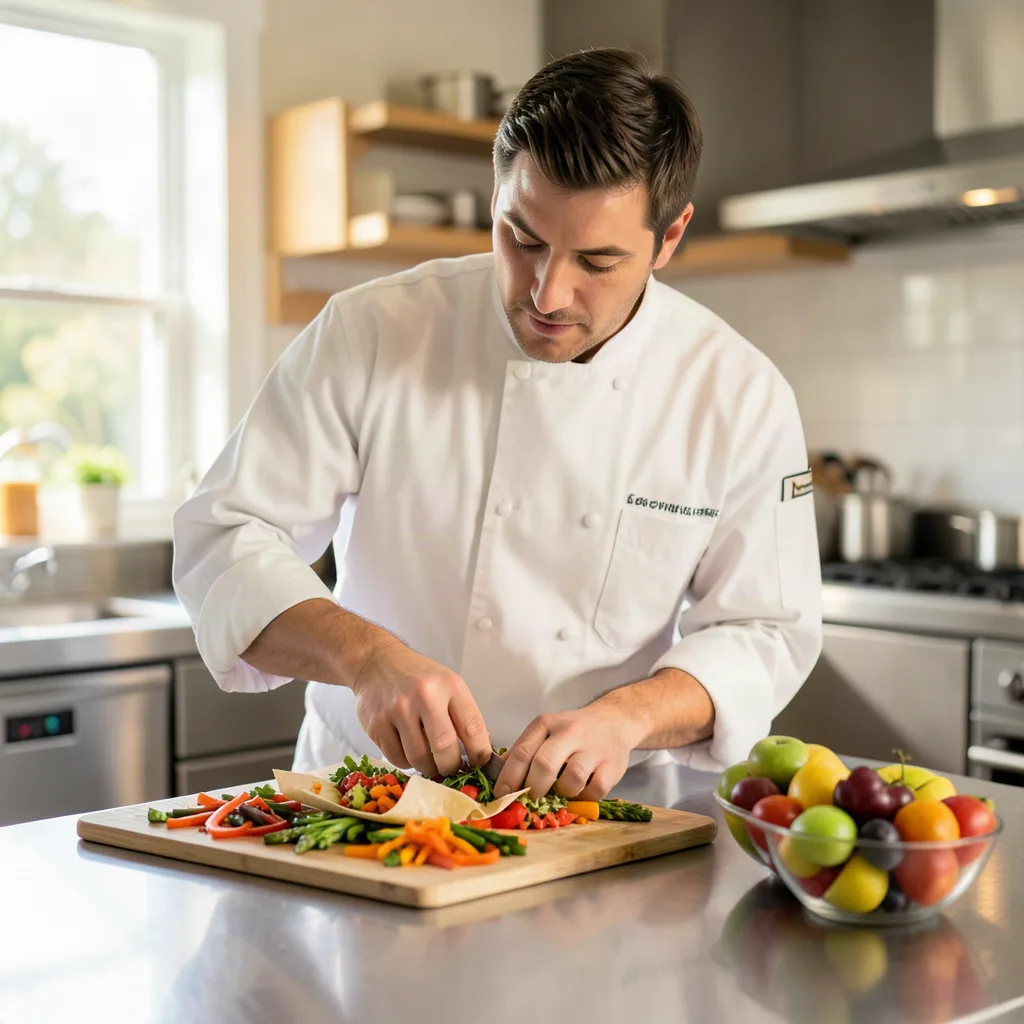
Walk into a school cafeteria today and you might be surprised by what you find. Instead of the mystery meat and canned vegetables that defined school lunch for decades, many schools now serve fresh salads, locally sourced produce, and meals prepared by trained chefs. This transformation didn’t happen overnight, but it represents one of the most significant shifts in how we feed children in America.
Key takeaways
- Chefs use herbs, spices, and roasting techniques to reduce sodium while maintaining flavor in school meals.
- Scratch cooking can reduce costs by replacing expensive processed items with seasonal, locally sourced ingredients.
- Schools increase food acceptance through repeated exposure, attractive presentation, and creative dish naming.
- Farm-to-school programs support local economies while providing students with fresher, more nutritious produce.
- Upgrading kitchen equipment to include steamers and combi ovens enables schools to transition to fresh preparation.
The chef revolution in school lunch programs combines culinary expertise with nutrition science to create meals that students actually want to eat. Professional chefs are bringing restaurant-quality techniques to school kitchens, proving that healthy food can be delicious, affordable, and scalable. This movement addresses a fundamental challenge: how do we nourish millions of children daily while respecting tight budgets and strict nutritional guidelines?
How Professional Chefs Are Redesigning School Cafeterias
The entry of trained chefs into school food service began as a grassroots movement and has grown into a recognized career path. Organizations like Chef Ann Cooper’s Food Family Farming Foundation have trained hundreds of food service directors and school cooks in scratch cooking techniques. These programs teach skills that many school food workers never learned: knife skills, flavor building, batch cooking, and menu planning.
Chefs bring several advantages to school kitchens. They understand how to build flavor without relying on excess salt, sugar, or fat. They know techniques for preparing vegetables that preserve nutrients and improve taste. Perhaps most importantly, they approach food service with creativity rather than simply heating and serving pre-made items.
The redesign process often starts with equipment upgrades. Many school kitchens were built for reheating, not cooking from scratch. Chefs advocate for steamers, combi ovens, and food processors that enable fresh preparation. They also reorganize workflows to make scratch cooking efficient enough for high-volume service.
Menu planning becomes more strategic under chef leadership. Instead of choosing items from a catalog, schools develop recipes that use seasonal ingredients, minimize waste, and reflect student preferences gathered through tastings and surveys. This approach requires more planning but often reduces costs by cutting reliance on expensive processed foods.
The Science Behind Kid-Friendly Healthy Meals
Creating healthy meals that children will actually eat requires understanding both nutrition and child development. Research consistently shows that children need repeated exposure to new foods—sometimes 10 to 15 attempts—before accepting them. Chefs use this knowledge to introduce new items gradually, pairing unfamiliar foods with favorites and offering samples before full servings.
Visual presentation matters significantly with young eaters. Studies from Cornell University’s Food and Brand Lab demonstrate that children respond to colorful plates, creative names, and attractive displays. Chefs apply these findings by creating salad bars with multiple colors, cutting vegetables into appealing shapes, and giving dishes enticing names that spark curiosity.
Texture plays an underappreciated role in children’s food acceptance. Many children reject mushy or inconsistently cooked vegetables. Proper cooking techniques—roasting vegetables until caramelized, blanching to preserve crunch, seasoning at the right moment—transform the eating experience. These skills distinguish trained chefs from standard food service approaches.
Sodium reduction illustrates the chef’s advantage. Federal guidelines limit sodium in school meals, but simply cutting salt makes food taste bland. Chefs build flavor through herbs, spices, citrus, and proper browning techniques. A roasted chicken thigh with garlic and herbs satisfies salt restrictions while delivering the flavor students expect.
From Farm to Tray: Sourcing Local Ingredients
Farm-to-school programs have become a cornerstone of the chef-led school lunch revolution. These initiatives connect schools with local farmers, creating supply chains that deliver fresh produce while supporting regional agriculture. The benefits extend beyond nutrition: students learn where food comes from, local economies receive support, and schools often access higher-quality ingredients.
Successful farm-to-school programs require logistical coordination. Chefs work with food service directors to identify local sources that can meet volume requirements and food safety standards. This often means developing relationships with multiple small farms rather than relying on single large distributors. Seasonal menu planning becomes essential, featuring strawberries in spring and squash in fall rather than expecting all items year-round.
Many schools have built on-farm programs where students visit local farms, creating direct connections between the field and the cafeteria. When students meet the farmer who grew their carrots, they become more likely to try unfamiliar vegetables. These experiences transform food from an abstract commodity into something tangible and meaningful.
Procurement policies matter for program success. Some states have passed legislation giving schools preference for local vendors when price is competitive. Federal programs like the USDA Farm to School Grant Program provide funding for equipment, training, and infrastructure development. Chefs often advocate for these policies, understanding that sourcing decisions affect both meal quality and community impact.
Meeting Federal Nutrition Standards While Keeping Flavor
The Healthy, Hunger-Free Kids Act of 2010 established updated nutrition standards for school meals, requiring more fruits, vegetables, and whole grains while limiting sodium, saturated fat, and calories. These standards represented significant progress, but they also created implementation challenges. Chefs have become essential partners in making these standards work in practice.
The standards require specific component amounts: students must take at least one fruit or vegetable, and meals must include grains, protein, and milk. Within these constraints, chefs find creative solutions. A pasta dish might feature a vegetable-rich sauce that counts toward multiple requirements. Grain bowls can combine components while showcasing diverse flavors and textures.
Whole grain requirements challenged schools accustomed to white bread and pasta. Chefs discovered that whole grain products have improved significantly in recent years, and that preparation techniques matter. Toasting whole grain bread, choosing quality whole grain pasta brands, and building robust sauces help students accept these changes.
Sodium targets phase in gradually, with each year bringing stricter limits. Chefs approach this as a culinary challenge rather than a burden. They create house-made spice blends, use umami-rich ingredients like mushrooms and tomatoes, and develop flavor-building techniques that don’t rely on salt shakers. Many find their food tastes better with less sodium because other flavors become more prominent.
Success Stories From Schools Across the Country
Real-world examples demonstrate what’s possible when culinary expertise meets school food service. In Boulder Valley School District, Chef Ann Cooper eliminated processed foods, introduced salad bars in every school, and saw participation increase even as meals became healthier. The district now serves over 70 percent scratch-cooked meals, proving the model can scale.
Minneapolis Public Schools transformed its program under chef leadership, moving from pre-packaged heat-and-serve meals to fresh preparation. The district invested in kitchen equipment, trained staff, and developed recipes reflecting the city’s diverse communities. Student participation increased, particularly among high schoolers who had previously avoided the cafeteria.
Smaller districts have achieved similar transformations. A rural Kentucky district partnered with a local chef to introduce scratch cooking, finding that the initial investment in equipment and training paid off through reduced food costs and increased participation. The chef worked with local farmers to source affordable produce, creating a sustainable model.
Urban districts face unique challenges, including older facilities and higher volumes. New York City’s school food program has incorporated chef-designed recipes and culinary training, serving over one million meals daily. The city demonstrates that chef-led approaches can work at any scale when properly supported.
Overcoming Budget Constraints in School Food Service
School food service operates under tight financial constraints. The federal reimbursement for a free lunch hovers around four dollars, which must cover food, labor, equipment, and overhead. Critics sometimes argue that chef-led programs cost more, but evidence suggests otherwise when programs are well-designed.
The key lies in shifting spending from processed foods to ingredients. Pre-made chicken nuggets cost more per serving than whole chicken pieces prepared in-house. Canned vegetables often cost more than fresh seasonal produce from local sources. By eliminating the processing premium, schools can afford better ingredients and still control costs.
Labor represents the largest challenge. Scratch cooking requires more staff hours than heat-and-serve approaches. Successful programs invest in staff training and often increase hours, but they offset these costs through food savings and increased participation. More students eating school lunch means more federal reimbursement, creating a positive cycle.
Equipment purchases require upfront investment but reduce long-term costs. A high-quality combi oven lasts years and enables efficient batch cooking. Food processors reduce prep time for vegetables. Schools often secure grants for initial equipment purchases, then maintain items through operational budgets.
Waste reduction also improves financial performance. Chefs trained in batch cooking prepare quantities matched to demand, reducing leftovers. Creative use of ingredients—vegetable trimmings in stocks, day-old bread in croutons—maximizes value. These practices reflect professional kitchen management applied to school settings.
Student Participation and the Importance of Student Input
Healthy meals only improve child nutrition if students actually eat them. Participation rates vary dramatically between schools, often reflecting meal quality and student engagement. Chefs understand that their customers have choices—many students can bring lunch from home or simply skip eating—and they design programs accordingly.
Student feedback mechanisms have become standard in successful programs. Taste tests allow students to sample new items before they appear on menus. Focus groups reveal preferences and concerns. Some schools form student advisory councils that meet regularly with food service staff. This input shapes menus and builds student investment in the program.
Cultural relevance matters enormously for diverse student populations. A school serving many Mexican-American students might feature pozole or fresh salsa. Schools with significant Asian populations might offer stir-fries or rice bowls. Chefs research traditional dishes and adapt them to school nutrition standards, creating meals that resonate with students’ experiences.
Marketing and presentation shouldn’t be underestimated. School lunch often suffers from an image problem, associated with unappealing food in students’ minds. Chefs change this through attractive displays, creative menu names, and enthusiastic staff engagement. When school lunch becomes something students discuss positively with peers, participation naturally increases.
Training the Next Generation of School Food Professionals
The chef revolution requires a workforce trained in scratch cooking techniques. Several organizations now offer certifications and training specifically for school food service. The School Nutrition Association provides professional development, while culinary schools have begun offering programs focused on institutional cooking. These efforts build the skilled workforce the movement needs.
Existing food service workers often have the motivation to learn but lack training opportunities. Successful districts invest in their current staff, providing hands-on culinary instruction during summer breaks or professional development days. Workers who once heated trays become skilled cooks, taking pride in their expanded capabilities.
Culinary schools increasingly recognize school food service as a legitimate career path. Some programs offer courses in quantity cooking, menu planning for institutions, and child nutrition. These courses attract students interested in sustainable food systems, childhood health, and community impact, not just restaurant careers.
Apprenticeship models show promise. A chef-led school kitchen can train entry-level workers while producing meals, creating a pipeline of skilled staff. These programs address both workforce needs and employment opportunities in the communities schools serve.
The Economic Ripple Effects of Chef-Driven School Food Programs
Beyond the cafeteria, chef-led school food programs create measurable economic impacts throughout communities. When schools shift purchasing from national distributors to local farms, those dollars circulate locally multiple times. Economists call this the multiplier effect: each dollar spent on local food generates additional economic activity as farmers purchase supplies, hire workers, and invest in their operations. A school district spending $500,000 annually on local produce might generate $800,000 or more in total economic activity within the region.
Job creation represents another often-overlooked benefit. Scratch cooking requires more kitchen staff than heat-and-serve operations, creating employment opportunities within the school district. These positions typically offer stable hours, benefits, and skill development pathways. In communities facing unemployment, school food service jobs provide reliable income while contributing to child welfare. Some districts have partnered with workforce development programs to train and hire individuals facing employment barriers, addressing labor needs while strengthening community ties.
The local farming sector benefits substantially when schools become reliable customers. Small and mid-sized farms often struggle with unpredictable market conditions, but school contracts provide stable demand during growing seasons. Some farmers have expanded operations specifically to serve school markets, investing in new crops or extending growing seasons with high tunnels and greenhouses. This agricultural infrastructure then becomes available for other markets, strengthening the regional food system beyond school walls.
Food hubs have emerged as critical infrastructure connecting schools with multiple local producers. These aggregation facilities allow small farms to combine their output to meet school volume requirements while handling distribution logistics. A food hub might collect produce from twenty farms, handle food safety documentation, and deliver to a school district that couldn’t feasibly coordinate with each farm individually. Chefs work closely with food hubs to plan menus around available products, creating reliable demand that justifies the hub’s existence.
Kitchen Equipment and Infrastructure: What Schools Actually Need
Many school kitchens built or renovated between 1980 and 2010 were designed for a single purpose: reheating pre-made food. These facilities lack the infrastructure needed for scratch cooking, creating a significant barrier to transformation. Understanding what equipment actually enables fresh preparation helps schools prioritize investments and avoid costly mistakes.
Combi ovens represent perhaps the most versatile investment a school kitchen can make. These units combine convection and steam cooking, allowing browning, roasting, steaming, and baking in a single piece of equipment. A combi oven can roast 200 pounds of vegetables for a lunch service, then proof and bake rolls for breakfast the next morning. Chefs prize these units for their precision and efficiency: programmable settings ensure consistent results across different staff members and shifts. While a quality combi oven costs $15,000 to $30,000, its versatility often eliminates the need for multiple single-purpose units.
Food processors in the 20-to-40-cup range transform vegetable preparation from a labor bottleneck into an efficient process. Hand-chopping onions, cabbage, and carrots for hundreds of servings consumes hours of staff time. A robust food processor completes the same work in minutes, freeing staff for other tasks. Chefs emphasize purchasing commercial-grade equipment designed for continuous use, as home-kitchen processors quickly fail under institutional demands. The initial cost difference—perhaps $2,000 for commercial versus $200 for consumer models—pays for itself rapidly through reduced downtime and replacement costs.
Steam-jacketed kettles enable large-batch cooking that maintains quality. Unlike standard stockpots on burners, these kettles heat evenly through a water jacket, preventing scorching and hot spots. A 40-gallon steam kettle can produce soup, chili, or pasta sauce for an entire school with consistent results. Chefs value these kettles for making bases, stocks, and sauces that form the flavor foundation of scratch cooking. The equipment also allows cooking at lower temperatures, preserving nutrients and flavor compounds that high heat destroys.
Reach-in refrigeration often requires upgrading when schools transition to scratch cooking. Fresh ingredients need proper storage at consistent temperatures, with adequate space for rotation and organization. Many schools discover that their existing refrigerators, designed for storing frozen pre-made items, cannot accommodate the volume of fresh produce required. Walk-in coolers represent a significant investment—often $20,000 to $50,000 including installation—but they provide the storage capacity that fresh cooking demands. Some schools have accessed facilities bonds or capital improvement funds for this infrastructure, treating kitchen upgrades similarly to other building improvements.
Warehousing and dry storage also need attention. Scratch cooking requires inventories of ingredients—flours, grains, oils, spices, canned goods—that exceed the storage needs of heat-and-serve operations. Proper shelving, pest management, and inventory rotation systems become essential. Chefs work with facilities managers to assess storage capacity and implement organization systems that prevent waste and ensure ingredient quality.
Addressing the Time Constraints of School Lunch Periods
School lunch periods typically last 20 to 30 minutes, including time for students to travel to the cafeteria, wait in line, eat, and return to class. This compressed timeframe shapes everything about school food service, from menu design to serving-line configuration. Chefs must work within these constraints while still producing appealing, nutritious meals.
Efficient serving lines become critical when hundreds of students need to pass through in minutes. Chefs reorganize lines to minimize bottlenecks: pre-plating some items while offering choices for others, positioning popular items at the start to keep lines moving, and designing self-service stations for capable age groups. The layout requires understanding traffic flow and anticipating where delays occur. Some schools have added parallel serving lines, nearly doubling throughput without expanding kitchen space.
Menu design adapts to time constraints in strategic ways. Items that require extensive assembly slow down lines during peak periods. Chefs might offer build-your-own stations during lower-volume meal periods while providing composed plates during rush hours. Grab-and-go options—salads, sandwiches, yogurt parfaits—allow students to select quickly and spend more time eating. These choices remain scratch-prepared but formatted for speed of service.
The eating time itself affects what students actually consume. Research from the Harvard T.H. Chan School of Public Health found that students with less than 20 minutes to eat consumed significantly less of their meals, particularly fruits and vegetables. Chefs advocate for adequate lunch periods while also designing meals that can be eaten efficiently. Pre-cut vegetables, easy-to-eat formats, and appropriate portion sizes help students complete meals within available time.
Breakfast service presents unique timing challenges, often occurring during a brief window before first period or during homeroom. Chef-led programs have innovated with breakfast-in-the-classroom models, grab-and-go carts in hallways, and second-chance breakfast after first period. These approaches meet students where they are rather than requiring cafeteria visits during narrow windows. Chefs develop breakfast items that travel well, maintain quality at room temperature, and appeal to students who might otherwise skip the morning meal.
Navigating the Regulatory Landscape of School Food Service
School food service operates within a complex regulatory environment that includes federal nutrition standards, food safety requirements, procurement rules, and local policies. Chefs working in schools must understand these regulations thoroughly to design programs that comply while delivering quality meals. This knowledge differentiates school chefs from their restaurant counterparts, who operate under different constraints entirely.
The USDA’s meal pattern requirements specify components that must appear in reimbursable meals: fruits, vegetables, grains, meats or meat alternatives, and milk. Each component has minimum quantities and, for vegetables, subgroups including dark green, red/orange, legumes, and starchy. Chefs track these requirements across weekly menus, ensuring cumulative totals meet standards while creating appealing daily offerings. Menu planning software helps manage this complexity, but understanding the underlying logic remains essential.
Offer versus serve provisions allow students to decline some components while still counting meals as reimbursable. This flexibility aims to reduce waste by not forcing students to take items they won’t eat. Chefs design serving lines to make required components prominent and appealing, encouraging selection without mandating it. The strategy depends on the age group: elementary students need more guidance, while high schoolers benefit from genuine choice. Understanding these nuances helps chefs maximize both student satisfaction and federal reimbursement.
Food safety regulations apply with particular stringency in schools, where children face higher risks from foodborne illness. Chefs implement HACCP (Hazard Analysis and Critical Control Points) plans, document temperatures throughout cooking and holding, and train staff on proper procedures. These requirements add documentation burden but also ensure consistent safety. Chefs experienced in restaurants sometimes underestimate the documentation rigor required in schools, learning to maintain detailed records as an integral part of their work.
Procurement regulations govern how schools purchase food, emphasizing fair competition and preventing conflicts of interest. These rules require competitive bidding above certain thresholds, documentation of vendor selection, and equal treatment of suppliers. Chefs navigating local sourcing must understand how to structure purchases to comply—sometimes splitting orders between vendors, developing specifications that don’t inappropriately favor particular suppliers, or using geographic preference policies where states have enacted them. The paperwork differs from restaurant purchasing, requiring attention to process alongside product quality.
Accommodation requirements for students with disabilities extend to food service. Schools must provide modified meals for students whose disabilities affect their diet, often documented through individualized education programs (IEPs) or 504 plans. Chefs work with nutrition staff to develop appropriate modifications: texture changes for students with chewing or swallowing difficulties, allergen-free versions of standard meals, or specialized preparations for students with multiple restrictions. These accommodations require careful labeling, segregation of ingredients, and staff training to prevent cross-contact.
Building Bridges Between Cafeteria and Classroom
The most successful chef-led school food programs connect cafeteria offerings to broader educational goals. When students understand where their food comes from, how nutrition affects their bodies, and why meals are prepared certain ways, they become more engaged participants in school lunch. Chefs increasingly see themselves as educators alongside their culinary roles, contributing to a whole-school approach to food and health.
Culinary demonstrations bring chef expertise directly to students. A chef might visit a classroom to show how vegetables are roasted, explain flavor combinations, or demonstrate knife skills. These sessions demystify cooking and create personal connections between students and food service staff. Students who’ve watched a chef prepare a dish become more likely to try that dish in the cafeteria, having witnessed its creation and understood its components. Schools have scheduled demonstrations to coincide with menu items, building anticipation before new offerings appear.
Gardens have become natural extensions of cafeteria programs in many schools. Chef involvement in school gardens—helping plan plantings based on menu needs, participating in harvest activities, featuring garden produce in meals—creates direct connections between growing and eating. Some schools have developed sophisticated garden programs where students plant, tend, harvest, and finally eat vegetables they’ve grown. Chefs work with teachers to align garden activities with curriculum standards, reinforcing academic learning through hands-on experience.
Nutrition education gains credibility when connected to actual meals. Rather than abstract lessons about food groups, students can analyze the composition of their school lunch, understanding how the components meet nutritional needs and why variety matters. Chefs contribute to this education by explaining recipe development decisions: why certain seasonings replace salt, how whole grains provide sustained energy, why different colored vegetables offer different nutrients. This applied nutrition education feels relevant because it connects to food students eat daily.
Cross-curricular connections extend food education beyond health class. Science classes explore the chemistry of cooking and the biology of growing plants. Social studies examines food traditions across cultures and the history of agriculture. Math applies to recipe scaling, cost calculation, and nutritional analysis. English classes write about food memories or research food systems. Chefs collaborate with teachers to support these connections, sometimes providing ingredients for experiments, recipes for analysis, or professional expertise for research projects.
Family engagement completes the circle between school and home. Chef-led programs often include family nights where parents can taste school meals, learn about program changes, and gain skills for healthy cooking at home. These events build support for school food service while extending its impact beyond school hours. Some schools have developed family cookbook projects, featuring recipes that appear in school meals alongside tips for preparation at home. When families understand and value school food programs, they become advocates for continued investment.
Measuring Success: Evaluation and Continuous Improvement
Effective chef-led programs implement robust evaluation systems to track outcomes, identify problems, and demonstrate impact. Without measurement, programs cannot determine whether changes improve student nutrition, operate efficiently, or justify continued investment. Chefs embrace evaluation as a tool for continuous improvement rather than an administrative burden.
Participation rates provide the most straightforward metric. Tracking daily meal counts by school, grade level, and meal type reveals trends over time and highlights where problems exist. A sudden drop in participation at one school might indicate a menu failure, service problem, or competing factor like a nearby convenience store. Chefs investigate anomalies quickly, using participation data as an early warning system. Month-to-month and year-to-year comparisons show whether programs are growing or stagnating.
Plate waste studies offer more granular insight into what students actually eat. These studies involve weighing food waste after meals, sometimes sorting by component to identify which items students discard. The data reveals whether students are taking required components merely to meet reimbursement rules or genuinely consuming them. Chefs use this information to adjust recipes, portion sizes, and presentation. A finding that students consistently discard a particular vegetable might prompt a recipe change, different seasoning, or alternative preparation method.
Student surveys provide qualitative data that numbers alone cannot capture. Questions about meal satisfaction, favorite items, and suggestions for improvement give students voice in the program. Chefs value open-ended responses that reveal unexpected insights: a student might mention that a dish reminds them of a grandparent’s cooking, or that they avoid the cafeteria on certain days because of crowding. Surveys administered annually or biannually track changes in perception as programs evolve.
Financial metrics demonstrate program sustainability. Food cost per meal, labor cost per meal, and overall revenue versus expense show whether programs operate within budget. Chefs track these metrics alongside participation, understanding the relationship between meal quality, student participation, and financial health. A program might spend more on ingredients but offset the cost through increased participation and reduced waste. Presenting this data clearly helps school boards and administrators understand the return on investment in chef-led programs.
Health outcomes represent the ultimate goal but prove challenging to measure directly. Changes in student BMI, rates of food insecurity, or academic performance reflect many factors beyond school meals. However, some programs have partnered with researchers to study health impacts over time, contributing to the evidence base for school food interventions. Chefs support these studies by maintaining consistent documentation and cooperating with research protocols. Even without formal research, anecdotal reports from teachers and school nurses—students with more energy, fewer visits for hunger-related complaints, improved attention—provide valuable feedback.
The Future of Chef Leadership in School Food
The chef revolution in school lunch continues evolving as programs mature, new challenges emerge, and innovative approaches develop. Understanding current trends helps schools anticipate future developments and position programs for continued success. The trajectory suggests that chef leadership in school food will expand, professionalize, and diversify in coming years.
Technology integration is transforming school food operations. Menu planning software now incorporates nutritional analysis, inventory management, and production scheduling in integrated platforms. Digital ordering systems allow students to pre-select meals, reducing waste and improving service speed. Chefs use these tools while maintaining focus on the fundamental culinary skills that technology cannot replace. The combination of technical sophistication and hands-on cooking defines the modern school chef’s role.
Sustainability concerns increasingly shape school food programs. Beyond local sourcing, schools are addressing food waste through composting, portion right-sizing, and share tables where students can leave unopened items for others. Some programs have installed dishware and washing systems to eliminate single-use trays and utensils. Chefs participate in these efforts, finding that sustainable practices often align with quality improvement: fresh preparation generates less packaging waste than processed foods, and scratch cooking allows portion flexibility that reduces plate waste.
Plant-forward menus are gaining traction in many districts, reflecting both health recommendations and environmental concerns. Chefs are developing substantial vegetarian options that appeal to all students, not just those avoiding meat. Items like grain bowls, vegetable-forward pastas, and legume-based soups can satisfy protein requirements while introducing diverse flavors. These offerings also accommodate students from various cultural and religious backgrounds who may avoid certain meats. The trend represents culinary evolution rather than elimination of animal proteins, with meat playing a smaller role in meals rather than a central one.
Career pathways into school food service are becoming more defined. Culinary schools, professional associations, and advocacy organizations are developing credentials specific to institutional cooking. These pathways help school food positions compete with restaurant careers for talented culinarians. The appeal includes regular hours, benefits, and mission-driven work—factors that attract chefs seeking alternatives to the demanding restaurant lifestyle. As school food careers become more visible and respected, the pipeline of culinary talent into schools will expand.
Policy advocacy remains important for continued progress. Chefs and food service directors engage with legislators and administrators to shape regulations that enable rather than impede quality programs. Issues include adequate reimbursement rates, flexibility in nutrition standards, funding for equipment and training, and support for local sourcing. The chef voice carries weight in these discussions, providing practical perspective on what works in real kitchens serving real students. As the chef revolution demonstrates success, policy increasingly supports rather than merely permits scratch cooking in schools.
Frequently Asked Questions
Do chef-led school lunch programs cost more than traditional programs?
Not necessarily. While scratch cooking often requires more labor, it typically costs less in food purchases since raw ingredients cost less than processed items. Successful programs also see increased student participation, which brings more federal reimbursement. The key is proper planning, staff training, and equipment investment. Many districts find they can serve higher-quality meals at similar or lower per-meal costs.
How do chefs handle food allergies and dietary restrictions in school settings?
Chefs work closely with school nutrition directors to accommodate allergies and restrictions, which are legal requirements under federal law. This includes careful ingredient sourcing, clear labeling, segregation of allergens in the kitchen, and training staff on cross-contact prevention. Many chef-led programs offer multiple options daily, ensuring students with restrictions can participate fully in school meals.
Can smaller or rural schools implement chef-led programs?
Absolutely. Small schools often have advantages: fewer meals to prepare means less complex operations. Rural schools can partner with local farms for affordable produce. Some districts share a chef between multiple schools, or food service directors receive chef training themselves. Regional cooperatives allow smaller districts to pool resources for training and procurement.
What role do parents play in supporting healthy school lunch programs?
Parents are essential advocates. They can attend school board meetings to support food service funding, join wellness committees, volunteer for taste tests and farm visits, and reinforce healthy eating at home. When parents understand the connection between nutrition and academic performance, they become powerful allies for continued investment in quality meals.
How can schools get started with transforming their food service?
Schools can start small: one scratch-cooked item per week, a pilot salad bar, or a single local product on the menu. Assessing current equipment and identifying gaps helps prioritize investments. Connecting with organizations like Food Family Farming Foundation or state farm-to-school networks provides resources and peer support. Most importantly, engaging students and staff in the process builds the buy-in needed for lasting change.
Related posts:
 How to Order Sushi Like a Pro
 America’s Most Vegan-Friendly City
 School Counselor Resources, Materials & Tools
 How to Hire a Personal Chef for Only $25
 The Best Food Shows to Binge on Netflix Right Now
 What is Positive Education? 3 Pillars (+ Examples in Schools)
 NYC’s Healthiest Meal Delivery Services That Actually Taste Amazing
 Sober Social Parties: College Trend