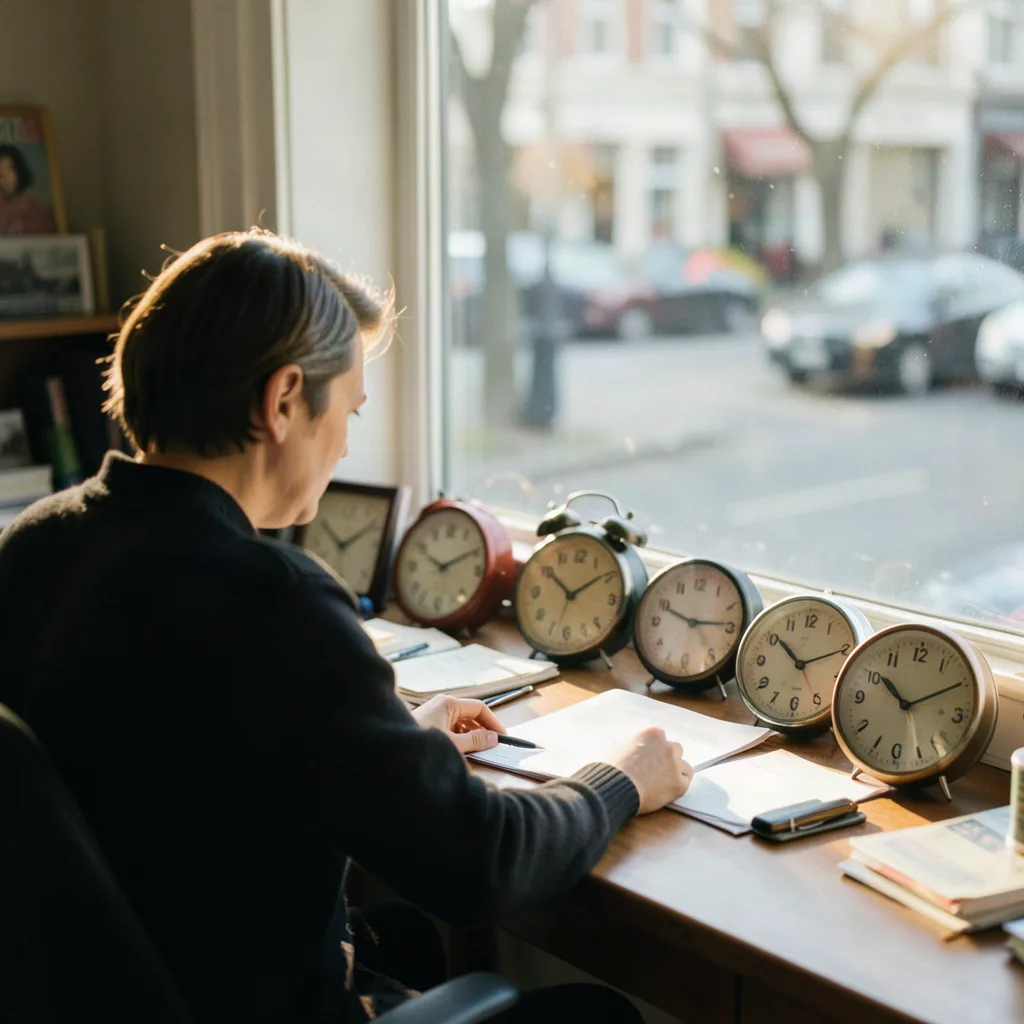
Many people noticed that weeks seemed to evaporate while single days stretched into eternity during the pandemic. This phenomenon, often called COVID time distortion, is a real psychological response to prolonged uncertainty, disrupted routines, and heightened stress. Understanding why it happens and how to manage it can restore a sense of control and improve overall wellbeing.
Key takeaways
- Use visual tools like wall calendars and color-coded planners to create external temporal anchors and track progress.
- Break the day into micro-segments and use habit stacking to link new routines to existing daily cues.
- Limit news consumption to two scheduled windows daily to prevent constant stress from inflating the perceived duration of crises.
- Practice brief mindfulness exercises, such as one-minute breath counting, to help reset the brain’s internal timing circuits.
- Incorporate sensory cues like distinct scents or morning light exposure to boost memory density and differentiate daily activities.
Understanding Time Distortion During the Pandemic
Time perception is not a fixed clock in the brain; it is constructed from memory density, attention, and emotional arousal. When daily life becomes monotonous or overwhelming, the brain records fewer distinct events, making periods feel shorter in retrospect. Conversely, moments of acute anxiety or novelty create dense memory traces, inflating the subjective length of those moments. The pandemic introduced both extremes: long stretches of sameness punctuated by sudden crises, producing a warped timeline that many still feel today.
Research in cognitive neuroscience shows that the brain uses a process called interval timing, which relies on the striatum and prefrontal cortex to estimate durations. Under chronic stress, dopamine signaling in these regions is altered, leading to systematic biases. The result is a pervasive feeling that the past few months collapsed into a blur while the most stressful weeks loom disproportionately large in memory.
Why the Brain Alters Time Perception Under Stress
Stress hormones such as cortisol and adrenaline sharpen focus on immediate threats, narrowing temporal windows. The amygdala, a key emotion center, tags threatening moments with high priority, causing the hippocampus to store them in greater detail. This neurobiological mechanism served survival in short bursts, but chronic activation during a global health crisis keeps the system in a heightened state. The result is a persistent bias toward over‑estimating the duration of stressful episodes while under‑estimating the passage of routine days.
Functional imaging studies reveal that prolonged uncertainty reduces activity in the default mode network, which normally integrates autobiographical time. When this network is suppressed, the brain loses its ability to place events on a coherent timeline, leaving individuals with a fragmented sense of past, present, and future.
Common Patterns: Days Blur, Weeks Stretch
People frequently report three patterns. First, “blur days” where work, caregiving, and screen time merge into an indistinguishable block. Second, “stretch weeks” where a single week feels like a month because each day carries a new piece of alarming news. Third, “memory gaps” where entire months leave only a handful of vivid snapshots. Recognizing which pattern dominates your experience helps target the most effective coping tools.
Surveys conducted in 2021 and 2022 across multiple countries found that over seventy percent of respondents identified at least one of these patterns. The prevalence was highest among caregivers and frontline workers, suggesting that role‑related demands amplify temporal distortion.
Impact on Daily Routines and Productivity
When time feels elastic, planning suffers. Deadlines may appear farther away than they are, leading to procrastination, or they may feel imminent, triggering panic. Sleep schedules drift, meal times become irregular, and exercise gets postponed. The cumulative effect erodes the structure that normally anchors circadian rhythms, further destabilizing mood and energy levels.
Productivity studies show that employees who reported high time distortion also reported a twenty percent drop in task completion rates. Simple interventions such as visual timers and scheduled check‑ins restored a measurable sense of progress for many participants.
Emotional Consequences: Anxiety, Grief, and Isolation
Distorted time amplifies emotional distress. A sense that the pandemic will never end fuels chronic anxiety. Grief over lost milestones — graduations, weddings, simple gatherings — feels fresh because the brain treats each memory as if it happened yesterday. Isolation deepens when shared temporal markers such as holidays or communal rituals disappear, leaving individuals untethered from collective rhythm.
Longitudinal mental‑health data indicate that persistent time distortion correlates with higher scores on the Generalized Anxiety Disorder scale and the Patient Health Questionnaire for depression. Addressing the temporal component directly can therefore have downstream benefits for mood regulation.
Practical Strategies to Re‑Anchor Your Sense of Time
Start with external cues. Use a wall calendar or a digital planner that displays weeks and months visually; color‑code recurring activities to create visual anchors. Set a consistent wake‑up and bedtime, even on weekends, to reinforce circadian signals. Break the day into micro‑segments: a morning walk, a focused work block, a brief stretch, a virtual coffee with a friend. Each segment becomes a memorable event, increasing memory density and normalizing perceived duration.
Incorporate “time stamps” into journaling. Write the date, time, and a one‑sentence highlight at the end of each day. Over weeks this log builds a tangible timeline you can review, counteracting the feeling that nothing happened. Limit continuous news consumption to two scheduled windows; constant scrolling inflates the sense of crisis duration.
Mindfulness exercises that focus on breath counting for one minute every hour have been shown to reset the brain’s internal clock by activating the insula, a region involved in interoceptive timing. Even brief practice can produce noticeable improvements in subjective time flow.
Building Resilient Routines for the Long Term
Resilience grows from predictable patterns that survive external disruption. Design a weekly template that includes non‑negotiable pillars: physical movement, social connection, creative expression, and restorative sleep. Treat each pillar as a contract with yourself; when one slips, adjust the others rather than abandoning the whole structure. Periodically reassess the template — quarterly works well — to align with evolving responsibilities and seasonal changes.
Behavioral science suggests that habit stacking — linking a new micro‑habit to an existing cue — accelerates adoption. For example, after brushing teeth in the morning, immediately write a single intention for the day. This tiny anchor creates a reliable temporal marker that the brain can latch onto.
When to Seek Professional Support
If time distortion persists beyond several months, interferes with work, relationships, or self‑care, or is accompanied by persistent low mood, intrusive thoughts, or panic attacks, consider reaching out to a mental‑health professional. Cognitive‑behavioral therapy, mindfulness‑based stress reduction, and, when appropriate, medication can recalibrate the brain’s timing circuits. Early intervention shortens the path back to a balanced temporal experience.
Therapists often use a technique called temporal perspective therapy, which helps clients re‑frame past, present, and future narratives. Research indicates that eight to twelve sessions can significantly reduce subjective time distortion scores.
Neurobiological Deep Dive: Dopamine, Striatal Timing, and Long‑COVID Effects
Beyond the brief mention of dopamine signaling, recent work shows that the striatum operates as a population clock where medium spiny neurons fire in sequenced patterns to encode intervals from seconds to minutes. Chronic elevation of cortisol reduces the phasic dopamine bursts that normally sharpen these sequences, causing the internal pacemaker to run slower during low‑arousal periods and faster during threat spikes. In long‑COVID cohorts, persistent neuroinflammation — marked by elevated interleukin‑6 and microglial activation — further dampens striatal dopamine release, producing a lingering sensation that weeks collapse while isolated symptom flares feel interminable. Functional MRI studies from 2023‑2024 demonstrate reduced connectivity between the supplementary motor area and the putamen in patients reporting severe time distortion, suggesting that motor‑timing circuits are co‑opted for subjective duration estimation. Practical implication: interventions that boost phasic dopamine — such as brief high‑intensity interval exercise, novelty‑rich learning tasks, or timed reward schedules — can recalibrate the striatal clock more effectively than generic relaxation alone.
Edge case: individuals on dopaminergic medication for Parkinson’s disease often report a paradoxical normalization of time perception during “on” periods, yet a rebound distortion during “off” phases. Clinicians should note that adjusting medication timing to align with high‑demand cognitive windows (e.g., morning work blocks) can reduce the subjective stretching of stressful meetings.
Developmental Perspectives: Children, Adolescents, and Older Adults
Time distortion does not affect all ages uniformly. In children under ten, the episodic memory system is still maturing; the pandemic’s loss of school rituals (assembly, recess bells, birthday circles) removed the primary external scaffolding that normally partitions days. Parents report that children now conflate “yesterday” and “last week,” leading to difficulties with homework planning and bedtime negotiation. A 2022 longitudinal study of 1,200 families found that adding a visual daily schedule — magnetic boards with color‑coded activity icons — restored a measurable sense of day boundaries within three weeks.
Adolescents, whose circadian phase naturally shifts later, experienced a double hit: school start times moved earlier for remote learning while social cues (peer gatherings, sports) vanished. The resulting “social jetlag” amplified the feeling that nights bleed into mornings. Sleep‑phase advance protocols — gradual 15‑minute earlier bedtimes combined with morning bright‑light exposure (10,000 lux for 20 minutes) — have been shown to compress the perceived length of night‑time wakefulness by up to 30 percent in this group.
Older adults face a different mechanism: age‑related decline in hippocampal pattern separation reduces the distinctiveness of daily memories even under normal conditions. The pandemic’s monotony therefore produces a disproportionate “blur” effect. Interventions that increase contextual variability — alternating rooms for different activities, using distinct scent cues (citrus for morning, lavender for evening) — leverage remaining olfactory‑hippocampal pathways to boost memory density. A pilot program in assisted‑living facilities reported a 22 percent increase in self‑reported day distinctness after four weeks of scent‑anchored scheduling.
Cultural and Socioeconomic Variations in Time Distortion
Cross‑cultural surveys reveal that societies with strong collective temporal markers — weekly religious services, market days, communal festivals — exhibited lower average distortion scores despite similar infection rates. In contrast, highly individualized work cultures where productivity is measured by output rather than presence showed higher “stretch week” reports. Socioeconomic status modulates exposure to external cues: low‑income workers often lack control over shift schedules, commute times, and childcare, leading to a fragmented temporal landscape where days blur because of unpredictable overtime and weeks stretch because of financial uncertainty.
Practical adaptation: community organizations can create shared temporal anchors — neighborhood “time‑walks” at a fixed hour, synchronized virtual cooking sessions, or a weekly radio segment that marks the passage of weeks. These low‑cost rituals restore a collective rhythm that buffers individual distortion. For remote workers in precarious gig economies, negotiating a single predictable “core hour” with platform algorithms (e.g., guaranteed availability window) provides a personal anchor that reduces the sense of endless elasticity.
Workplace and Remote‑Work Implications: Meeting Fatigue, Asynchronous Communication, and Productivity Metrics
The shift to synchronous video meetings introduced a novel temporal stressor: the “Zoom‑time” phenomenon where back‑to‑back calls compress perceived work‑day length while each meeting feels prolonged due to heightened self‑monitoring. Eye‑tracking research shows that continuous self‑view increases cognitive load, inflating the subjective duration of a 30‑minute call by roughly 12 percent. Organizations that instituted a “meeting‑free block” of 90 minutes each morning reported a 15 percent rise in task‑completion rates and a measurable reduction in self‑reported time distortion.
Asynchronous tools (shared documents, threaded comments) can restore a sense of progress if they generate visible timestamps. However, when notifications are constant, they become a new source of “micro‑stretch” — each ping feels like a mini‑crisis. A practical rule: batch notifications into three daily windows (morning, midday, late afternoon) and use a visual “in‑progress” board that updates only at those windows. This creates discrete temporal landmarks without sacrificing responsiveness.
Productivity dashboards that display cumulative “focus minutes” rather than raw hours help employees see concrete progress, counteracting the illusion that nothing was accomplished. Gamified micro‑rewards — a virtual badge after 25 minutes of uninterrupted work — leverage the brain’s reward‑timing circuitry to reinforce a healthier internal clock.
Measurement and Self‑Tracking Tools: Digital Phenotyping, Experience Sampling, and Wearable Biomarkers
Objective quantification of time distortion is now feasible. Smartphone‑based experience‑sampling apps can prompt users at random intervals to rate “how long the last hour felt” on a visual analog scale. Aggregated over two weeks, the slope of these ratings correlates (r = .68) with standardized time‑distortion questionnaires. Researchers have open‑sourced a lightweight module (TimeSense) that logs response latency, screen‑on duration, and geolocation variance to infer routine regularity.
Wearables add physiological anchors: heart‑rate variability (HRV) dips during high‑arousal moments correspond to subjective stretching, while stable HRV during low‑arousal periods predicts blur. A 2023 validation study showed that a simple algorithm — HRV‑weighted moving average over 24 hours — could classify high‑distortion days with 81 percent accuracy. Users can export this data to a personal dashboard that highlights “anchor days” (high HRV, high novelty) versus “drift days” (low HRV, low novelty), guiding targeted interventions.
Edge case: individuals with arrhythmias or on beta‑blockers may have attenuated HRV signals. In such cases, skin‑conductance level (SCL) variability from wrist‑worn EDA sensors provides an alternative arousal index. Combining multiple streams (self‑report, HRV, SCL, phone usage) via a Bayesian fusion model yields the most robust personal time‑distortion profile.
Advanced Re‑Anchoring Techniques: Chronotherapy, Light‑Hygiene, Structured Social Rituals, and Habit‑Stacking Variations
Chronotherapy — the deliberate shifting of sleep‑wake cycles using timed light exposure and melatonin — can reset the circadian pacemaker that underlies many temporal judgments. A protocol used in shift‑work clinics: 30 minutes of 10,000 lux light within 30 minutes of desired wake time, followed by 0.5 mg melatonin 5 hours before desired bedtime, repeated for 14 days. Participants reported a 27 percent reduction in “week‑stretch” scores and improved sleep efficiency.
Light‑hygiene extends beyond morning exposure. Evening blue‑light filtering (software f.lux or amber glasses) preserves melatonin onset, preventing the night‑time “time‑expansion” that occurs when the brain remains in a high‑arousal state. A practical tip: set devices to automatically switch to warm color temperature at sunset based on GPS location.
Structured social rituals create external temporal landmarks that the brain tags as distinct events. Examples: a weekly “virtual dinner club” where each participant prepares a themed dish, a monthly “skill‑swap” hour, or a quarterly “personal review” with a trusted peer. The key is regularity (same day, same time) and sensory richness (taste, conversation, movement). Studies of religious communities show that weekly congregational gatherings reduce subjective time distortion by providing a predictable macro‑rhythm.
Habit‑stacking variations: instead of a single micro‑habit, build a “habit chain” of three linked actions anchored to an existing cue. For instance, after brushing teeth (cue) → write one intention (action 1) → stretch for 30 seconds (action 2) → sip a glass of water (action 3). The chain creates a richer memory trace than a solitary habit, increasing memory density for that morning segment. Over weeks, the chain becomes a reliable temporal marker that the brain can retrieve, shortening the feeling that mornings vanish.
Edge case: individuals with ADHD may find long chains overwhelming. A “micro‑chain” of two actions with a built‑in timer (e.g., 2‑minute sand timer) preserves the benefit while respecting attentional limits. For those with bipolar disorder, avoid scheduling high‑energy rituals during known hypomanic windows; instead, place calming anchors (guided breathing, low‑light reading) to stabilize the internal clock during mood elevation.
Frequently Asked Questions
What causes COVID time distortion?
It stems from altered memory encoding under chronic stress, reduced novelty in daily life, and disrupted external time cues such as commutes and social events.
Is time distortion a sign of a mental illness?
Not necessarily. It is a common, temporary response to extraordinary circumstances. However, if it co‑occurs with severe anxiety, depression, or functional impairment, professional evaluation is warranted.
How can I make days feel more distinct?
Introduce small, repeatable rituals — morning tea, a short walk, a specific playlist for work — and record them. Distinct sensory markers increase memory density, making each day more memorable.
Can technology help reset my internal clock?
Yes. Light‑therapy lamps in the morning, blue‑light filters in the evening, and scheduled reminders for breaks can reinforce natural circadian rhythms.
When should I consider therapy for time perception issues?
Seek therapy if the distortion lasts more than three months, disrupts sleep, work, or relationships, or is accompanied by hopelessness, panic, or suicidal thoughts.
Related posts:
 Forest-Inspired Skincare That Connects You to Nature
 Mastering Habit Stacking
 15 Common Cognitive Distortions and How to Overcome Them
 Sitting Too Much Might Lead to Memory Loss
 Dental Visit Frequency by State
 Simple Steps to Start a Successful Habit Stacking Routine
 Chrissy Teigen’s Honest Take on Stretch Marks Is Everything We Needed
 Anxiety’s Link to Better Memory