Introduction
The digital nomad lifestyle is becoming increasingly popular, allowing professionals to work from anywhere in the world. One of the essential aspects of maintaining productivity and efficiency in this lifestyle is creating a functional and inspiring home office. In this article, we’ll explore tips and strategies to design a home office that caters to the unique needs of digital nomads.
Choosing the Right Location
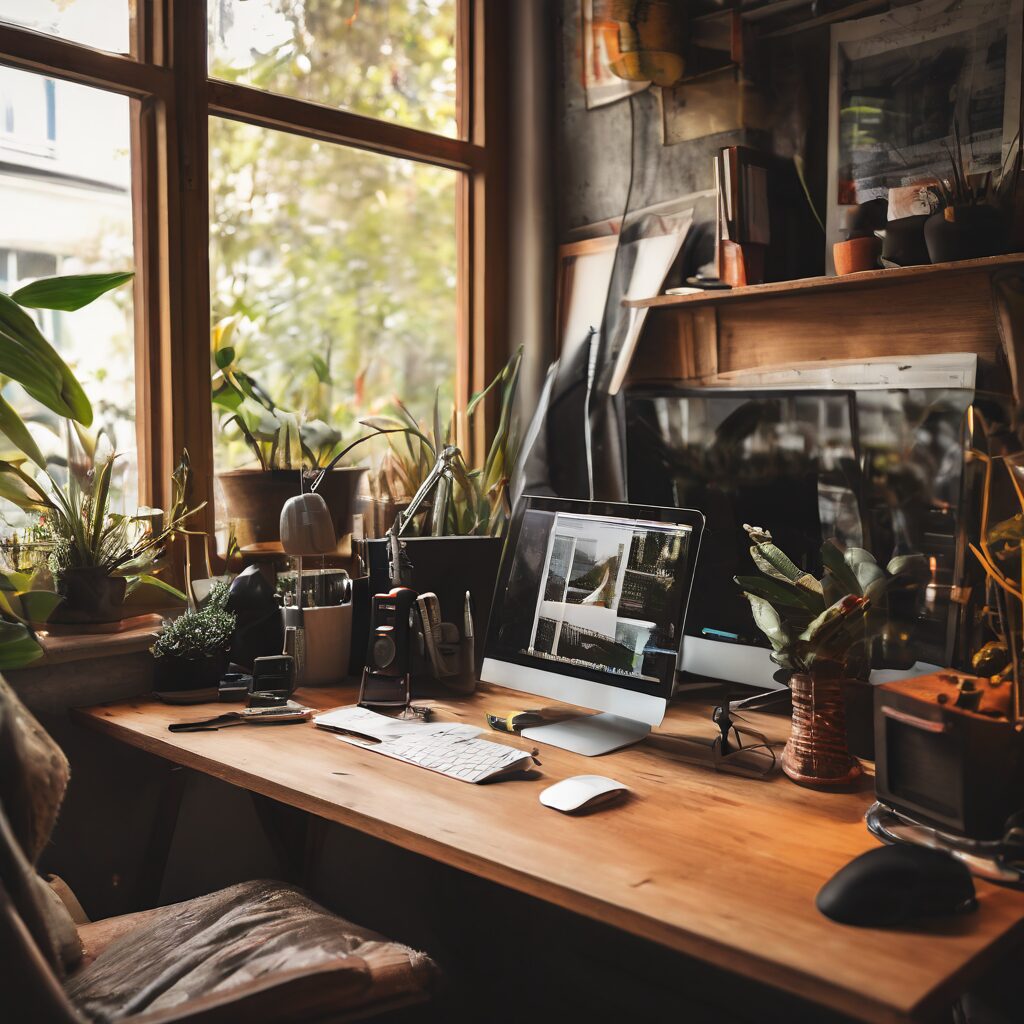
Location is key when setting up a home office. Ideally, choose a quiet and well-lit space in your home that is free from distractions. Natural light can boost mood and productivity, so positioning your desk near a window might be beneficial. If natural light isn’t an option, invest in good quality artificial lighting.
Essential Furniture and Equipment
Investing in the right furniture and equipment is crucial. Here are some essentials:
- Ergonomic Chair: Comfort is paramount, especially if you spend long hours working. An ergonomic chair supports good posture and reduces the risk of back pain.
- Adjustable Desk: A desk that allows you to switch between sitting and standing positions can improve comfort and health.
- High-Quality Monitor: A large, high-resolution monitor can reduce eye strain and enhance productivity.
- Reliable Internet Connection: Fast and stable internet is essential for seamless communication and work.
- Noise-Canceling Headphones: These can help block out background noise and improve concentration.
Organizational Tools
Staying organized is vital for maintaining productivity. Consider the following tools:
- Shelves and Cabinets: Keep your workspace tidy with ample storage for documents and supplies.
- Cable Management Solutions: Prevent a tangle of cords with cable organizers or clips.
- Task Management Apps: Tools like Trello, Asana, or Todoist can help you stay on top of your tasks and deadlines.
Personalization and Inspiration
Your home office should reflect your personality and inspire creativity. Add personal touches such as:
- Artwork and Posters: Decorate your walls with art that motivates you.
- Plants: Indoor plants can enhance air quality and add a touch of nature.
- Comfortable Accessories: Consider adding a cozy rug, cushions, or a blanket for a homely feel.
Maintaining a Work-Life Balance
One of the challenges of the digital nomad lifestyle is maintaining a clear boundary between work and personal life. Here are some tips:
- Set a Schedule: Stick to regular working hours to create a routine.
- Dedicated Workspace: Use your home office solely for work to create a mental separation.
- Take Breaks: Regular breaks can prevent burnout and increase productivity.
Advanced Connectivity and Power Redundancy Strategies
For the digital nomad, a “reliable internet connection” is more than just a high-speed fiber line; it is a multi-layered system designed to prevent downtime at all costs. While the existing article highlights the need for stability, professional-grade home offices require a failover strategy. This involves a Dual-WAN router capable of handling two simultaneous internet sources. For instance, you might have your primary fiber optic line connected to WAN 1 and a secondary 5G cellular gateway or Starlink terminal connected to WAN 2. In the event of a local ISP outage, the router automatically switches traffic to the secondary source without dropping your active Zoom call or VPN session.
Beyond the data connection, power stability is a frequently overlooked edge case. If you are working from a region with an unstable power grid, a standard surge protector is insufficient. An Uninterruptible Power Supply (UPS) is essential. A UPS provides battery backup for those critical minutes during a blackout, allowing you to save your work and shut down gracefully, or even continue working through short flickers. For nomads in more remote locations, investing in a portable power station with pass-through charging can serve as a heavy-duty UPS, keeping your laptop, router, and external monitor powered for several hours during extended outages.
To further optimize the network, consider the physical medium of your data. While Wi-Fi is convenient, it is prone to interference from household appliances and neighboring signals. Hardwiring your primary workstation with CAT6a or CAT7 Ethernet cables ensures the lowest possible latency and maximum throughput. This is particularly vital for those handling large file transfers, such as video editors or cloud architects, where every millisecond of jitter can disrupt the workflow.
Professional Audiovisual Integration for Virtual Presence
As remote work matures, the standard for professional presence has shifted. A laptop webcam and built-in microphone are often inadequate for high-stakes presentations or client meetings. To elevate a home office, one must consider the principles of three-point lighting: a key light, a fill light, and a back light. The key light, positioned at a 45-degree angle from your face, provides the primary illumination, while a softer fill light on the opposite side cancels out harsh shadows. A back light (or hair light) helps separate you from the background, creating a sense of depth that prevents you from looking “flat” on screen.
Audio quality is arguably more important than video; people will tolerate a grainy image, but they will quickly lose focus if your audio is echoey or distorted. Transitioning from noise-canceling headphones to a dedicated XLR or high-quality USB condenser microphone can transform your professional image. However, a sensitive microphone captures more environmental noise. This necessitates acoustic treatment. You do not need a professional recording studio, but strategically placing acoustic foam panels or even heavy fabric curtains can significantly reduce the “slap back” echo common in rooms with hard surfaces. For an invisible solution, consider clear acoustic clouds hung from the ceiling or specialized desk-mounted shields that wrap around the microphone to isolate your voice.
For those who frequently present, a teleprompter setup can be a game-changer. By using a small beam-splitter glass over a tablet displaying your notes, you can maintain direct eye contact with the camera while reading your script. This creates a much stronger psychological connection with your audience compared to looking down at a second screen or a piece of paper.
The Modular and Travel-Ready Workspace Strategy
A digital nomad’s home office must often be as flexible as their lifestyle. Creating a modular workspace allows you to maintain a high-performance environment at home while being able to transition to a “mobile mode” in minutes. This is achieved through the use of Thunderbolt or USB-C docking stations. A single cable should connect your laptop to all peripherals: monitors, keyboard, mouse, audio interface, and external storage. When it is time to travel, you simply unplug one cable, and your entire “brain” is ready to go.
For the equipment itself, consider the “Vesa Mount” ecosystem. Instead of using the bulky stands that come with monitors, use articulating monitor arms. These not only save desk space—allowing for a cleaner, more minimalist aesthetic—but also permit you to rotate your screen to a vertical orientation, which is superior for coding or reading long documents. If you move frequently between different home bases, look for portable 4K monitors that are thin enough to slide into a laptop sleeve but offer the screen real estate of a desktop setup.
Edge cases for modularity include the “clamshell” setup. Many nomads prefer to use their laptop purely as a CPU, keeping it closed and tucked away in a vertical stand to maximize desk space. This requires a reliable external cooling solution, as laptops can run hotter when closed. A quiet, high-RPM cooling pad can prevent thermal throttling during intensive tasks, ensuring that your compact setup performs as well as a full-sized desktop tower.
Environmental Control and Cognitive Ergonomics
While the existing article mentions plants and light, the technical side of environmental control significantly impacts cognitive load and long-term health. Air quality is a silent productivity killer. High levels of CO2 in a closed room can lead to drowsiness and impaired decision-making. A dedicated air quality monitor that tracks CO2, PM2.5 (fine particulate matter), and VOCs (volatile organic compounds) provides actionable data. If CO2 levels exceed 1,000 ppm, it is a signal to open a window or engage a high-efficiency particulate air (HEPA) filter to refresh the oxygen supply.
Humidity management is another critical factor. If the air is too dry, particularly in winter or high-altitude locations, it can lead to dry eyes and respiratory irritation, making long hours at a screen uncomfortable. A smart humidifier that maintains a consistent 40-60% humidity level can alleviate these issues. Conversely, in tropical environments, a dehumidifier prevents mold growth on expensive electronics and leather office chairs.
Lighting should also be considered from a circadian rhythm perspective. Beyond just having “good light,” nomads should utilize tunable white lighting. During the morning and early afternoon, cool blue-toned light (5000K-6500K) mimics daylight and boosts alertness by suppressing melatonin. As evening approaches, the office lighting should transition to warm, amber tones (2700K) to help the body prepare for sleep. This transition is essential for nomads who may be working late hours to sync with a different time zone, as it helps mitigate the “jet lag” effect of working non-traditional schedules.
Advanced Ergonomics: Beyond the Chair
The standard ergonomic chair is a baseline, but true long-term health for a digital nomad involves “dynamic sitting” and specialized input devices. Traditional keyboards force the wrists into an unnatural pronated position, which can lead to Carpal Tunnel Syndrome over years of work. Split mechanical keyboards allow you to place the two halves of the keyboard shoulder-width apart, keeping your chest open and your wrists in a neutral position. Pair this with a vertical mouse or a trackball, which eliminates the need for repetitive forearm twisting.
Footrests and floor surfaces are equally important. If your desk is at the correct height but your feet are dangling, you are putting undue pressure on your lower back. A height-adjustable, tilting footrest encourages micro-movements in the legs, which aids circulation. For those using standing desks, a flat floor is often tiring; an anti-fatigue mat with “topography”—raised bumps and ridges—encourages your feet to move and stretch while you stand, preventing the blood pooling and joint stiffness associated with static standing.
An emerging trend for the dedicated home office is the integration of an under-desk treadmill or “walking pad.” These devices are designed for low-speed walking (usually 0.5 to 2.0 mph) while working. Walking at this pace does not typically interfere with typing or mouse accuracy but can burn hundreds of calories and significantly improve metabolic health over an eight-hour workday. This is an ideal solution for nomads who find it difficult to fit a traditional gym session into a busy schedule of travel and work.
Cybersecurity and Physical Data Privacy
A home office is not just a physical space; it is a digital fortress. For the digital nomad, security must be baked into the office infrastructure. This starts with a hardware-based security key (such as a YubiKey) for two-factor authentication. Unlike SMS-based codes, these physical keys are nearly impossible to intercept remotely, providing a critical layer of protection for sensitive client data and financial accounts.
Physical privacy is another consideration, especially if your home office is in a shared living space or has windows facing a public street. Privacy screen filters for your monitor restrict the viewing angle so that the screen appears black to anyone not sitting directly in front of it. Furthermore, a “clean desk policy,” even at home, is a good habit. This involves using a small cross-cut paper shredder for any physical documents containing sensitive information and ensuring that external hard drives are encrypted (using tools like BitLocker or FileVault) and stored in a fireproof, lockable drawer when not in use.
For those who handle highly confidential voice calls, consider “sound masking” technology. A small white noise machine placed near the door of your office can prevent your voice from carrying into other rooms, ensuring that your business conversations remain private. Additionally, using a VPN at the router level—rather than just on individual devices—ensures that every piece of hardware in your office, including smart lights and printers, is protected from potential local network intrusions.
Managing Asynchronous Logistics and Time Zone Fatigue
Working as a digital nomad often means operating in a different time zone than your team or clients. The home office should be designed to facilitate this asynchronous reality. A physical world clock wall, featuring three or four analog clocks set to the time zones of your key collaborators, provides an instant mental shift that digital clocks often fail to provide. This helps in planning meetings and respecting the “off-hours” of your colleagues without having to do constant mental math.
To combat the fatigue of working night shifts or irregular hours, the office should include “blackout” capabilities. High-quality blackout curtains are essential for those who need to sleep during the day and work at night. However, the office itself should also have a “dark mode” configuration—low-level, indirect red lighting that allows you to see your surroundings without fully waking up your brain or destroying your night vision. This is particularly useful for nomads who need to hop on a quick 3:00 AM call and then return to sleep.
Finally, consider the logistics of digital storage and physical backups. Relying solely on the cloud is risky for nomads who may face intermittent connectivity. A local Network Attached Storage (NAS) device in your home office provides a private cloud that you can access at high speeds within your local network. You can set the NAS to automatically sync with your cloud providers (like Google Drive or Dropbox) overnight, ensuring you always have a local, physical copy of your entire body of work, protected from both internet outages and cloud-service failures.
FAQ
1. What is the most important factor in choosing a home office location?
The most important factor is choosing a quiet and distraction-free space that has good lighting, preferably natural light.
2. What furniture is essential for a digital nomad’s home office?
Essential furniture includes an ergonomic chair, an adjustable desk, a high-quality monitor, and storage solutions like shelves and cabinets.
3. How can I improve my internet connection for a home office?
To improve your internet connection, consider upgrading your plan, using a wired connection instead of Wi-Fi, or investing in a high-quality router.
4. What are some tips for maintaining a work-life balance as a digital nomad?
Set a regular work schedule, use a dedicated workspace for work only, and take regular breaks to maintain a healthy work-life balance.
5. How can I personalize my home office?
Add personal touches like artwork, indoor plants, and comfortable accessories to make your home office a space that inspires you.
Related posts:
 Tiny Green Therapy: How Mini Plants Are Revolutionizing the Workspace
 Desk Setup Game-Changer: The Perfect Phone Perch for Productivity
 Minimalist Home Office
 Creative Home Office Desk Ideas
 Feeling Lonely While Working from Home? You’re Not Alone
 Mood Makeover: The Office Supplies That Will Transform Your Workday Vibes
 Desk Yoga for Back Pain Relief
 Natural Light Lamps for Winter Wellness