
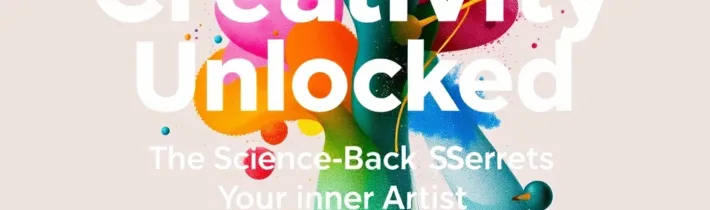
For too long, society has treated creativity as a mystical gift—a lightning bolt of inspiration that strikes a chosen few, the “born artists” or the “tortured geniuses.” This narrative is not only limiting; it is scientifically inaccurate. Modern neuroscience and psychology reveal that creativity is not a fixed trait, but a cognitive process that can be cultivated, practiced, and expanded. Whether you are a corporate executive looking for innovative solutions, a parent wanting to foster imagination in your children, or someone who hasn’t picked up a paintbrush since grade school, the capacity for creative thought is hardwired into the human brain.
Unlocking your inner artist is less about “finding” a hidden talent and more about creating the right neurological and environmental conditions for ideas to flourish. By understanding the interplay between different brain networks and the psychological triggers that lead to “flow,” anyone can move from a state of creative stagnation to one of vibrant expression. This guide explores the science-backed secrets to bypassing mental blocks and leveraging your brain’s natural architecture to unleash your creative potential.
The Neuroscience of Creativity: Balancing the DMN and CEN
To understand how to be more creative, we must first look at the brain’s internal machinery. Creativity does not happen in a single “creative center” of the brain. Instead, it is the result of a dynamic dance between two primary neural networks: the Default Mode Network (DMN) and the Executive Control Network (ECN).
The Default Mode Network (DMN) is active when our minds wander. It is the network of daydreaming, imagining the future, and reflecting on the past. When you are not focused on a specific external task, the DMN takes over, allowing the brain to make distant, unexpected connections between disparate ideas. This is where the “raw material” of creativity is generated.
The Executive Control Network (ECN) is the opposite. It is the seat of focus, logic, and critical evaluation. The ECN is what you use when you are editing a paragraph, calculating a budget, or following a recipe. While the DMN generates the wild ideas, the ECN filters them for viability and structure.
The secret to high-level creativity is cognitive flexibility—the ability to switch between these two networks seamlessly. People who struggle with “creative blocks” are often stuck in the ECN, over-analyzing their ideas before they have had a chance to form. To unlock your inner artist, you must learn to consciously engage the DMN to generate possibilities and then pivot to the ECN to refine them.
Divergent vs. Convergent Thinking: The Two Phases of Creation
Creativity is often misunderstood as a single act of “inspiration,” but it is actually a two-phase process: divergent thinking and convergent thinking. Understanding the difference allows you to stop fighting your brain and start working with its natural rhythms.
Divergent thinking is the process of creating many possible solutions to a problem. It is expansive, non-linear, and judgment-free. In this phase, there are no “bad” ideas. Practical examples of divergent thinking include mind-mapping, free-writing, or sketching random shapes without a goal. The goal here is volume, not quality.
Convergent thinking is the process of narrowing those possibilities down to the single best solution. This is where logic, criticism, and refinement come into play. This is the editing phase, the polishing phase, and the execution phase.
The most common mistake creators make is trying to perform both types of thinking simultaneously. When you try to edit while you are brainstorming, you activate the ECN, which effectively shuts down the DMN. This creates a “mental freeze.” To avoid this, set strict boundaries: dedicate one hour to pure divergent exploration (where criticism is banned) and a separate hour to convergent refinement.
The Power of Incubation and the ‘Aha!’ Moment
Have you ever noticed that your best ideas come to you in the shower, during a walk, or just as you are falling asleep? This is not a coincidence; it is a psychological phenomenon known as incubation.
When you focus intensely on a problem for a long period, your brain can reach a point of saturation. You hit a wall because you are looping through the same familiar patterns of thought. By stepping away from the task—engaging in a low-effort, repetitive activity—you allow the conscious mind to relax. This lowers the inhibition of the ECN and allows the DMN to continue processing the problem in the background.
During this incubation period, the brain continues to search for associations. When a distant connection is finally made, it triggers a sudden burst of insight known as the “Aha!” moment (or epiphany). To leverage this science, incorporate “strategic breaks” into your creative process. Instead of forcing your way through a block, switch to a mundane task: wash the dishes, take a fifteen-minute walk without your phone, or garden. By giving your brain permission to stop “trying,” you provide it the space to actually solve the problem.
Overcoming Creative Blocks through Cognitive Reframing
Creative blocks are rarely about a lack of ideas; they are usually about a presence of fear. Specifically, the fear of producing something “bad” or “unoriginal.” This is where perfectionism acts as a neurological brake, triggering the brain’s stress response and shutting down the imaginative centers.
To overcome this, you can use cognitive reframing—the process of changing the way you perceive a situation. Instead of viewing a blank canvas as a test of your skill, reframe it as a “laboratory for experimentation.”
Actionable Strategies for Reframing:
- The “Bad First Draft” Permission: Explicitly tell yourself, “I am now going to spend 30 minutes making the worst version of this possible.” By removing the goal of quality, you remove the fear of failure, which unlocks the DMN.
- Quantity over Quality: Set a goal for volume. Instead of trying to write one perfect poem, try to write ten terrible ones. Often, the eleventh poem—born from the momentum of the previous ten—is the masterpiece.
- The “What If” Game: When stuck, ask a series of absurd “what if” questions. “What if this character were a fish?” “What if this painting were only neon green?” This disrupts the linear patterns of the ECN and forces the brain into a divergent state.
Environmental Triggers for Creative Flow
Our environment acts as a series of cues for our brain. If you always pay bills and answer stressful emails at your desk, your brain associates that physical space with stress and executive function (ECN). Trying to be “creative” in that same spot can be an uphill battle.
To trigger a state of flow—the mental state of complete immersion in an activity—you can manipulate your surroundings based on environmental psychology.
1. The “Third Space” Effect: Many people find they are more creative in coffee shops or libraries. This is often due to “ambient noise.” A moderate level of background noise (around 70 decibels) has been shown to enhance creativity by creating just enough distraction to prevent the ECN from being too controlling, allowing the DMN to slip in.
2. Nature and Attention Restoration Theory (ART): Spending time in nature reduces mental fatigue. According to ART, urban environments drain our “directed attention,” while natural environments allow it to replenish. A short walk in a park can reset your cognitive resources, making you more capable of the deep focus required for creative work.
3. Lighting and Color: Soft, dim lighting is often associated with more creative thinking, while bright, blue-toned light is better for analytical tasks. If you are in a brainstorming phase, try lowering the lights or using warmer tones to signal to your brain that it is time to relax and explore.
The Relationship Between Boredom and Innovation
In the age of the smartphone, we have nearly eliminated boredom from our lives. Every spare second—waiting in line, riding the elevator, sitting in a doctor’s office—is filled with digital stimulation. While this feels productive or entertaining, it is a creativity killer.
Boredom is the gateway to the Default Mode Network. When the brain is deprived of external stimulation, it begins to create its own. This internal generation is the essence of imagination. If we constantly feed our brains a stream of short-form videos and notifications, we never reach the threshold of boredom necessary to trigger original thought.
To reclaim your inner artist, you must practice “productive boredom.” This means intentionally scheduling periods of time where you have no digital input. Try a “digital fast” for one hour a day. Sit in a chair and just look out the window. Let your mind wander without a destination. At first, this may feel uncomfortable or restless, but that restlessness is the sound of your creative engine starting up.
Practical Habits to Cultivate a Creative Mindset
Creativity is a muscle; the more you use it, the stronger it becomes. While inspiration is spontaneous, the habit of being creative is a choice. Here are three science-backed rituals to integrate into your daily life:
1. Morning Pages: Popularized by Julia Cameron but rooted in the concept of “brain dumping,” this involves writing three pages of longhand, stream-of-consciousness thoughts first thing in the morning. This clears the “mental clutter” of the ECN, allowing you to access the deeper, more imaginative layers of your subconscious before the day’s stresses take over.
2. The Curiosity Journal: Instead of a traditional diary, keep a journal of observations. Note things that pique your interest: the way light hits a building, a strange phrase you overheard, or a question about how something works. This trains your brain to be in a constant state of divergent observation, providing a rich library of raw material for your art.
3. Cross-Pollination: Read books, watch films, or attend lectures in fields entirely unrelated to your own. If you are a programmer, study Renaissance art. If you are a gardener, read about quantum physics. Creativity is often just the act of taking a concept from one field and applying it to another. The more diverse your inputs, the more unique your outputs will be.
Integrating Creativity into Non-Artistic Life
It is important to remember that “the artist” is not just someone who paints or writes; an artist is anyone who approaches a problem with curiosity and a willingness to experiment. Creative thinking is an invaluable asset in professional and personal spheres.
In the workplace, this manifests as innovative problem-solving. Instead of asking “How have we always done this?” (convergent thinking), ask “How would a five-year-old solve this?” or “What would happen if we did the exact opposite of the current strategy?” (divergent thinking). This shifts the team from a mindset of maintenance to a mindset of growth.
In personal relationships, creativity allows for emotional agility. When conflicts arise, a creative approach involves imagining the situation from multiple perspectives and brainstorming non-obvious ways to find common ground. By viewing your life as a canvas, you stop reacting to circumstances and start designing your experiences.
The Paradox of Constraints: Why Limits Fuel Innovation
One of the most pervasive myths about creativity is that it requires absolute freedom. We imagine the artist in a vast studio with every color of paint available, or the writer with an endless stretch of empty time and no deadlines. However, psychological research into the “paradox of choice” suggests that an abundance of options often leads to decision paralysis and cognitive overload. When the possibilities are infinite, the Executive Control Network (ECN) becomes overwhelmed by the sheer volume of paths to take, which can lead to a state of frozen indecision rather than a burst of inspiration.
Constraints, conversely, act as a catalyst for the Default Mode Network (DMN). When you are forced to work within a strict set of boundaries, your brain can no longer rely on the most obvious or “safe” solutions. It is forced to scan for non-linear associations and unconventional workarounds. This is why some of the most iconic creative achievements were born from limitation. For example, Dr. Seuss wrote Green Eggs and Ham because of a bet that he couldn’t write a book using only fifty unique words. The restriction didn’t hinder his storytelling; it forced him to be more inventive with rhythm, repetition, and structure.
Practical Applications of Creative Constraints:
- The Limited Palette Technique: If you are a visual artist, limit yourself to only two colors for a project. This forces you to explore value, contrast, and mood more deeply than if you had a full spectrum.
- The Time-Box Sprint: Set an aggressively short deadline for a first draft—such as 20 minutes to outline an entire project. The pressure prevents the ECN from over-editing and forces the DMN to provide the first, most intuitive associations.
- The “Forbidden Tool” Rule: Identify the tool you rely on most (e.g., a specific software feature, a favorite chord progression, or a go-to adjective) and ban it from your current project. This forces you to discover new techniques to achieve the same emotional effect.
An edge case to consider is the “Constraint Crash,” where limitations become so severe that they trigger a stress response (cortisol spike), which shuts down creative thinking entirely. The key is to find the “Goldilocks Zone” of constraint: enough to provide direction and challenge, but not so much that the task feels impossible. When you feel stuck in a sea of endless options, the most scientific solution is not to seek more freedom, but to intentionally build a wall around your project.
The Neurobiology of Sleep and REM-Driven Insight
While the previous discussion on incubation highlighted the importance of strategic breaks, the most potent form of incubation happens during sleep. Creativity is not just about waking habits; it is deeply tied to the biological architecture of the sleeping brain. Specifically, Rapid Eye Movement (REM) sleep plays a critical role in associative processing—the ability to link unrelated concepts.
During wakefulness, our brains prioritize linear, logical connections to help us navigate the world safely. However, during REM sleep, the brain’s neuromodulators shift. Levels of norepinephrine (a chemical associated with stress and focused attention) drop significantly, while acetylcholine increases. This chemical shift relaxes the boundaries between disparate memories and ideas. The brain begins to perform “cross-associative” leaps, testing connections that the waking ECN would have dismissed as illogical or irrelevant. This is why a problem that seemed insurmountable at 11:00 PM often feels solved by 7:00 AM.
Optimizing Your Sleep for Creative Problem-Solving:
- The “Pre-Sleep Priming” Ritual: Just before bed, spend five to ten minutes reviewing the specific problem you are trying to solve. Do not try to solve it; simply “prime” your brain by visualizing the core challenge. This signals to the subconscious that this particular data set is a priority for overnight processing.
- The REM Extension Technique: Since REM cycles get longer toward the end of the night, the most creative associations often happen in the final two hours of sleep. If you consistently wake up feeling “stuck,” try adding an extra 90 minutes of sleep to your schedule to allow for a full final REM cycle.
- The Hypnopompic Capture: The state between sleep and wakefulness (the hypnopompic state) is a window where the DMN is still highly active but the ECN is just beginning to boot up. Keep a notebook or voice recorder by your bed. The ideas that surface in these first few seconds of wakefulness are often the rawest and most innovative because they haven’t yet been filtered by the day’s logical constraints.
It is important to note that sleep deprivation is a creativity killer. When we lack sleep, the prefrontal cortex—the seat of the ECN—becomes dysfunctional, but not in a way that helps creativity. Instead of a balanced dance between networks, we experience “cognitive fog,” where we lack the focus to refine the wild ideas generated by the DMN, leaving us with fragmented thoughts that cannot be executed.
The Psychology of Play and the “Serious Play” Framework
There is a profound neurological difference between “working on a project” and “playing with a project.” When we approach a task as “work,” we often inadvertently activate the brain’s reward-and-punishment circuitry. We focus on the outcome, the deadline, and the potential for criticism. This shifts the brain into a high-beta wave state, which is excellent for analytical tasks but restrictive for creative ones.
Play, on the other hand, is characterized by a lack of external goal-orientation. In a state of play, the brain releases dopamine and endorphins, which lower the threshold for risk-taking. This “play state” allows the creator to engage in combinatorial play—the act of taking existing elements and rearranging them just to see what happens, without the pressure of producing a “correct” result. This is the essence of the “serious play” framework used by design thinkers at top innovation hubs.
Integrating Play into the Creative Process:
- Gamification of the Process: Turn a creative hurdle into a game. For example, if you are struggling with a character’s dialogue, challenge yourself to write the scene as if it were a tennis match, where each line must “return” a specific keyword from the previous line.
- The “Oblique Strategies” Method: Developed by Brian Eno and Peter Schmidt, this involves using a deck of cards with cryptic instructions (e.g., “Honor thy error as a hidden intention” or “Ask your body”) to break a deadlock. By introducing a random, playful constraint, you disrupt the ECN’s looping patterns.
- Low-Stakes Prototyping: Use materials that feel “temporary” or “childish.” Instead of using a professional software suite, sketch your idea with crayons or build a physical model out of cardboard and tape. The perceived low value of the materials signals to your brain that the stakes are low, which encourages a more playful, experimental mindset.
The edge case here is the “Play-to-Work Transition.” Many creators struggle to move from the playful, divergent phase to the disciplined, convergent phase. The transition requires a conscious shift in identity: moving from the “Explorer” (who plays) to the “Editor” (who polishes). Recognizing which “hat” you are wearing prevents the editor from killing the play state too early in the process.
Collaborative Synergy and the Medici Effect
While much of the science of creativity focuses on the individual brain, creativity is often a social phenomenon. The “Medici Effect” refers to the burst of innovation that occurs when individuals from different disciplines, cultures, and backgrounds intersect. From a neurological perspective, this is a form of externalized cross-pollination. When you encounter a perspective radically different from your own, it forces your brain to create new conceptual bridges to make sense of the information, often sparking an “Aha!” moment that would be impossible in isolation.
However, most traditional group brainstorming is scientifically flawed. The “loudest voice in the room” phenomenon often leads to groupthink, where the ECNs of the group converge too quickly on a single, safe idea to avoid social friction. This effectively shuts down the divergent thinking of the more reserved members of the team.
Science-Backed Collaborative Strategies:
- Brainwriting over Brainstorming: Instead of shouting ideas out loud, have everyone write three ideas on a piece of paper in silence for five minutes. Then, pass the papers to the right, and have the next person build upon those ideas. This ensures that the divergent phase is protected from social judgment and that every brain’s DMN is fully engaged.
- The “Interdisciplinary Collision”: Intentionally seek a “creative partner” who has zero expertise in your field. If you are a coder, partner with a poet; if you are a chef, partner with an architect. Ask them to critique your work not based on technical correctness, but based on their own field’s logic. This forces you to translate your ideas into a new language, revealing gaps and opportunities you were blind to.
- The “Devil’s Advocate” Rotation: To prevent groupthink during the convergent phase, assign one person the formal role of the “Skeptic.” Their job is not to be negative, but to find the structural weaknesses in the leading idea. By making skepticism a formal role, you remove the social anxiety associated with disagreement, allowing for a more rigorous refinement of the final product.
The challenge in collaboration is managing “creative friction.” When two strong visions clash, it can either lead to a superior third option (synthesis) or a stalemate. The key is to maintain a shared commitment to the problem rather than the solution. When the focus remains on the problem, friction becomes a tool for polishing the idea rather than a personal conflict.
The “Gap” and the Dopamine Loop of Iteration
p>
One of the most significant psychological hurdles for any aspiring artist is what Ira Glass calls “The Gap.” This is the period where your taste is highly developed—you know what great work looks like—but your technical skill is not yet sufficient to produce that quality. This gap creates a cognitive dissonance that often triggers the brain’s avoidance response, leading many to quit just before they reach a breakthrough.
To survive the gap, you must shift your reward system from outcome-based dopamine to process-based dopamine. Outcome-based dopamine is the rush you get when you finish a masterpiece; it is rare and unpredictable. Process-based dopamine is the small hit of satisfaction you get from solving a tiny technical problem or completing a single sketch. By focusing on “micro-wins,” you can sustain the motivation required to bridge the gap between your taste and your skill.
Strategies for Managing the Iterative Struggle:
- The “Version History” Perspective: Instead of viewing a piece of work as a single entity, view it as a series of versions (v1.0, v1.1, v1.2). This frames the work as a scientific experiment. If v1.0 is bad, it isn’t a failure; it is simply the necessary data required to inform v1.1.
- The 1% Improvement Rule: Rather than trying to make the whole piece “perfect,” pick one specific element—the lighting in a painting, the pacing of a paragraph, the transition in a song—and focus on improving only that element by 1%. This reduces the cognitive load on the ECN and makes the task feel achievable.
- The “Ugly Phase” Acceptance: Every creative project goes through an “ugly phase” where the elements are present but the harmony is missing. Scientifically, this is the transition from the divergent phase to the convergent phase. Recognizing this as a biological necessity—rather than a sign of lack of talent—prevents the panic that leads to premature abandonment.
An edge case occurs when a creator becomes addicted to the “idea phase” (the DMN rush) and avoids the “execution phase” (the ECN grind). This is often a defense mechanism to avoid facing the gap. The cure is to implement a “shipping deadline,” where the work must be shared or completed regardless of its perceived quality, forcing the brain to value completion over theoretical perfection.
Sensory Anchoring and Multi-Modal Input
Creativity is often treated as a purely mental exercise, but it is deeply rooted in our sensory experience. The brain does not store memories or ideas in isolation; they are anchored to sensory cues. This is why a specific smell can suddenly transport you back to a childhood memory. By intentionally using “sensory anchors,” you can trigger the DMN and access deep-seated associations that are usually inaccessible through linear thought.
Multi-modal input—engaging multiple senses simultaneously—increases the density of the neural networks involved in a task. When you combine visual, auditory, and tactile stimuli, you create a richer “associative web,” providing more hooks for the brain to grab onto when searching for an innovative solution.
Practical Sensory Anchoring Techniques:
- Olfactory Triggering: Use a specific scent (like a particular essential oil or candle) only when you are in a deep creative flow. Over time, your brain will form a powerful associative link between that scent and the creative state. When you hit a block, lighting that candle can act as a neurological “shortcut,” signaling the brain to enter the DMN state.
- Rhythmic Movement: Engage in repetitive, low-effort physical movement—such as pacing, knitting, or using a fidget spinner. This occupies the “background noise” of the ECN, preventing it from over-analyzing and allowing the DMN to float more freely. This is the physiological equivalent of the “shower effect.”
- Tactile Switching: Change the medium of your thinking. If you are stuck in a digital document, switch to a whiteboard, then to a notebook, then to a voice recording. The physical act of changing how you interact with your ideas forces the brain to re-process the information through different neural pathways, often revealing a new angle.
A sophisticated application of this is “synesthetic thinking,” where you intentionally describe a non-visual concept in sensory terms. If you are stuck on a business strategy, ask yourself: “What would this strategy smell like? What is its texture? Is it heavy or light?” This forces the brain to move the problem from the analytical centers to the sensory centers, bypassing the logical blocks of the ECN and unlocking more visceral, intuitive insights.
Frequently Asked Questions
Q: I feel like I’m too old to become creative. Is that true?
A: Absolutely not. Thanks to neuroplasticity, the brain’s ability to form new connections continues throughout adulthood. While children are naturally more divergent because they haven’t yet been conditioned by social norms, adults can reclaim this ability through intentional practice. In fact, many artists find their most profound work in later life because they can combine lifelong experience with newly cultivated creative habits.
Q: Does creativity require a specific set of tools or expensive materials?
A: No. Creativity is a cognitive process, not a material one. Some of the most innovative ideas in history were sketched on napkins or written in margins. The most important “tool” is your attention. Starting with a simple pen and paper is often better than expensive software because it reduces the technical friction and allows you to focus on the flow of ideas.
Q: How do I know when to stop brainstorming and start editing?
A: A good rule of thumb is the “Saturation Point.” When you find that you are repeating ideas or feeling an urge to “fix” the things you’ve already written/drawn, you have likely reached the end of your divergent phase. This is the signal to switch gears. Set a timer or a specific goal (e.g., “I will generate 20 ideas”) to create a clear boundary between the two phases.
Q: What should I do if I’m terrified of what people will think of my work?
A: Recognize that this fear is an ECN response—your brain is trying to protect you from social rejection. The best way to bypass this is to create “private art.” Commit to making things that you promise yourself you will never show to anyone. When the stakes are zero, the fear vanishes, and you can experiment freely. Once your confidence grows in private, sharing your work becomes much easier.
Q: Can you be too creative? Is there such a thing as “creative burnout”?
A: Yes, burnout happens when the ECN is overworked trying to manage and execute too many divergent ideas without adequate rest. If you feel mentally exhausted, it is usually a sign that you need more “incubation” time. Step away from your projects entirely for a few days. Remember that rest is not the absence of creativity; it is a required part of the creative cycle.
Related posts:
 The Sleep Stories That Are Putting Millions to Bed Every Night
 Sleep Hypnosis: A Meditation Guide
 Brain-Boosting Foods
 Why Taking Career Naps Makes Sense
 Permission to Beach: Why Your Boss Should Want You to Leave Work for the Shore
 Three Scientific Reasons to Become a Morning Person
 Weekend Sleep Recovery
 Nap Revolution: NYC’s Sleep Café Is Making Rest Trendy Again