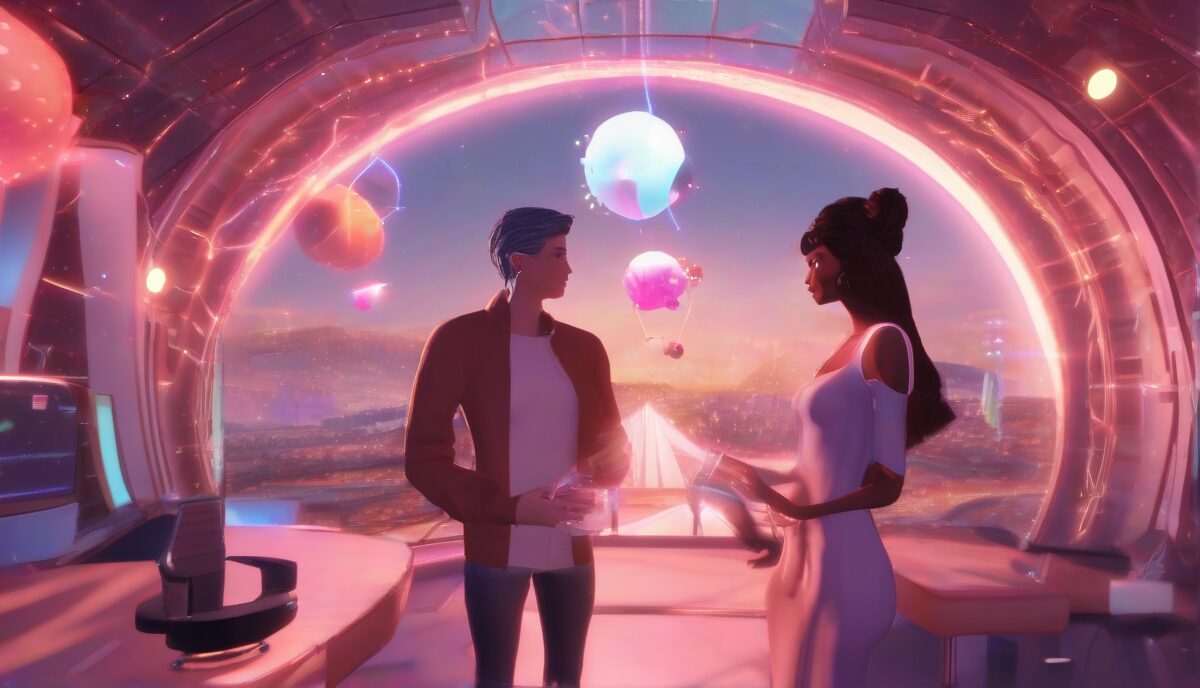
Introduction to Dating in the Metaverse
The concept of dating has evolved significantly over the years, and the latest frontier is the metaverse. This digital universe offers a new and exciting way for people to connect, interact, and find love. In this article, we will explore how dating in the metaverse works, its benefits, challenges, and what the future holds for virtual romance.
What is the Metaverse?
The metaverse is a collective virtual shared space, created by the convergence of virtually enhanced physical reality and physically persistent virtual reality. It includes virtual worlds, augmented reality, and the internet. Users can create avatars, interact with each other, and explore environments in a way that blurs the line between the digital and physical worlds.
How Does Dating in the Metaverse Work?
Dating in the metaverse typically involves using virtual reality (VR) or augmented reality (AR) platforms where users can create avatars to represent themselves. These avatars can meet in virtual environments such as bars, clubs, parks, or even on virtual dates like movie nights or dinner dates. The experience can be enhanced with VR headsets, providing a more immersive and interactive way to connect with potential partners.
Benefits of Metaverse Dating
- Accessibility: The metaverse removes geographical barriers, allowing people from different parts of the world to meet and interact.
- Creativity: Users can create and customize their avatars and environments, leading to more personalized and imaginative dating experiences.
- Comfort: For those who are shy or anxious about dating, the metaverse offers a less intimidating way to meet new people.
- Safety: Virtual dating can provide a safer environment as there is no physical presence, reducing the risks associated with traditional dating.
Challenges of Metaverse Dating
- Authenticity: It can be challenging to know if someone is being genuine or if their avatar truly represents who they are.
- Technical Issues: Users may face technical problems such as connectivity issues, glitches, or hardware limitations.
- Emotional Connection: Building a deep emotional connection can be harder in a virtual environment compared to face-to-face interactions.
- Privacy Concerns: Protecting personal information and data in the metaverse is crucial to avoid potential misuse or exploitation.
The Future of Dating in the Metaverse
As technology continues to advance, the metaverse will likely become an increasingly popular platform for dating. Improved VR and AR technologies, along with better security measures, will enhance the overall experience. Additionally, the integration of AI and machine learning could provide more accurate matchmaking and personalized dating experiences.
Sensory Integration and the Evolution of Haptic Feedback
While the existing landscape of metaverse dating relies heavily on visual and auditory stimuli, the next phase of immersion is rooted in haptics—the technology of touch. For virtual romance to move beyond mere chatting, users are increasingly looking toward hardware that can simulate physical presence. High-end haptic vests, such as those developed by companies like Woojer or bHaptics, allow users to feel the thumping bass of a virtual nightclub or the subtle vibration of a partner’s digital touch. This sensory layer is critical because it bridges the gap between ‘watching’ a date and ‘experiencing’ one.
Advanced haptic gloves are also entering the fray, utilizing micro-fluidics or tiny pneumatic actuators to simulate the resistance of a handhold or the texture of a virtual object. Imagine a date spent exploring a virtual botanical garden where you can actually ‘feel’ the velvet of a petal or the weight of a glass. However, this level of immersion introduces unique edge cases. For instance, ‘haptic griefing’—where a user might attempt to trigger uncomfortable sensations in another—has necessitated the development of haptic ‘kill switches’ and intensity sliders. Users must now navigate the etiquette of ‘haptic consent,’ establishing boundaries for what sensations are permitted and at what intensity, much like one would discuss physical boundaries in the real world.
Thermal feedback is another emerging frontier. Researchers are developing modules that can simulate warmth or cold, allowing a user to feel the ‘warmth’ of an avatar standing nearby or the chill of a virtual snowy landscape. For long-distance couples utilizing the metaverse, these sensory cues are not just gimmicks; they are vital tools for maintaining a sense of ‘co-presence,’ the psychological feeling of truly being in the same room as another person despite the thousands of miles of physical distance between them.
The Virtual Economy of Romance: NFTs, Gifting, and Digital Assets
Dating in the metaverse is inextricably linked to the burgeoning digital economy. In traditional dating, a bouquet of flowers or a thoughtful dinner might be the standard gesture of affection. In the metaverse, these gestures are being replaced by non-fungible tokens (NFTs) and unique digital assets. A suitor might gift a rare, designer skin for their partner’s avatar or a piece of limited-edition virtual jewelry that can be worn across multiple platforms. This introduces a new layer of ‘social signaling’ where the rarity and provenance of digital items serve as indicators of effort and investment.
Virtual real estate also plays a significant role in how relationships develop. Rather than meeting in public hubs like VRChat’s ‘Great Pug’ or Horizon Worlds’ plazas, established couples often invest in private ‘home worlds.’ These are customizable spaces where they can display digital mementos of their relationship, such as 3D-scanned photos of their real-life pets or virtual trophies from games they’ve played together. The management of these spaces often mirrors real-life domesticity, including the shared cost of ‘land’ maintenance in platforms like Decentraland or The Sandbox.
However, the financialization of romance carries risks. The ‘pay-to-win’ mentality of some mobile games can bleed into metaverse dating, where those with more cryptocurrency can curate more impressive dates or more aesthetically pleasing avatars, potentially creating a class divide in virtual romance. Furthermore, the permanence of the blockchain means that a ‘breakup’ in the metaverse can be complicated. If a couple co-owns a high-value NFT or a piece of virtual land, the digital ‘divorce’ requires a technical separation of assets that can be just as messy as a real-world legal battle. Users are now beginning to use ‘smart contracts’ to dictate how shared digital assets are handled in the event of a relationship’s end.
The Proteus Effect and the Fluidity of Digital Identity
One of the most profound psychological aspects of metaverse dating is the ‘Proteus Effect’—the phenomenon where a person’s behavior conforms to the perceived characteristics of their avatar. In the metaverse, you are not limited by your physical body; you can be a towering fantasy creature, a glowing orb of light, or a hyper-realistic version of your younger self. Studies have shown that users who inhabit more attractive or confident-looking avatars tend to act more extroverted and flirtatious than they might in real life. This allows individuals to explore different facets of their personality that may be suppressed by social anxieties or physical insecurities in the ‘meatspace.’
This fluidity, however, raises complex questions about authenticity. In a world where you can change your height, voice, and gender with a few clicks, what does it mean to be ‘true’ to yourself? Metaverse daters often navigate a spectrum of identity, ranging from ‘true-to-life’ (avatars that look like the user) to ‘fantasy-expression’ (avatars that represent an internal ideal). A common edge case is the ‘voice-to-avatar mismatch,’ where a user may inhabit a feminine avatar but retain a masculine voice, or vice-versa. This has led to a culture of radical acceptance in many metaverse circles, but it can also lead to ‘identity shock’ when couples eventually decide to meet in person or move to video calls.
For the neurodivergent community, the Proteus Effect is particularly empowering. Individuals with autism, for example, may find that the structured nature of virtual interaction—where social cues can sometimes be augmented by UI elements or where eye contact is less intense—allows them to form connections that would be overwhelming in a physical setting. The avatar acts as a ‘buffer,’ providing a sense of security that facilitates deeper emotional vulnerability. In the metaverse, the ‘masking’ often required in physical social settings can be replaced by a digital mask that ironically allows for more genuine self-expression.
Governance, Safety Bubbles, and Virtual Consent
As virtual spaces become more populated, the need for robust governance and safety protocols has moved to the forefront. Unlike a 2D dating app where harassment is limited to text or images, the 3D nature of the metaverse allows for ‘spatial harassment.’ This includes ‘phantom touch’ (the psychological sensation of being touched when an avatar enters your personal space) and stalking. To combat this, platforms have implemented ‘Personal Space Bubbles’—invisible barriers that cause other avatars to fade out or disappear if they get too close without permission.
Establishing consent in a 3D environment requires new social scripts. For example, in many high-end VR social circles, it is considered polite to ‘request’ a teleport to someone’s private instance rather than just showing up. Furthermore, the use of ‘community moderators’ or ‘sentinels’ in virtual clubs helps maintain a safe atmosphere for dating. These moderators are often volunteers or paid staff who have the power to ‘kick’ or ‘mute’ disruptive users instantly. For someone on a date, these features provide a level of security that is often missing in physical bars or clubs, where extracting oneself from an uncomfortable situation can be physically and socially difficult.
There is also the rising issue of ‘deepfake’ avatars and AI-driven bots. As AI becomes more sophisticated, it is becoming possible to encounter ‘dating bots’ that are indistinguishable from real humans in a virtual environment. These bots may be designed to farm cryptocurrency or personal data. Savvy metaverse daters are now adopting ‘verification rituals,’ such as asking a partner to perform a specific, complex series of movements or gestures that an AI might struggle to replicate in real-time, or moving the conversation to a platform with verified identity protocols.
Navigating the ‘V-to-P’ Transition: From Virtual to Physical
A unique challenge for metaverse-born relationships is the transition from the virtual (V) to the physical (P). While traditional online dating moves from text to photos to a physical meeting, metaverse dating involves hundreds of hours of ‘shared experiences’—attending concerts, playing games, and ‘living’ together in digital spaces—before ever meeting in person. This creates a high level of emotional intimacy that can sometimes be at odds with physical reality. The ‘V-to-P’ transition can be jarring because the physical body lacks the ‘perfection’ or the specific aesthetic charms of a custom-built avatar.
To manage this, many couples engage in ‘phased disclosure.’ This might involve moving from VR to video calls, then to exchanging physical items like hoodies or letters, before finally meeting. The ‘first meeting’ in a metaverse relationship often carries a different weight; it is less about discovering if you like the person (which you already know) and more about discovering if your physical chemistries align. A common edge case is the ‘scent gap’—the realization that while you love a person’s digital presence, their physical scent or idiosyncratic mannerisms in the real world are unexpected.
Conversely, the metaverse can serve as a ‘long-term maintenance’ tool for physical couples separated by distance. Unlike a standard phone call, ‘meeting’ in the metaverse to watch a movie together on a virtual big screen or to play a round of mini-golf provides a sense of shared activity that mimics the ‘boring but important’ aspects of daily life. This ‘parallel play’—simply existing in the same virtual space while doing different things—is a key component of long-term relationship stability that the metaverse facilitates better than any previous technology.
Niche Communities and the Democratization of Niche Dating
The metaverse is not a monolith; it is a collection of thousands of smaller, niche worlds and subcultures. This fragmentation is a boon for dating, as it allows individuals to find partners based on highly specific interests or identities. For example, there are entire worlds dedicated to ‘furry’ culture, ‘cyberpunk’ roleplay, or specific anime fandoms. In these spaces, the ‘barrier to entry’ for finding a compatible partner is significantly lower because the environment itself acts as a filter for shared values and interests.
For the LGBTQ+ community, the metaverse offers a ‘safe harbor’ for dating, especially for those living in regions where physical queer spaces are non-existent or dangerous. Virtual ‘pride’ events and queer-only clubs allow for a level of exploration and community-building that is unconstrained by local geography. Similarly, for those with physical disabilities that make traditional ‘going out’ difficult, the metaverse provides a level playing field. A user who uses a wheelchair in real life can fly, dance, or explore a mountain range with a partner in the metaverse, focusing the date on shared interaction rather than physical navigation.
However, this niche-focus can lead to ‘echo chambers’ or ‘filter bubbles.’ If a user only dates within a specific virtual subculture, they may miss out on the broader social diversity of the metaverse. There is also the risk of ‘performative identity’ within these niches, where the pressure to conform to a specific subcultural aesthetic (e.g., having a ‘cool enough’ avatar) can create new forms of social anxiety. Navigating these micro-societies requires a high degree of ‘meta-literacy’—understanding the specific rules, slang, and etiquette of each individual world-instance.
Technical Barriers and the Digital Divide in Virtual Romance
While the potential for metaverse dating is vast, it is currently limited by a significant ‘digital divide.’ High-quality VR dating requires a stable, high-speed internet connection, a powerful PC or a modern standalone headset, and often, expensive peripherals like trackers for full-body movement. This creates a gatekeeping effect where only those with significant disposable income can participate in the ‘premium’ dating experiences. For a user in a developing country or a rural area with poor connectivity, ‘lag’ or ‘latency’ can literally ruin the romantic timing of a joke or a tender moment.
Furthermore, ‘hardware fatigue’ is a real factor. Wearing a heavy headset for hours during a long date can cause physical strain, ‘VR sickness’ (nausea caused by motion), or ‘face-mask’ (red marks left by the headset). These physical realities often cut dates short or require users to take frequent breaks, breaking the immersion. We are currently seeing a trend toward ‘cross-play’ dating, where one person might be in a full VR rig while the other joins via a desktop or mobile version of the same world. This ‘asymmetrical dating’ requires its own set of social adjustments, as the VR user has a much higher range of expressive motion (hand gestures, head tilts) than the desktop user.
The ‘interoperability’ of these platforms is the next great technical hurdle. Currently, if you meet someone in VRChat, you cannot easily move your relationship—including your avatars and shared assets—over to a world like NeosVR or ChilloutVR. This ‘walled garden’ approach means that couples often have to choose a ‘primary’ platform, which can be limiting. The push for an ‘Open Metaverse’ aims to create standards that would allow a couple to take their digital identity and history with them across the entire digital universe, making virtual love as portable and persistent as its physical counterpart.
FAQ
1. Is dating in the metaverse safe?
While the metaverse can provide a safer environment for dating by eliminating physical risks, users should still be cautious about sharing personal information and protect their privacy.
2. Can you form a real connection in the metaverse?
Yes, it is possible to form real connections in the metaverse, although it may require more effort to build trust and understanding without physical interactions.
3. What equipment do I need for metaverse dating?
To fully experience metaverse dating, you will need a VR headset or AR device, a compatible platform or app, and a stable internet connection.
4. How do I start dating in the metaverse?
Start by choosing a metaverse platform that supports social interactions and dating. Create an avatar, explore the virtual environments, and engage with other users just like you would in a real-world setting.
5. Are there dating apps specifically for the metaverse?
Yes, there are several dating apps and platforms designed specifically for the metaverse, such as VRChat, AltspaceVR, and others that facilitate virtual social interactions and dating.
Related posts:
 Modern Dating App Trends
 Swipe Right for Immunity: Why People Are Adding Antibody Results to Dating Profiles
 The Scientific Reason Dating Apps Don’t Work
 Therapy vs Dating Comparison
 Summer Romance Compatibility Guide
 Understanding Sexual Fluidity in the Modern Dating World
 French Dating Wisdom
 Facebook’s New Dating App Feature