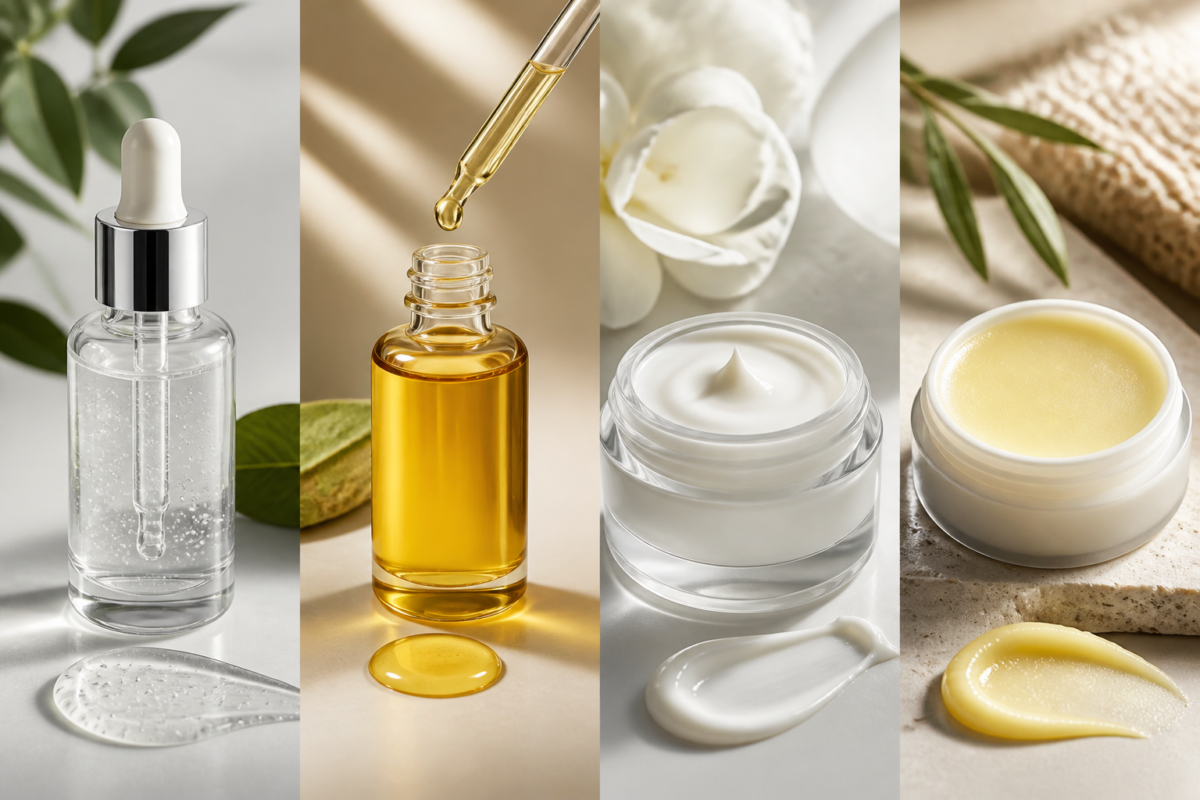
Navigating the world of skincare can feel like learning a new language. Walk down any beauty aisle or scroll through a skincare site, and you’re met with a dizzying array of bottles and jars: serums, facial oils, moisturizers, and balms. They all promise glowing, hydrated skin, but they are fundamentally different products with distinct roles, textures, and ingredients. Using them incorrectly can mean wasting money or, worse, sabotaging your skin’s health.
Key takeaways
- Apply products from thinnest to thickest consistency to ensure active ingredients can penetrate the skin effectively.
- Serums deliver concentrated actives deep into skin, while oils and balms act as seals to prevent moisture loss.
- Always apply facial oils over damp skin or after water-based serums to lock in hydration properly.
- Use balms as targeted treatments for dry areas rather than daily facial moisturizers to avoid clogged pores.
- Select moisturizers by skin type: use gel-creams for oily skin and rich creams for dry skin.
Understanding these differences isn’t just for beauty enthusiasts; it’s the foundation of an effective routine that addresses your specific needs. Is your skin feeling tight and flaky? You might be missing a key layer. Does that luxurious oil leave you feeling greasy? You might be applying it in the wrong order. This guide will break down the science and purpose behind each product type, turning confusion into clarity and helping you build a skincare regimen that truly works.
1. The Lightweight Powerhouse: Understanding Serums
Think of a serum as a targeted treatment, the specialist in your skincare lineup. Its primary role is not to moisturize in the traditional sense but to deliver a high concentration of active ingredients deep into the skin. Formulated with smaller molecules than creams or oils, serums are designed to penetrate the epidermis more effectively to address specific concerns like hyperpigmentation, fine lines, acne, or dullness.
Texture-wise, serums are typically water-based or have a thin, gel-like or liquid consistency. They absorb quickly, leaving little to no residue. Common active ingredients you’ll find include:
- Vitamin C (L-ascorbic acid): A potent antioxidant that brightens skin and protects against environmental damage.
- Hyaluronic Acid: A hydration magnet that can hold up to 1,000 times its weight in water, plumping the skin.
- Niacinamide (Vitamin B3): Improves skin barrier function, reduces redness, and minimizes pore appearance.
- Retinol (Vitamin A): Speeds up cell turnover to reduce wrinkles and improve skin texture.
When to Use It: Apply a serum after cleansing and toning, but before any heavier oils or moisturizers. This allows the actives to penetrate without a barrier. A pea-sized amount is usually sufficient for the entire face. Because they are so potent, it’s wise to patch test and introduce one new serum at a time.
2. The Nourishing Sealant: The Role of Facial Oils
Facial oils are often misunderstood. They are not moisturizers in the classic sense—they do not add water to the skin. Instead, they are emollients and occlusives. Their job is to nourish the lipid barrier of the skin, seal in existing moisture, and provide a protective layer to prevent transepidermal water loss (TEWL).
Oils are lipid-based, derived from plants, nuts, or seeds. They are rich in fatty acids, antioxidants, and vitamins. Their texture can range from lightweight (like squalane or jojoba) to richer (like marula or avocado oil). A good facial oil mimics the skin’s natural sebum, helping to balance oil production over time.
Key Benefits: They reinforce the skin’s barrier, impart a natural glow, and can soothe inflammation. For example, rosehip oil is celebrated for its vitamin A content and scar-fading properties, while tamanu oil has notable healing and anti-inflammatory effects.
When to Use It: The golden rule: oils go after water-based products (like serums) but before or mixed with your moisturizer, depending on your skin’s needs. For dry skin, applying oil before a cream can help lock it all in. For oilier skin, using 2-3 drops mixed into your moisturizer can provide the benefits without a heavy feel. Never apply an oil to a dry face; always layer it over damp skin or a hydrating serum.
3. The Essential Hydrator: Demystifying Moisturizers
This is the workhorse of skincare. A moisturizer’s core function is to hydrate and protect the skin’s surface. It does this through a combination of three types of ingredients:
- Humectants (e.g., glycerin, hyaluronic acid): Draw water from the dermis and the environment into the outer skin layer.
- Emollients (e.g., ceramides, fatty acids): Smooth and soften the skin by filling in the gaps between skin cells.
- Occlusives (e.g., petrolatum, shea butter, dimethicone): Create a physical barrier on top of the skin to prevent moisture loss.
Moisturizers come in various weights: lotions (light, water-based), creams (richer), and ointments (very heavy, occlusive). A good daily moisturizer will balance humectants and emollients, while a nighttime or winter cream may have more occlusive ingredients.
When to Use It: Moisturizer is a non-negotiable final step in your daytime and nighttime routine, after serums and oils. It seals everything in and provides lasting hydration. Choose one based on your skin type—a gel-cream for oily skin, a lotion for combination, and a rich cream for dry skin.
4. The Intensive Problem-Solver: The Power of Balms
Balms are the heavy artillery. They are anhydrous, meaning they contain little to no water. Their base is usually a blend of butters (like shea or cocoa), waxes (like beeswax), and heavy oils, creating a dense, often solid texture that melts upon contact with skin.
Their purpose is intensely protective and reparative. They act as a supreme occlusive barrier, making them ideal for:
- Extremely dry, cracked areas (heels, elbows, lips).
- Soothing irritation, such as windburn or minor scrapes.
- “Slugging”—the practice of applying a thin layer over a nighttime routine to supercharge moisture retention.
Balms are not for everyday all-over facial use for most people, as they can be too occlusive and potentially pore-clogging. They are targeted treatments.
When to Use It: Use a balm as the absolute final step in a routine, or as a spot treatment on very dry patches. A little goes a very long way.
5. Texture and Absorption: Feeling the Difference
The sensory experience is a major differentiator. A serum should sink in almost immediately. A quality facial oil will absorb within a few minutes, leaving a satin—not slick—finish. A moisturizer should feel comforting and disappear, leaving skin soft. A balm will sit on top of the skin, creating a noticeable protective layer.
If a product feels like it’s “sitting” on your skin unpleasantly, you may be using the wrong type for your skin or applying it in the wrong order. Oily skin types might prefer a serum and a light moisturizer, skipping a separate oil, while dry skin might thrive with a serum, oil, and rich cream combination.
6. Ingredient Focus: What Each Product Delivers Best
The formulation dictates what ingredients can be effectively used.
- Serums excel with water-soluble vitamins, peptides, and acids (like AHAs/BHAs).
- Oils are champions for fat-soluble vitamins (A, D, E, K), antioxidants like polyphenols, and nourishing fatty acids (linoleic, oleic).
- Moisturizers are ideal for barrier-repairing ingredients like ceramides, cholesterol, and niacinamide, combined with humectants.
- Balms are perfect for ultra-soothing, occlusive agents like panthenol, colloidal oatmeal, and high-percentage shea butter.
7. Building Your Routine: The Correct Order of Application
The standard rule is to apply products from thinnest consistency to thickest. This ensures each layer can penetrate effectively.
- Cleanser
- Toner/Essence (if used)
- Serum(s) (Water-based first, then any treatment serums)
- Face Oil (Or mix with next step)
- Moisturizer
- Balms & Occlusives (Spot treatment or all-over if needed)
- Sunscreen (AM only, always last step before makeup)
Wait a minute or so between layers, especially between serum and moisturizer, to allow for absorption.
8. Common Mistakes and How to Avoid Them
- Mistake: Using an oil as your moisturizer on dry skin. Fix: Oil seals, it doesn’t hydrate. Always apply it to damp skin or over a hydrating serum/moisturizer.
- Mistake: Applying serum after moisturizer. Fix: The thicker moisturizer will block the serum’s absorption. Serums always go first.
- Mistake: Using a balm all over the face daily. Fix: Reserve balms for targeted, intensive repair or occasional slugging.
- Mistake: Assuming “natural” oils are non-comedogenic. Fix: Coconut oil is highly comedogenic for many. Research oils for your skin type (e.g., squalane, hemp seed oil are good for acne-prone skin).
9. Tailoring Choices to Your Skin Type
- Oily/Acne-Prone: Focus on water-based, non-comedogenic products. A hyaluronic acid serum + a lightweight, oil-free moisturizer (gel-cream) is ideal. Use oils sparingly (2 drops of squalane).
- Dry: You need hydration and occlusion. A hydrating serum + a nourishing oil (like marula) + a rich cream with ceramides. A balm can be used on extra-dry spots.
- Combination: You can layer differently on different zones. Use a lighter moisturizer on the T-zone and a richer one or an oil on the cheeks.
- Sensitive: Minimize actives. Focus on a soothing serum (with centella asiatica), a gentle moisturizer, and a simple oil (like jojoba). Always patch test.
- Mature: Prioritize serums with retinoids or peptides, nourishing oils (rosehip), and moisturizers with strong barrier support.
The Science of Penetration: How Molecule Size and Formulation Dictate Efficacy
Understanding why serums penetrate deeply while balms sit on the surface requires diving into cosmetic chemistry. The vehicle—the base formula that carries active ingredients—determines everything. Water-based serums, often called “hydrophilic” systems, use penetration enhancers like propylene glycol or ethanol to help small, water-soluble molecules (like vitamin C or peptides) bypass the stratum corneum. These systems are designed for rapid absorption, often leaving no trace within minutes. In contrast, the lipid-rich matrix of a facial oil, composed of triglycerides and fatty acids, merges with the skin’s own sebum and lipid bilayers, allowing fat-soluble vitamins (A, D, E, K) and antioxidants to integrate into the cellular membrane structure. This is why applying a retinol serum (water-soluble derivative) feels different from applying rosehip oil (which contains fat-soluble carotenoids and trans-retinoic acid precursors); they’re using different biochemical pathways to achieve similar anti-aging goals.
Moisturizers present a more complex case as oil-in-water or water-in-oil emulsions. The emulsifying agents (like cetearyl alcohol or polysorbate 60) create microscopic droplets that can deliver both hydrophilic humectants and lipophilic emollients simultaneously. The stability of this emulsion affects absorption: a poorly formulated cream might “pill” because the polymers separate, while a well-engineered one creates a uniform film that gradually releases ingredients. Balms, being anhydrous, have zero water activity, which makes them inherently preservative-free but also means they cannot deliver water-soluble actives. Their wax matrix (beeswax, carnauba) melts at skin temperature, creating an occlusive mesh that physically blocks transepidermal water loss but allows minimal active ingredient transfer—hence their designation as protective, not penetrating, agents.
Practical implication: when choosing a product for a specific concern, consider the solubility of the active ingredient. For example, treating hyperpigmentation with vitamin C requires a serum with a low pH (under 3.5) to keep the L-ascorbic acid stable and bioavailable. A vitamin C oil would be ineffective because ascorbic acid isn’t oil-soluble. Conversely, to soothe eczema with anti-inflammatory omega-3s, a sea buckthorn oil (rich in palmitoleic acid) will be more effective than a serum because the fatty acids need that lipid carrier to integrate into the compromised barrier.
Beyond the Basics: Hybrid Formulations and Category Blurring
The modern skincare market is evolving beyond strict categories, creating products that challenge traditional definitions. An “oil-serum” might be a waterless formula where oil is thinned with volatile silicones (like cyclopentasiloxane) to achieve a serum-like spreadability while delivering lipid-soluble actives. A “balm-to-oil” product uses emulsifying waxes that transform from solid to liquid upon application, offering the ritual of a balm with the absorption of an oil. These hybrids create confusion but also opportunities for simplified routines.
Consider the “moisturizing serum”—typically a thicker serum with humectants like sodium hyaluronate crosspolymer or polyglutamic acid that provides temporary hydration but lacks the occlusive elements of a true moisturizer. It’s perfect for oily skin in humid climates where a traditional cream feels suffocating. Then there’s the “face oil mist,” which suspends micro-droplets of oil in an aqueous base with a surfactant, allowing it to be sprayed over makeup for a midday glow boost without disrupting layers underneath. These innovations respond to consumer demand for multi-tasking products but require careful evaluation: does this hybrid actually perform both functions adequately, or is it compromising efficacy for novelty?
When encountering these hybrids, examine the ingredient list hierarchy. If water (aqua) is the first ingredient, it’s fundamentally a water-based product with added oils—prioritize it earlier in your routine like a serum. If plant oils or butters lead the list, treat it as an oil or balm alternative. A true emulsion will have water and oil phases separated by an emulsifier (e.g., “glyceryl stearate SE”) in the top five ingredients. For example, Summer Fridays’ Jet Lag Mask lists water first, then multiple oils and butters, with emulsifiers—making it a rich cream-balm hybrid best used as a final occlusive step despite its marketing as a “mask.”
Climate and Environment: Adjusting Your Layers for External Factors
Your skincare shouldn’t be static—it should respond to humidity, temperature, pollution, and indoor heating/cooling. In arid desert climates (low humidity, high evaporation), the air actively pulls moisture from your skin. Here, skipping humectant-heavy serums without adequate occlusion can backfire: hyaluronic acid may draw water from deeper skin layers rather than the environment, potentially dehydrating you further. The solution is the “sandwich method”: apply a humectant serum to damp skin, immediately follow with a lipid-rich oil (like borage or evening primrose) to create a buffer, then seal with a moisturizer containing occlusives like shea butter or silicones. This creates multiple barriers against moisture loss.
In tropical humidity, the air is saturated with water vapor, making humectants exceptionally effective but also increasing the risk of feeling “sweaty” under heavy products. Switch to a gel-based serum with betaine or glycerin (lighter than hyaluronic acid), skip facial oils entirely or use one drop of squalane mixed with your moisturizer, and choose a mattifying moisturizer with silica or zinc PCA to control shine. Pollution-heavy urban environments add another layer: tiny particulate matter (PM2.5) can penetrate and generate free radicals. Here, antioxidant serums (vitamin C, ferulic acid, resveratrol) become non-negotiable morning shields, followed by a moisturizer with barrier-strengthening niacinamide and a facial oil high in polyphenols (like argan or grapeseed) to reinforce the lipid barrier against pollutant adhesion.
Seasonal shifts demand the most dramatic adjustments. Winter (cold, dry air + indoor heating) calls for a “moisture sandwich” with potentially three layers: hydrating serum, nourishing oil, rich cream. Consider switching from a lotion to a cream with higher oil content, and don’t fear petrolatum-based balms for overnight recovery on cheeks and lips. Summer (heat, humidity, UV exposure) favors lightweight layers: a vitamin C serum, a peptide gel moisturizer, and sunscreen—often eliminating separate oils entirely. Spring/fall transitional periods are ideal for testing new products as skin is less stressed, allowing you to introduce a retinol serum or experiment with a new oil without overwhelming your barrier.
The Budget Breakdown: Where to Invest and Where to Save
Not every product category justifies luxury pricing. Understanding where formulation complexity matters helps allocate your skincare budget strategically. Serums are typically worth the investment because their efficacy hinges on stable, high-quality actives at optimal concentrations and pH levels. A $10 vitamin C serum likely uses unstable ascorbic acid in water without proper antioxidants, turning brown and ineffective within weeks, while a $80 serum may contain L-ascorbic acid at 15% concentration with ferulic acid and vitamin E in an airless pump, remaining potent for months. Similarly, prescription-grade retinoids (tretinoin) outperform over-the-counter retinol serums because they don’t require conversion in the skin—here, medical-grade trumps cosmetic.
Facial oils, however, have a lower barrier to quality. A cold-pressed, unrefined organic oil from a reputable supplier often performs identically to a luxury brand’s “signature blend” at triple the price. The key is purity: look for single-origin oils in dark glass bottles without added fragrance or silicones. Jojoba, rosehip, and squalane oils are commodities where packaging and marketing account for most price differences. Exceptions exist for rare oils (like bakuchiol or tamanu) where extraction methods affect potency, but generally, this category offers high value at mid-range prices.
Moisturizers occupy middle ground. A basic drugstore moisturizer with ceramides, glycerin, and petrolatum (like CeraVe) can outperform a designer cream filled with fragrance and essential oils. However, advanced formulations with patented delivery systems (like Estée Lauder’s ChronoluxCB™ or SkinCeuticals’ Triple Lipid Restore) do offer scientifically validated benefits for barrier repair and anti-aging that justify premium pricing for those with specific concerns. Balms are the simplest category: beeswax, shea butter, and plant oils don’t require advanced technology. A homemade balm with equal parts shea butter, coconut oil, and beeswax performs similarly to most commercial versions, making this an easy area to save.
Smart splurging follows this hierarchy: invest most in treatment serums (especially antioxidants and retinoids), moderately in moisturizers with patented barrier-support technology, save on oils and balms through quality budget brands, and never overspend on cleansers or toners that rinse off. Also consider multi-use products: a facial oil can double as cuticle oil, a balm works for lips and dry elbows, and a hyaluronic acid serum can be mixed with foundation for extra hydration.
Application Techniques: How Method Changes Performance
How you apply these products significantly impacts their efficacy. For serums, the “press and pat” method is superior to rubbing. Pour 3-4 drops into your palm, press hands together to warm, then gently press over face and neck until mostly absorbed. This minimizes waste on fingertips and reduces pulling on delicate skin. For concentrated treatment serums (like retinol or AHA), use the “dot and spread” technique: dot small amounts on forehead, cheeks, chin, and nose, then spread outward gently—this ensures even coverage without over-application in any area.
Facial oils demand warmth for optimal absorption. Place 2-3 drops in your palm, rub hands together briefly to emulsify and warm the oil, then press firmly over skin. The warmth lowers viscosity, helping the oil penetrate rather than sit atop. For oilier skin types, try “oil buffing”: mix one drop of oil with your moisturizer in your palm before application, creating a lighter, combined layer that feels less greasy. Never vigorously rub oils in circular motions; this can spread bacteria and irritate skin.
Moisturizer application varies by consistency. Lightweight lotions and gels can be smoothed over the entire face. Richer creams benefit from the “upward and outward” technique: start at the chin, move upward along jawline to ears, from nose outward to temples, and from forehead center to hairline with gentle upward strokes. This follows lymphatic drainage pathways and reduces downward tugging. For balms, the “warm and tap” method is essential: scoop a pea-sized amount with clean fingertips, rub between fingers to melt, then gently tap onto targeted areas (like cheekbones, lips, or dry patches) until a thin, even film forms. Rubbing a balm creates friction and uneven distribution.
Specialized tools can enhance application. A jade or quartz roller used over serum or oil helps with absorption and depuffing. A silicone applicator for retinol serums prevents finger absorption (ensuring more product reaches your skin) and avoids transferring oils from fingers that could destabilize actives. For those with arthritis or limited dexterity, pump dispensers are preferable to dropper bottles for serums and oils, while spatulas help scoop balms hygienically.
Ingredient Conflicts and Compatibilities: Building Synergistic Layers
Layer intelligently by understanding which ingredients work together and which cancel each other out. The most notorious conflict is between vitamin C (L-ascorbic acid) and niacinamide. Conventional wisdom warned against combining them due to potential niacin formation causing redness, but modern formulations at proper pH levels (vitamin C under pH 3.5, niacinamide at pH 5-7) are generally compatible when applied sequentially with brief drying time between. However, using them in the same product remains risky unless specifically formulated for stability.
More critical conflicts involve pH-dependent actives. Applying an AHA/BHA serum (requires low pH 3-4 for exfoliation) immediately after a higher pH toner (like one with witch hazel at pH 5-6) neutralizes the acid’s effectiveness. Always apply low pH products first after cleansing, wait 15-20 minutes for pH to stabilize, then continue with neutral pH products. Another conflict occurs with peptides and acidic products: copper peptides can be denatured by vitamin C or AHAs, rendering both ineffective. Separate them into morning (vitamin C) and evening (peptides) routines.
Positive synergies create “power pairs” that outperform individual use. Vitamin C + vitamin E + ferulic acid is the gold-standard antioxidant combo, with studies showing the combination provides eight times more photoprotection than vitamin C alone. Apply as a single serum containing all three. Hyaluronic acid + ceramides work sequentially: hyaluronic acid draws water into skin, ceramides in your moisturizer lock it in by repairing the lipid barrier. Retinol + niacinamide is another powerhouse: niacinamide mitigates retinol’s irritation while enhancing barrier repair, making the retinoid more tolerable. Apply niacinamide serum first, wait, then retinol.
Facial oils have natural compatibilities based on their fatty acid profiles. Oils high in linoleic acid (safflower, grapeseed, hemp) complement oily, acne-prone skin and work well with niacinamide serums to regulate sebum. Oleic acid-rich oils (olive, avocado, marula) better suit dry skin and pair effectively with richer creams. For custom blending, mix oils with similar viscosities: lightweight squalane with jojoba, medium-weight rosehip with sea buckthorn, avoiding drastic combinations like thick castor oil with watery camellia that won’t blend evenly.
Shelf Life and Storage: Preserving Potency Across Categories
Each product type has distinct stability concerns. Water-based serums are most vulnerable to oxidation and microbial growth because water supports bacterial life. Vitamin C serums famously oxidize from clear to yellow to brown—once brown, they’ve lost efficacy and may irritate skin. Store all serums in their original opaque or dark glass bottles in a cool, dark cabinet (not the bathroom where humidity fluctuates). Airless pumps are ideal; dropper bottles allow oxygen exposure each use. Most serums maintain potency 6-12 months unopened, 3-6 months after opening.
Facial oils degrade through rancidity (oxidation of fatty acids). Signs include a change in smell (from nutty/grassy to crayon-like or sour), color darkening, or thicker consistency. Cold-pressed oils last 6-9 months after opening; oils with added antioxidants like vitamin E or rosemary extract may last a year. Always store in dark glass bottles in cool temperatures—refrigeration extends shelf life but can cause cloudiness that reverses at room temperature. Never store oils in plastic (which can leach chemicals) or clear glass on sunny windowsills.
Moisturizers, as emulsions, face double jeopardy: water content can breed bacteria while oils can turn rancid. Preservative systems (like phenoxyethanol, potassium sorbate) are essential for safety. Signs of spoilage include separation (oil pooling on top), color change, or foul odor. Jar packaging is worst for creams because fingers introduce bacteria each use; pump or tube packaging is superior. Most moisturizers are stable 12-18 months unopened, 6-12 months after opening.
Balms, being anhydrous, have the longest shelf life—often 2-3 years—because without water, bacteria cannot grow. However, their butters and waxes can still oxidize. Store in airtight containers away from heat (which causes melting and re-solidification that breaks down texture). Label all homemade balms with creation date. Universal rule: if any product changes texture, smell, or color dramatically, or causes new irritation, discard it. Your skin’s health outweighs the cost of replacement.
FAQ: Frequently Asked Questions
Can I use a serum and an oil together?
Absolutely, and they often work synergistically. Apply your water-based serum first to damp skin. Once it has absorbed, press a few drops of oil into your skin. The oil will seal in the hydration and actives from the serum, boosting efficacy and preventing moisture loss.
Do I need a moisturizer if I use a facial oil?
In most cases, yes. Unless you have very oily skin and are using a rich oil in a humid climate, a moisturizer provides the humectant-driven hydration that oils cannot. Think of it as the oil locking in the water that the moisturizer provides. For optimal results, use both.
What’s the difference between a night cream and a balm?
A night cream is a moisturizer, typically richer than a day cream, containing hydrating and reparative ingredients. It is still an emulsion (contains water). A balm is anhydrous and primarily occlusive—it forms a more intense barrier. You might use a night cream every evening and a balm over it on extra-dry nights or as a targeted treatment.
Should I apply skincare to wet or dry skin?
It depends on the step. Cleansing should be done on wet skin. For the treatment steps (serums, oils, moisturizers), apply them to damp skin. Pat your face with a towel after cleansing but leave it slightly moist. This helps humectants in your products pull that water into the skin, dramatically boosting hydration.
How long should I wait between applying different products?
A good rule is to wait 30-60 seconds for thinner products like toners and serums to absorb before moving to the next layer. For treatments like prescription retinoids, waiting 10-20 minutes is often recommended. You don’t need to wait for a moisturizer or oil to “dry” completely—just until it feels tacky, not wet.
Mastering the differences between serums, oils, moisturizers, and balms transforms skincare from a guessing game into a strategic ritual. By selecting each product for its specific strength and applying it in the correct order, you empower your skin to look and feel its healthiest. Listen to your skin’s needs, experiment carefully, and enjoy the journey to finding your perfect, personalized routine.
Related posts:
 Spring Awakening: The Hydrating Serums Your Winter Skin Is Craving
 Proper Order of Skincare Application
 Foundation’s Impact on Skin
 The Best Toners for Acne-Prone Skin That Won’t Strip Your Face
 Rael and Good Chemistry Advanced Antioxidant Serum Review
 The Slow Beauty Movement’s Secret Hydration Recipes
 The Tinted Lip Balm Trend Taking Over Beauty
 Buxom Power-Full Plump Lip Balm