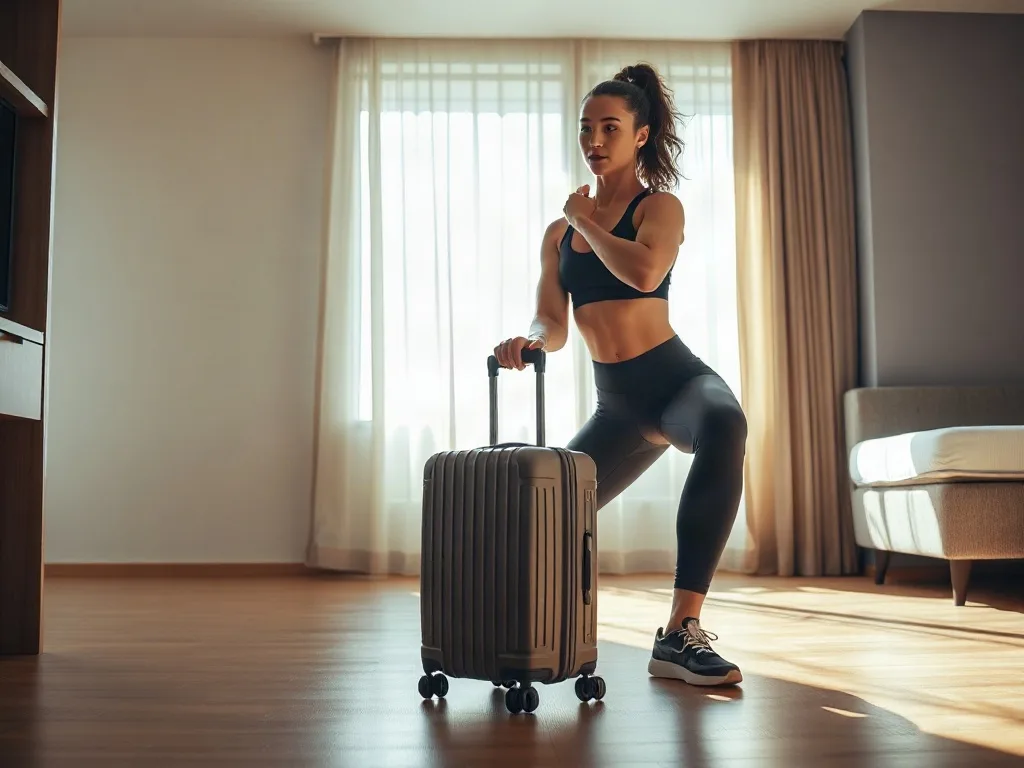
Travel doesn’t have to derail your fitness routine. Whether you’re navigating airport delays, settling into a hotel room, or exploring a new city, your luggage can become an effective piece of workout equipment. This practical approach eliminates excuses and keeps you active anywhere your journey takes you.
Key takeaways
- Use your packed suitcase as a weight for squats, rows, and presses to maintain muscle strength without needing gym access.
- Ensure your suitcase is structurally sound and packed with heavier items centered to keep the weight stable during movements.
- Prioritize safety by clearing adequate space, maintaining proper form, and listening to your body to avoid travel-related injuries.
- Incorporate 15 to 20-minute circuits or micro-workouts to maintain fitness momentum without disrupting your travel schedule.
The beauty of a luggage workout lies in its simplicity and accessibility. You’re already carrying weight—why not put it to use? From resistance training to cardio intervals, your suitcase offers surprising versatility without requiring gym access or specialized equipment.
Why Your Luggage Makes an Ideal Travel Workout Tool
Your suitcase is already part of your travel routine, making it the most convenient workout tool available. Unlike dumbbells or resistance bands that require extra packing space, your luggage serves double duty. A typical carry-on weighs 15-25 pounds when packed, while checked bags can reach 40-50 pounds—comparable to moderate-weight kettlebells or dumbbells.
The irregular shape and weight distribution of luggage actually creates beneficial training challenges. Unlike gym equipment with balanced weight, your suitcase engages stabilizer muscles as you control its movement. This functional fitness approach mirrors real-world activities like lifting groceries or moving furniture, building practical strength you’ll use daily.
Luggage workouts also require zero setup time. No hunting for hotel gyms, no researching local fitness centers, no equipment rental fees. Your hotel room, airport gate area, or park bench becomes your gym. This immediacy removes barriers that typically derail travel fitness intentions.
The psychological benefit shouldn’t be underestimated either. Maintaining your routine while traveling preserves the habit momentum you’ve built at home. Even a 15-minute luggage session signals to your brain that fitness remains a priority, making it easier to resume your full routine when you return.
Essential Safety Considerations Before You Start
Before transforming your suitcase into exercise equipment, assess its structural integrity. Hard-shell luggage with reinforced handles works best for most exercises. Soft-sided bags can work but may shift unpredictably during movement. Check that handles are securely attached and show no signs of wear or loose stitching.
Pack your bag strategically for workouts. Distribute weight evenly throughout the suitcase rather than concentrating it in one area. Place heavier items like shoes or toiletries in the center, surrounded by clothing. This creates a more stable weight distribution and prevents the bag from becoming lopsided during exercises.
Start with a lighter bag if you’re new to resistance training. A 15-20 pound suitcase provides adequate resistance for beginners. More experienced exercisers can work with heavier checked luggage, but always prioritize proper form over weight. Jerking or swinging the bag increases injury risk, particularly to your lower back and shoulders.
Clear adequate space around you, especially in hotel rooms with furniture. You’ll need room to extend your arms fully and step forward or backward without obstacles. Move coffee tables, chairs, or luggage racks to create a safe workout zone. If exercising outdoors, choose level ground away from foot traffic.
Listen to your body throughout the workout. Travel already stresses your system through schedule disruption, time zone changes, and unfamiliar sleeping arrangements. Scale back intensity if you feel unusually fatigued. A moderate workout that you complete safely is more valuable than an aggressive session that leads to injury.
Upper Body Exercises Using Your Suitcase
Transform your luggage into an effective upper body strengthening tool with these targeted exercises. For suitcase rows, stand with feet hip-width apart, hinge forward at your hips while keeping your back straight. Grip the suitcase handle with one hand and pull it toward your ribcage, squeezing your shoulder blade back. Lower with control and repeat for 10-12 repetitions before switching sides. This exercise targets your back, biceps, and core stabilizers.
Overhead presses build shoulder strength and stability. Stand tall with feet shoulder-width apart, holding your suitcase by its handle at shoulder height. Press the bag straight overhead until your arms are fully extended, then lower back to shoulder level. Perform 8-10 repetitions. If your suitcase has two handles, grip both for better balance, or use a single handle to increase core engagement.
For chest flyes, lie on your back on the floor or bed with knees bent. Hold the suitcase with both hands above your chest, arms slightly bent. Lower the bag out to your side in a wide arc until you feel a stretch across your chest, then bring it back to center. Complete 10-12 controlled repetitions. This exercise mimics the dumbbell fly movement pattern while challenging your stabilizers.
Tricep extensions target the backs of your arms. Hold the suitcase handle with both hands and raise it overhead. Keeping your upper arms stationary, bend your elbows to lower the bag behind your head, then press it back to the starting position. Perform 10-15 repetitions. This exercise works particularly well with smaller carry-on bags.
Lower Body Strengthening With Your Luggage
Your legs contain your body’s largest muscle groups, and luggage provides excellent resistance for lower body training. Suitcase squats form the foundation of any lower body routine. Hold your bag by the handle with both hands at chest level, stand with feet slightly wider than hip-width, toes pointed slightly outward. Lower yourself by bending at your hips and knees as if sitting into a chair, keeping your chest up and weight in your heels. Descend until your thighs are parallel to the floor, then press through your heels to return to standing. Complete 12-15 repetitions.
Lunges add balance challenges while targeting quads, glutes, and hamstrings. Hold your suitcase against your chest with both hands. Step forward with your right foot, lowering your body until both knees form 90-degree angles. Your back knee should hover just above the ground. Push through your front heel to return to standing, then repeat on the opposite leg. Perform 10-12 lunges per leg. For variety, try reverse lunges by stepping backward instead.
Romanian deadlifts strengthen your posterior chain—hamstrings, glutes, and lower back. Stand holding your suitcase by the handle with both hands in front of your thighs. With a slight bend in your knees, hinge forward at your hips, lowering the bag toward the floor while keeping it close to your legs. Your back should remain straight throughout the movement. Once you feel a stretch in your hamstrings, drive your hips forward to return to standing. Complete 10-12 repetitions.
Single-leg deadlifts challenge your balance while building unilateral strength. Hold your suitcase in your right hand. Stand on your left leg with a slight knee bend. Hinge forward at your hips, extending your right leg behind you for balance while lowering the suitcase toward the floor. Keep your back straight and hips level. Return to standing by engaging your glutes and hamstrings. Perform 8-10 reps per leg.
Core-Focused Movements for Travel Fitness
A strong core improves posture, reduces back pain, and enhances overall functional fitness—crucial benefits when traveling involves long periods of sitting. Suitcase Russian twists target your obliques and deep core muscles. Sit on the floor with knees bent and feet flat. Lean back slightly to engage your core, holding your suitcase with both hands at chest level. Rotate your torso to the right, bringing the bag toward the floor beside your hip, then rotate to the left. Complete 20 total rotations (10 per side).
Plank pulls combine core stability with upper body engagement. Start in a high plank position with your suitcase positioned just outside your right hand. Maintaining a strong plank, reach your left hand across to grab the suitcase and drag it to the opposite side. Place your left hand back in plank position, then reach across with your right hand to drag the bag back. Continue alternating for 8-10 pulls per side.
Weighted sit-ups intensify traditional core training. Lie on your back with knees bent and feet flat on the floor. Hold your suitcase against your chest with both hands. Engage your core to lift your shoulder blades off the floor, curling your upper body toward your knees. Lower back down with control. Perform 12-15 repetitions. For less intensity, place the bag on the floor and tap it at the top of each sit-up instead.
Standing side bends target your obliques and improve lateral flexibility. Stand tall holding your suitcase by the handle in your right hand, letting it hang beside your leg. Place your left hand behind your head. Slowly bend to the right, lowering the suitcase toward your knee, then engage your left oblique to return to standing. Complete 12-15 bends, then switch sides.
Full-Body Circuit Workouts in Small Spaces
When time is limited, circuit training maximizes efficiency by combining cardio and strength. This 20-minute full-body circuit requires only your suitcase and 6×6 feet of clear space. Perform each exercise for 40 seconds, rest for 20 seconds, then move to the next exercise. Complete the entire circuit three times through.
Begin with suitcase swings for cardiovascular conditioning. Stand with feet shoulder-width apart, holding your bag with both hands. Squat down, then explosively stand while swinging the suitcase from between your legs up to chest height. Control the descent and repeat continuously. This movement elevates your heart rate while engaging your entire posterior chain.
Move directly into alternating reverse lunges with overhead hold. Press your suitcase overhead with both hands and maintain this position while performing reverse lunges, alternating legs continuously for the 40-second interval. This challenges your shoulders, core, and legs simultaneously.
Third, perform push-ups with your hands on the suitcase for an elevated surface. Position your suitcase flat on the floor, place both hands on top, and perform push-ups maintaining a straight line from head to heels. The elevated position slightly reduces difficulty while the unstable surface increases core engagement.
Follow with suitcase high knees. Hold your bag at chest level and perform high knees, driving your knees toward the suitcase with each step. This cardio burst keeps your heart rate elevated between strength movements.
Complete the circuit with plank to downward dog. Start in a high plank with your feet on your suitcase (lying flat). Hold the plank for a breath, then press your hips toward the ceiling into downward dog position, keeping feet on the bag. Return to plank and repeat continuously. This dynamic movement strengthens your core while improving flexibility.
Recovery and Flexibility Work Using Your Luggage
Your suitcase can support recovery practices that reduce muscle soreness and improve mobility. After your workout, use your luggage as a prop for assisted stretching. For a standing hamstring stretch, place one heel on top of your suitcase (laying flat or on its side depending on your flexibility). Keep your supporting leg straight and hinge forward at your hips, reaching toward your elevated foot. Hold for 30 seconds, then switch legs.
Hip flexor stretches counteract the tightness that develops from prolonged sitting during travel. Kneel with your right knee on the floor and left foot flat in front of you, knee bent at 90 degrees. Place your suitcase under your left foot to elevate it slightly, intensifying the stretch through your right hip flexor. Press your hips forward gently while keeping your torso upright. Hold for 30 seconds per side.
For chest opening, lie on your back with your suitcase positioned lengthwise beneath your spine. Extend your arms out to the sides in a T-position and allow gravity to stretch your chest and shoulders. This passive stretch releases tension that accumulates from hunching over phones and laptops during travel. Hold for 2-3 minutes, breathing deeply.
Use your suitcase as a stability aid during balance work. Single-leg balance improves proprioception and ankle stability. Stand on one leg, lightly touching your suitcase handle for minimal support. Close your eyes to increase difficulty. Hold for 30-60 seconds per leg. This exercise prevents ankle injuries and improves overall stability.
Creating Sustainable Travel Fitness Habits
Consistency matters more than perfection when maintaining fitness while traveling. Set realistic expectations based on your schedule. Three 20-minute luggage workouts during a week-long trip beats planning elaborate hour-long sessions you won’t complete. Schedule workouts like any other appointment, ideally first thing in the morning before the day’s plans create obstacles.
Adapt your routine to your energy levels and travel demands. After a long flight, a gentle 15-minute mobility session with basic movements may serve you better than an intense circuit. On days with lighter schedules, push harder with more challenging exercises and longer durations. Flexibility in your approach prevents the all-or-nothing thinking that derails fitness intentions.
Track your travel workouts to maintain accountability and motivation. A simple note in your phone documenting which exercises you completed and how you felt builds a success record. Over time, you’ll notice patterns—perhaps you consistently work out on travel days, or mid-trip sessions boost your energy. Use these insights to optimize your routine.
Combine luggage workouts with other travel activities for efficiency. Do calf raises while brushing your teeth, squats during phone calls, or a quick circuit before your morning shower. These micro-workouts accumulate throughout the day, reducing pressure to find a single dedicated workout block.
Remember that travel fitness serves your overall wellbeing, not just physical goals. Movement reduces travel stress, improves sleep quality despite time zone changes, and provides mental clarity during busy trips. Reframe workouts from obligations to self-care practices that make you feel better, and consistency becomes easier.
Progressive Overload Strategies When Your Luggage Weight Stays Constant
One challenge of luggage-based training is the fixed weight of your packed bag. Unlike adjustable dumbbells, you can’t simply add plates between sets. However, progressive overload—the principle of gradually increasing training stress—remains achievable through strategic modifications that don’t require changing your suitcase weight.
Tempo manipulation provides powerful progression without additional equipment. Slow down the eccentric (lowering) phase of each exercise to 3-4 seconds instead of the standard 1-2 seconds. For suitcase squats, take four seconds to descend, pause for one second at the bottom, then explode upward. This time-under-tension increase creates greater metabolic stress and muscle fiber recruitment despite using the same weight. Your muscles don’t know pounds—they respond to effort and duration.
Isometric holds at peak contraction points intensify any exercise dramatically. During overhead presses, pause for 2-3 seconds when your arms reach full extension. In a plank pull, hold the plank position for five seconds between each drag. These static holds exhaust fast-twitch muscle fibers and build strength at specific joint angles, particularly useful for breaking through plateaus.
Increase exercise complexity by combining movements into compound sequences. Transform basic squats into squat-to-overhead-press combinations, or pair lunges with rotation twists. A curtsy lunge with a suitcase pass-under (transferring the bag beneath your front leg during the lunge) challenges coordination, balance, and multiple muscle groups simultaneously. These hybrid movements elevate heart rate while building functional movement patterns.
Volume progression offers straightforward advancement. If you’re completing 10 repetitions comfortably, progress to 12, then 15, then add an additional set. Expanding from three sets to four or five increases total training volume significantly. For circuit workouts, extend work intervals from 40 seconds to 50 or 60 seconds while maintaining the same rest period. Track these variables in your phone to ensure you’re genuinely progressing rather than repeating identical sessions.
Unilateral training—single-arm or single-leg variations—effectively doubles the challenge without changing weight. A two-handed suitcase row becomes significantly harder when performed with one arm, forcing your core to resist rotation while your working arm pulls. Single-leg Romanian deadlifts with your luggage demand far more from your stabilizers than bilateral versions. These variations expose and correct strength imbalances while increasing difficulty.
Positioning changes alter leverage and muscle emphasis. Perform chest presses with your suitcase at different angles: flat on the floor, on an inclined bed surface, or in a decline position with feet elevated. Each angle targets chest fibers differently. For rows, experiment with underhand grips versus overhand, wide stance versus narrow, or bent-over versus upright positions. Small adjustments create fresh training stimulus.
Addressing Common Form Mistakes and Movement Compensations
Improper form with luggage exercises carries greater injury risk than bodyweight movements due to the external load and awkward object shape. Recognizing and correcting these common mistakes protects your joints while maximizing training effectiveness.
Lower back rounding during hinge movements represents the most frequent and dangerous error. When performing Romanian deadlifts or bent-over rows, many people round their spine to reach lower, especially when fatigue sets in. This lumbar flexion under load compresses spinal discs dangerously. The fix: maintain a neutral spine by engaging your lats to “pull” your shoulder blades down and back, bracing your core as if preparing for a punch to the stomach, and only hinging as far as your hamstring flexibility allows while keeping your back flat. If you can’t reach the floor without rounding, that’s your current range of motion—don’t force it.
Knee valgus—knees collapsing inward during squats and lunges—stresses knee ligaments and reduces power generation. This compensation often occurs because of weak glutes or hip external rotators. Watch for your knees tracking past your toes or diving toward each other. Correct this by consciously pressing your knees outward throughout the movement, imagining spreading the floor apart with your feet. Place a resistance band around your thighs just above the knees during warm-ups to build awareness and activate hip abductors.
Momentum-driven lifting defeats the purpose of resistance training. Swinging, jerking, or using your legs to “cheat” weight upward during upper body exercises reduces muscle engagement and increases injury risk. This happens most often on overhead presses when the weight feels heavy, or during rows when people use their lower back to yank the bag upward. Solution: reduce your repetition speed to a controlled 2-second lift, 1-second pause, 3-second lower. If you can’t complete the movement without momentum, your luggage is too heavy—remove items to lighten it.
Shoulder shrugging during overhead movements causes neck tension and reduces shoulder muscle activation. When pressing your suitcase overhead, many people elevate their shoulder blades toward their ears rather than pressing through the shoulders. This compensation recruits your upper trapezius excessively while underutilizing your deltoids. Fix it by consciously depressing your shoulder blades—think “shoulders down and back”—before initiating the press. At the top of the movement, continue pressing upward to achieve full shoulder flexion rather than stopping when your elbows lock.
Breath-holding during exertion spikes blood pressure dangerously and reduces core stability. The Valsalva maneuver—holding breath against a closed glottis—is appropriate for maximal lifts in powerlifting but unnecessary and risky for moderate resistance training. Breathe continuously: exhale during the concentric (lifting) phase, inhale during the eccentric (lowering) phase. For core exercises like planks, maintain steady breathing rather than holding your breath, which actually reduces core engagement.
Incomplete range of motion cheats your muscles of full development. Partial squats that don’t reach 90 degrees, lunges where the back knee stays high, or rows that don’t bring the bag to your torso all reduce training effectiveness. These shortened ranges often feel easier in the moment but deliver inferior results. Use your full available range of motion on every repetition unless you’re explicitly performing partial reps as an advanced technique. Quality beats quantity—eight full-range squats outperform twenty half-squats.
Nutrition Timing and Hydration for Travel Workouts
Exercise physiology doesn’t change during travel, but practical nutrition challenges multiply. Strategic eating and hydration around your luggage workouts supports performance, recovery, and overall energy during your trip without requiring elaborate meal prep or supplement stacks.
Pre-workout nutrition timing depends on your workout intensity and personal digestion. For moderate morning circuits, many people perform well fasted or with just coffee. If you prefer eating first, consume a small portion of easily digestible carbohydrates 30-45 minutes before training—a banana, a granola bar, or a slice of toast with honey. Avoid heavy, high-fat, or high-protein meals within two hours of working out, as they slow digestion and can cause discomfort during movement. The goal is stable blood sugar without feeling stuffed.
Hydration deserves more attention during travel than at home. Airplane cabin humidity sits around 10-20%, causing significant fluid loss even without exercise. Add a workout, and dehydration becomes likely. Drink 16-20 ounces of water 2-3 hours before your workout, another 8 ounces 20 minutes before starting, and 7-10 ounces every 10-15 minutes during exercise. For sessions under 45 minutes, water alone suffices. Longer or more intense workouts, especially in hot climates, benefit from electrolyte replenishment—pack single-serve electrolyte packets or drink coconut water if available.
Post-workout nutrition accelerates recovery and reduces next-day soreness. The anabolic window—the supposed 30-minute post-exercise period requiring immediate protein—has been largely debunked. You have several hours to refuel effectively. Aim for a meal containing both protein and carbohydrates within 2-3 hours of finishing your workout. A Greek yogurt with fruit, a turkey sandwich, or eggs with toast all support recovery. The protein provides amino acids for muscle repair, while carbohydrates replenish glycogen stores depleted during exercise.
Travel often means restaurant meals with limited control over ingredients. Don’t let imperfect nutrition become an excuse to skip workouts or feel guilty about food choices. A sub-optimal meal still supports recovery better than no meal. Order protein-containing options when possible, include vegetables for micronutrients and fiber, and don’t stress about the preparation method. Your body adapts remarkably well to varied nutrition over short periods.
Alcohol consumption requires consideration around travel workouts. That business dinner wine or vacation cocktails impact recovery more significantly than many realize. Alcohol interferes with muscle protein synthesis, disrupts sleep quality, and promotes dehydration—all counterproductive to fitness goals. If drinking is part of your travel plans, separate it from workout times by at least 3-4 hours, increase water consumption, and avoid training with a hangover. Exercise while impaired or recovering from alcohol is both dangerous and ineffective.
Caffeine can enhance workout performance, particularly useful when training in unfamiliar time zones or after poor sleep. A cup of coffee 30-60 minutes before training increases alertness, reduces perceived exertion, and may improve power output. However, caffeine also acts as a diuretic, so compensate with extra water intake. Skip it if you’re training in the evening, as caffeine’s effects last 5-6 hours and may further disrupt already-compromised travel sleep.
Modifying Workouts for Different Travel Scenarios
Not all trips are created equal. A three-day business conference demands different fitness strategies than a two-week beach vacation or a month-long work relocation. Adapting your luggage workout approach to specific travel contexts increases consistency and relevance.
Business travel with packed schedules requires maximum efficiency. Focus on 15-20 minute high-intensity sessions rather than longer moderate workouts. Circuit training delivers the best return on time investment—you’ll maintain strength, elevate metabolism, and manage stress in less than half the time of traditional split routines. Schedule these sessions immediately after waking, before your day spirals into meetings and obligations. Pack workout clothes at the top of your suitcase the night before, eliminating friction between intention and action. Even if you only manage three weekly sessions during a business trip, that maintains your fitness baseline and preserves your routine identity.
Vacation travel often provides more flexibility but introduces different challenges—later wake times, social meals, alcohol consumption, and the psychological shift away from discipline. Frame vacation workouts as energy boosters rather than obligations. A 20-minute beach or park session with your luggage enhances your day rather than detracting from relaxation. Focus on enjoyable movement—play with exercise variations, try outdoor locations, keep the intensity moderate. Two to three vacation workouts weekly prevents complete deconditioning without creating stress. Remember that walking, swimming, hiking, and other vacation activities contribute to your overall fitness, so formal workouts can be shorter.
Extended travel or temporary relocation justifies more investment in your fitness setup. If you’re spending 3-4 weeks in one location, consider supplementing luggage workouts with minimal additional equipment. A resistance band and a door anchor (both highly packable) exponentially increase exercise variety. Establish a consistent workout schedule as you would at home—same time, same days. Extended trips provide opportunity to build rather than merely maintain fitness, so progress your luggage workout variables more aggressively than during shorter trips.
Multi-city trips with frequent hotel changes require ultra-portable solutions. When you’re packing and unpacking every 2-3 days, elaborate workout planning becomes impractical. Master 2-3 go-to circuits that you can perform anywhere without thinking—a full-body circuit, an upper-body focus, and a lower-body focus. These reliable routines eliminate decision fatigue. Your workout becomes as automatic as brushing your teeth, requiring no mental energy to plan or execute. Consistency beats variety during chaotic travel periods.
Travel with family or colleagues adds social complexity. Early morning workouts avoid schedule conflicts, but if that’s not feasible, invite others to join you. A partner workout with competing suitcases can transform exercise from a solitary obligation into social activity. If working out together isn’t realistic, communicate your fitness priorities clearly. A simple “I’m taking 20 minutes to work out, then I’m all yours” sets expectations and reduces guilt about carving out personal time.
Jet lag significantly impacts workout performance and timing. After crossing multiple time zones, your circadian rhythm and performance capacity misalign. During the first 24-48 hours in a new time zone, keep workouts light—gentle movement, stretching, and easy circuits. Avoid high-intensity training when your body thinks it’s 3 AM. Exercise can actually help reset your circadian clock: working out in the morning local time signals your body to wake up, while avoiding evening exercise prevents further sleep disruption. Prioritize sleep over workouts during severe jet lag—recovery serves you better than forcing exhausted training.
Mental Strategies for Maintaining Motivation Away From Home
Physical capability means nothing without psychological commitment. Travel disrupts your environmental cues and social support systems that normally sustain fitness habits. Understanding the mental game of travel fitness separates those who maintain their routines from those who plan to start again Monday.
Implementation intentions—specific if-then plans—dramatically increase follow-through. Instead of vague goals like “I’ll work out while traveling,” create concrete plans: “If I wake up in my hotel Tuesday morning, then I’ll immediately change into workout clothes and do a 20-minute luggage circuit.” Research shows this simple planning technique doubles the likelihood of behavior execution. Write down your implementation intentions before your trip. When situations are pre-decided, you bypass the moment-of-choice where motivation fails.
Identity-based motivation outlasts goal-based motivation. Instead of “I want to work out three times this week,” reframe to “I’m someone who prioritizes fitness regardless of circumstances.” This subtle shift from doing to being creates stronger behavioral commitment. When deciding whether to work out, you’re not weighing costs and benefits in the moment—you’re acting consistently with your identity. People who maintain travel fitness see themselves as fit people who travel, not travelers who occasionally exercise.
Lower your standards temporarily to maintain consistency. Perfect is the enemy of good, especially during travel. A suboptimal 12-minute workout is infinitely better than skipping entirely while waiting for the perfect 45-minute window that never arrives. Grant yourself permission to do less than your home routine. This isn’t compromise—it’s strategic adaptation. The goal during travel is habit preservation, not performance optimization. You’re practicing consistency under challenging conditions, which strengthens your long-term adherence.
Environmental design shapes behavior powerfully. Place your packed workout clothes on top of your suitcase the night before. Set your alarm 20 minutes earlier than necessary, creating a buffer before your first commitment. Keep your workout area clear of distractions—no phone scrolling, no email checking. These micro-environmental tweaks remove friction between intention and action. Conversely, increase friction for competing behaviors. Put your phone across the room during your workout window, making distraction require deliberate effort.
Accountability mechanisms work even solo. Text a friend or post to social media that you’re working out today. This public commitment increases follow-through. Track your workouts in a simple spreadsheet or app—seeing a streak of completed sessions motivates continuation. Some people benefit from self-contracts: “If I complete four workouts during this week-long trip, I’ll buy that book I’ve wanted.” External accountability or reward systems supplement intrinsic motivation during difficult periods.
Reframe discomfort as information rather than punishment. When your luggage feels heavy during the tenth squat, that’s your muscles adapting and growing stronger. When you’d rather sleep than work out, recognize that feeling as the exact moment your discipline strengthens. Travel workouts aren’t about comfort—they’re about capability. You’re proving to yourself that your fitness commitment transcends convenience. This cognitive reframe transforms workouts from unpleasant obligations into evidence of your resilience.
Separate feelings from actions. Motivation is unreliable and unnecessary. You often won’t feel like working out during travel—you’ll be tired, distracted, or would rather explore. Do it anyway. Action precedes motivation more often than motivation precedes action. Once you start moving, energy and engagement typically follow. The first three minutes are always the hardest. Commit to beginning, and give yourself permission to stop after five minutes if you genuinely want to. You rarely will.
Integration With Bodyweight Training and Hotel Gym Equipment
Your luggage workout toolkit expands exponentially when combined with bodyweight exercises and opportunistic use of hotel facilities. This integrated approach prevents boredom and addresses the limitations of any single training modality.
Superset your luggage exercises with bodyweight movements for efficient full-body sessions. Pair suitcase rows with push-ups: perform 12 rows, immediately drop to 15 push-ups, rest 60 seconds, repeat. This antagonist pairing (pulling then pushing) maintains intensity while allowing each muscle group to recover between sets. Similarly, combine suitcase squats with bodyweight jump squats, or luggage overhead presses with bodyweight dips using a chair. These combinations create greater metabolic demand and cardiovascular benefit than either modality alone.
Many hotel gyms offer limited equipment—perhaps a treadmill, a few dumbbells, and a bench. Use these strategically without abandoning your luggage entirely. Perform your warm-up on the treadmill, complete your main strength work with your suitcase in your room where you have privacy and space, then return to the gym for a finisher—perhaps dumbbell curls and tricep extensions that are difficult to replicate with luggage. This hybrid approach leverages the best of both environments.
Your hotel room itself contains training equipment beyond your suitcase. Chairs enable tricep dips, elevated push-up variations, and step-ups. Beds provide unstable surfaces for plank variations and elevated surfaces for incline or decline presses. Towels create sliders for mountain climbers and hamstring curls on smooth floors. Walls support handstand progressions and wall sits. Combining these found objects with your luggage creates a surprisingly complete home gym experience.
Plyometric exercises—explosive jumping movements—complement luggage work beautifully. After a set of suitcase squats that fatigue your legs with slow, controlled movement, perform 10 bodyweight jump squats or box jumps onto your suitcase (if structurally sound). This post-activation potentiation—performing explosive moves after heavy resistance—enhances power development. The luggage pre-exhausts your muscles, making bodyweight plyometrics feel more challenging and effective.
Isometric bodyweight holds paired with luggage movements create intense combinations. Perform a wall sit while pressing your suitcase overhead repeatedly. Hold a plank position while doing suitcase rows with one arm. These dual-demand exercises drastically increase difficulty without additional equipment. Your stabilizer muscles and core work overtime to maintain the isometric position while your prime movers handle the luggage movement.
Flexibility and mobility work integrates seamlessly. Use your suitcase as a prop for active stretching between sets—stand on it for elevated calf stretches, press it overhead to increase shoulder flexibility during reaching exercises, or place your foot on it during hip flexor lunges. This integrated approach to flexibility ensures you maintain range of motion despite potentially sitting more during travel.
When hotel gyms are genuinely well-equipped, use your luggage workout skills to enhance rather than replace machine training. The functional movement patterns you’ve mastered with awkward luggage improve your stability and control on machines. The mind-muscle connection developed through focused luggage work translates to better engagement during cable exercises or machine presses. Consider your luggage workouts as fundamental movement practice that makes all other training more effective.
Frequently Asked Questions
How heavy should my luggage be for an effective workout?
A suitcase weighing 15-25 pounds works well for most people starting luggage workouts. This weight range provides adequate resistance for toning and strength maintenance without overwhelming your muscles or risking injury. If you’re experienced with resistance training, a 30-50 pound checked bag can offer more challenge. The key is choosing a weight that allows you to complete exercises with proper form for 10-15 repetitions. You should feel muscle fatigue by the final reps but maintain control throughout each movement. If your normal luggage feels too light, strategically pack heavier items like shoes, books, or full toiletry bottles to increase resistance.
Can I really maintain my fitness level with just luggage workouts while traveling?
Yes, you can maintain your fitness level during travel periods of 1-2 weeks using luggage workouts, though results depend on consistency and effort level. Research shows that muscle mass and cardiovascular fitness can be maintained with 2-3 weekly sessions when you work at moderate to high intensity. The key is challenging your muscles sufficiently—performing exercises to near-fatigue, not just going through motions. While you might not make significant strength gains compared to a fully equipped gym routine, luggage workouts effectively preserve the fitness you’ve built and prevent the deconditioning that occurs from travel inactivity. For trips longer than two weeks, consider supplementing with bodyweight exercises or seeking occasional gym access.
What if my hotel room is too small for a full workout?
Small hotel rooms require creativity but rarely prevent effective workouts. Focus on vertical movements and exercises that don’t require lateral space. Overhead presses, squats, lunges in place, planks, and most core exercises fit within a 4×4 foot area. Move the coffee table aside or work in the narrow space between the bed and window. Many exercises can be performed on the bed itself, like lying chest presses or bridges. If your room is genuinely too cramped, scout alternative locations: hotel hallways during quiet hours, fitness center (even without using their equipment), stairwells, pool deck areas, or nearby parks. Even a parking lot corner provides adequate space for a 20-minute luggage circuit.
Is it safe to work out in public areas like airports with my luggage?
Yes, light movement and stretching in airports is increasingly common and generally accepted, though full workouts may draw attention. Many airports now feature dedicated yoga rooms or fitness areas. For general gate areas, stick to subtle exercises like calf raises, standing leg lifts, or seated core twists that don’t require lying on the floor or dramatic movements. Save more intensive exercises for private spaces. Always stay within view of your belongings and avoid blocking pathways or creating safety hazards for other travelers. If you feel self-conscious, airport hotel rooms, if available during layovers, provide privacy for fuller workouts. Focus on mobility and light movement in public spaces, reserving strength circuits for your hotel room or other private locations.
Should I work out before or after long flights?
Light movement before a long flight is generally more beneficial than intense exercise. A 15-minute session of dynamic stretches, bodyweight squats, and gentle mobility work increases circulation, which may reduce the risk of deep vein thrombosis and reduces stiffness during the flight. Avoid exhausting workouts immediately before flying, as they can increase dehydration and fatigue. After landing, let your body adjust for at least a few hours before working out. If you arrive in the morning, a light afternoon session can help combat jet lag by promoting alertness. Evening arrivals are better followed by stretching and rest, saving fuller workouts for the next day. Listen to your body—travel is stressful, and sometimes extra sleep serves you better than exercise.
Related posts:
 Kate Hudson’s Latest Obsession: The High-Energy Workout Called PloyoJam
 Peloton Partners with Hilton
 Grounded: Why Smart Luggage Got Banned and What Travelers Need to Know
 How to Change Your Fitness Routine to Avoid Plateau
 PHA Bodyweight Workout: Efficient Fitness Anywhere, Anytime
 5-Minute Core Blast Workout
 Biggest Suitcases Review
 Audio Workout Apps Taking Over the Gym Scene