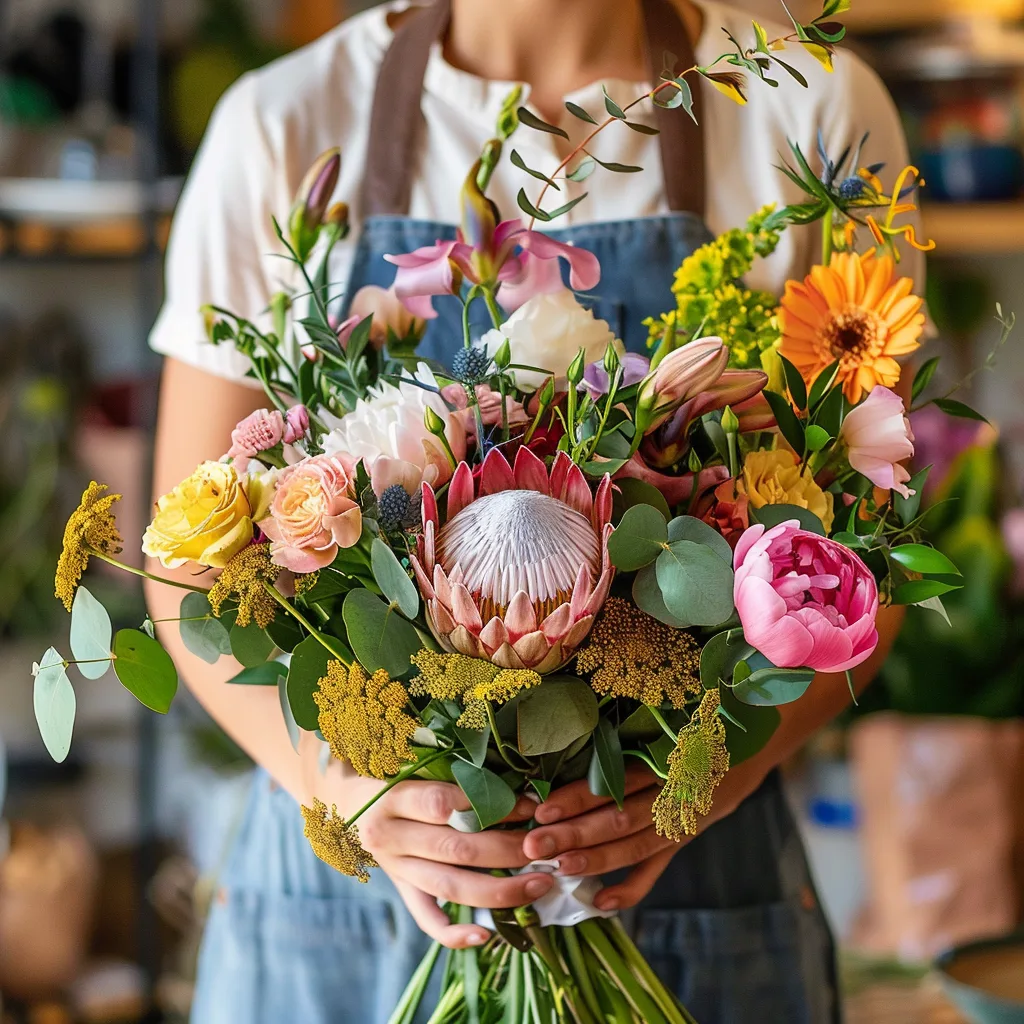
Gathering flowers and plants to create stunning arrangements can be a wonderfully creative and fulfilling hobby. More importantly, it is an act of love – for the natural world that provides such beauty, for loved ones who receive special bouquets, and for our own joy in appreciating the splendor around us.
Choosing Flowers Mindfully
When selecting flowers and greenery for arrangements, consider their sources mindfully. Support local and sustainable growers when possible, or grow your own. Appreciate the ephemeral beauty of each bloom, handling tender petals with care.
Arranging from the Heart
Creating floral designs is a meditative practice. Clear your mind, then let intuition guide your choices of vessels, materials and placement. Do not worry about perfection – instead, focus on conveying warmth and positive energy through your arrangement.
Gifting Arrangements
Presenting floral gifts uplifts both giver and receiver. Choose flowers suiting the recipient’s tastes, and include a personal note expressing your sentiments. Remember that simple bouquets given thoughtfully often bring the greatest joy.
Finding Fulfillment
Regularly take time to appreciate the splendor nature provides through floral arrangements – tiny wildflowers along a path, elegant orchids on the windowsill, a burst of color brightening a room. Finding beauty in small moments cultivates gratitude within our hearts.
Technical Foundations and Structural Integrity
While intuition plays a vital role in floral design, the physical stability of an arrangement relies on sound mechanics. To move beyond the basic “bouquet in a jar,” one must master the invisible structures that hold stems in place. The most versatile tool for the modern, eco-conscious designer is coated chicken wire (floral netting). By crumpling a length of 12-inch wide chicken wire into a loose ball and securing it inside a vessel with waterproof floral tape, you create a multi-dimensional grid that supports stems at various angles. Unlike floral foam, which can be restrictive and environmentally taxing, chicken wire allows for a more natural, airy aesthetic where stems can drink freely from clear water.
For wide-mouthed bowls or shallow compotes, the “grid method” is an essential technique. Using clear 1/4-inch floral tape, create a tic-tac-toe pattern across the rim of the vessel. This grid provides individual pockets for stems, preventing them from flopping to the sides and allowing you to position heavy focal flowers, like peonies or hydrangeas, exactly where they need to stay. An edge case to consider is the use of a Kenzan, or pin frog. This heavy metal spike plate, rooted in the Japanese art of Ikebana, is perfect for minimalist designs where the water and the vessel are part of the visual story. When using a Kenzan, ensure you cut your stems straight across rather than at an angle to provide a secure grip on the pins, and press firmly to anchor the flower.
Another crucial mechanical element is the “anchor point.” When building a large-scale arrangement, start by placing your heaviest or woodiest stems first. These act as a secondary internal skeleton, providing friction and support for more delicate, soft-stemmed flowers that follow. If you are working with top-heavy blooms like amaryllis, consider inserting a thin bamboo skewer inside their hollow stems to prevent buckling. These technical underpinnings ensure that your arrangement not only looks stunning upon completion but maintains its intended shape as the flowers continue to open and shift over time.
The Art of Color Theory and Visual Weight
To elevate an arrangement from a simple collection of flowers to a cohesive work of art, understanding the relationship between colors and their visual weight is paramount. Color theory provides a roadmap for creating specific moods. For a serene, sophisticated look, a monochromatic palette—using various shades, tints, and tones of a single hue—creates immediate harmony. For example, an all-white arrangement can gain depth by mixing creamy ivory roses, bright white ranunculus, and greenish-white hydrangeas. The variation in texture prevents the design from looking flat.
If you desire a more vibrant, high-energy arrangement, look to complementary colors—those opposite each other on the color wheel, such as purple and yellow or blue and orange. The key to successfully using complementary colors is to avoid a 50/50 split, which can feel jarring. Instead, choose one dominant color and use its complement as an accent. An arrangement of deep indigo delphiniums with small pops of buttery yellow pansies feels balanced and intentional. Analogous schemes, which use colors next to each other (like red, coral, and orange), offer a smooth, sunset-like transition that is naturally pleasing to the eye.
Visual weight refers to how much a flower “commands” the viewer’s attention. Darker colors and larger, dense blooms (like dahlias or sunflowers) have more visual weight and should generally be placed lower and more centrally in the arrangement to act as an anchor. Lighter-colored, smaller, or more delicate flowers (like sweet peas or Queen Anne’s lace) have less visual weight and can “float” toward the edges or higher up. If you place a very dark, heavy flower at the very top of an arrangement, it can make the design feel top-heavy and unstable. Balance this by echoing that dark color near the base or by surrounding it with plenty of negative space to soften its impact.
Advanced Conditioning and Post-Harvest Longevity
The longevity of a floral arrangement is determined long before the first stem is placed in a vase. Professional “conditioning” is the process of preparing flowers to maximize their water intake and minimize bacterial growth. Always begin with a “surgical” clean: your vases and tools should be clean enough to eat from. Bacteria are the primary cause of premature wilting, as they clog the microscopic tubes (xylem) that transport water up the stem.
When you bring flowers home, or harvest them from your garden, give every stem a fresh cut at a 45-degree angle. This increased surface area allows for better hydration. For woody stems like lilac or forsythia, a vertical snip up the center of the stem base can further aid water absorption. An often-overlooked step is the removal of all foliage that would sit below the water line. Leaves submerged in water will rot, fueling bacterial blooms that kill the flowers. However, be careful not to strip too much foliage from the upper stem, as leaves are necessary for the “transpiration pull” that helps draw water upward.
Temperature and chemistry also play a role. Most flowers benefit from being placed in lukewarm water initially, as the molecules move faster and are absorbed more easily than in ice-cold water. The exception to this rule is spring bulbs like tulips and hyacinths, which prefer cool water to match their natural growing environment. Using a floral preservative is highly recommended; these packets contain a carbohydrate (sugar) to feed the bloom, an acidifier to balance the pH of the water, and a biocide to kill bacteria. If you run out of store-bought preservative, a tiny drop of bleach and a pinch of sugar can serve as a functional substitute in a pinch. Finally, keep your arrangements away from direct sunlight, heating vents, and—crucially—ripening fruit. Fruit emits ethylene gas, a ripening hormone that causes flowers to drop their petals and age rapidly.
Foraging Ethics and Wild-Harvested Elements
Incorporating foraged materials adds a unique, local character to arrangements that store-bought flowers simply cannot replicate. However, wild-harvesting requires a disciplined approach to ethics and ecology. The golden rule of foraging is the “one-in-ten” principle: never take a plant or bloom unless there are at least ten others of its kind in the immediate vicinity. This ensures that you are not depleting the local population or disrupting the food source for pollinators.
When foraging, timing is everything. Most wild plants are best harvested in the early morning when they are fully turgid (hydrated) from the night air. Bring a bucket of water with you so that stems can be submerged immediately; wild plants lack the resilience of commercially grown varieties and will often wilt beyond recovery if left dry for even ten minutes. Be mindful of the legality of your actions—never forage in national parks or on private property without permission, and avoid harvesting near busy roads where plants may be coated in exhaust particulates or treated with herbicides.
Look for “interest” beyond just the blooms. In the autumn, foraged branches with colorful berries (like bittersweet or beautyberry), dried seed pods, and even interesting grasses can provide the structural “line” of your arrangement. In winter, evergreen boughs and lichen-covered branches offer texture and a sense of place. When bringing foraged items indoors, give them a vigorous shake or a gentle rinse to remove any hitchhiking insects. Foraging allows you to tell a story of the current season and your specific landscape, creating a bridge between your home and the wild world outside.
Sculptural Design: Creating Movement and Negative Space
A common mistake in floral arranging is the “mound” effect, where flowers are packed tightly together into a dense ball. While this can be lush, it often hides the individual beauty of each bloom. To create a truly stunning arrangement, one must embrace negative space—the empty areas between flowers. Negative space allows the eye to rest and gives each flower the room to be appreciated as a sculptural object. Think of your arrangement as a conversation; if everyone is shouting at once, no one is heard. By varying the heights of your stems, you create “rhythm,” leading the viewer’s eye on a journey through the design.
Movement is another hallmark of professional design. This is achieved by using “line flowers” or reaching branches that extend beyond the main body of the arrangement. Use the natural curve of a stem to your advantage. If a stem of jasmine or a tulip has a natural bend, place it so it reaches outward or arches gracefully over the rim of the vase. This mimics the way plants grow in nature—rarely in perfectly straight lines. Creating a “focal point” near the rim of the vase—usually a large, open bloom—serves as the visual heart from which all other elements radiate.
Consider the “360-degree” versus the “one-sided” approach. If the arrangement is for a dining table, it must be beautiful from all angles and kept low enough so guests can see over it. If it is for a mantle or a sideboard, you can focus on a primary “face,” allowing you to use taller, more dramatic stems at the back to create a sense of theater. Experiment with “layering”: place some flowers deep within the arrangement and others poking out further. This creates a sense of three-dimensional depth that invites the viewer to look closer and discover hidden details nestled among the leaves.
Navigating the Florist Relationship for Custom Commissions
When you aren’t making the arrangement yourself, ordering from a professional requires a specific vocabulary to ensure the result matches your vision. Instead of simply asking for “something pretty,” use descriptive terms that define the style. “Garden-style” or “organic” suggests a loose, airy arrangement with lots of greenery and varying heights. “Biedermeier” or “compact” indicates a dense, formal, and often geometric pattern. “Lush and moody” might signal a preference for deep, saturated colors like burgundy and plum with minimal greenery.
Trust is the most important component of the relationship with a florist. Often, the best results come from providing a color palette and a budget, then asking for “Designer’s Choice.” This allows the florist to use the freshest, highest-quality blooms available that day, rather than forcing them to use a specific flower that might be out of season or of poor quality. If you have a specific flower in mind, such as peonies or dahlias, be aware of their seasonality; asking for peonies in November will either result in a very high price tag for imported stems or a disappointed expectation.
When ordering for a gift, provide the florist with a few details about the recipient’s personality or their home decor. Do they prefer modern minimalism or classic Victorian abundance? This helps the designer choose a vessel and a style that will resonate. Also, clarify the delivery logistics—ensure there is a safe place for the flowers to be left if the recipient isn’t home, or provide a phone number so the driver can coordinate. A well-communicated commission results in a floral gift that feels bespoke and deeply personal, reflecting the care you took in ordering it.
Sustainable Mechanics and Eco-Friendly Alternatives
As we become more aware of our environmental footprint, the floral industry is shifting toward more sustainable practices. Traditional green floral foam, while convenient, is a non-biodegradable plastic that breaks down into microplastics and contains formaldehyde. Transitioning away from foam is one of the most impactful changes a floral enthusiast can make. Beyond chicken wire and pin frogs, consider using “shredded wood” or even reusable glass marbles to provide stem support in clear vases.
Sustainability also extends to the flowers themselves. “Slow Flowers” is a movement that encourages buying local and seasonal blooms to reduce the carbon footprint associated with international shipping. Imported flowers are often treated with heavy pesticides to meet strict import regulations; by choosing local growers or organic certified stems, you are supporting healthier ecosystems and getting a product that often smells much better, as many commercial roses have had their scent bred out in favor of durability. You can also look for the “Fair Trade” or “Veriflora” certifications, which ensure ethical labor practices and environmental stewardship.
Finally, think about the “afterlife” of your arrangement. When the flowers begin to fade, don’t simply toss the entire thing in the trash. Compost the organic material, and save the vessel and any mechanical aids like wire or frogs for your next creation. Some flowers, like hydrangea, protea, and many types of eucalyptus, dry beautifully. By hanging them upside down in a dark, dry place, you can extend the life of your arrangement indefinitely as a dried installation. Embracing these sustainable habits ensures that our love for floral beauty doesn’t come at the expense of the natural world that inspires us.
FAQ
Where do I find flowers and supplies?
Check your local flower shops, nurseries, and even grocery stores for fresh-cut stems and supplies like vases, foam, and floral tape. Also consider foraging or growing your own materials.
How much do supplies cost?
Costs vary, but you can likely find basic supplies quite affordably, especially if recycling vases and containers from home. Focus more on finding beautiful, healthy blooms than expensive vessels.
What are good flowers for beginners?
Durable classics like roses, carnations, chrysanthemums, and baby’s breath work well for beginners. Play with different heights, shapes and colors to find pleasing combinations.
How do I arrange flowers?
Start by anchoring sturdy focal flowers, then intersperse complementary shapes and textures. Layer gradually outward from the center to create full, balanced designs. Remember – your unique creative vision is what matters.
Who would enjoy receiving floral arrangements?
Truly, anyone can be uplifted by receiving thoughtfully crafted bouquets – friends, family members, coworkers, mentors, neighbors. Spread beauty through floral gifts whenever the spirit moves you.
Related posts:
 Ina Garten’s Flower Arranging Tips
 Handmade Ceramic Vases for the Perfect Spring Home Update
 Blooming Beautiful: China’s Incredible Floral Transformation
 Drew Barrymore’s Cruelty-Free Beauty Line Hits Major Stores
 Budget-Friendly Flower Arranging Tips
 How to Dry Fresh Flowers for Everlasting Beauty
 The Floral Experts Behind Drybar’s Flowers Share Their Tips on Keeping a Fresh Bouquet Longer
 California’s Super Bloom Creates Once-in-a-Lifetime Photo Opportunities