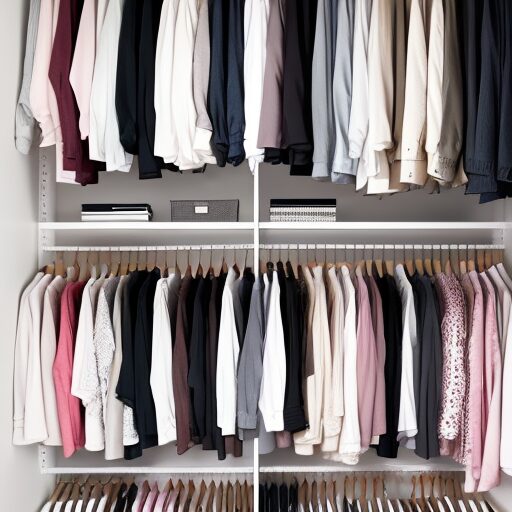
Organizing your closet by color can be an aesthetically pleasing way to bring harmony to your wardrobe. However, it may not work for everyone’s lifestyle or closet space. This article explores the pros and cons of color-coordinating your closet so you can decide if it’s right for you.
Key takeaways
- Sort clothing by category first before arranging each group into specific color families or gradients.
- Arrange items from light to dark, placing whites on the left and deeper tones like black on the right.
- Install high-CRI LED lighting to help distinguish between similar dark shades like navy, charcoal, and black.
- Use consistent hangers in a single style to minimize visual clutter and highlight the color-coded system.
- Place patterned garments into sections based on their dominant background color to maintain a cohesive visual flow.
Benefits of Organizing by Color
Grouping clothing by color has some potential advantages:
- Creates a visually appealing, rainbow effect when you open your closet doors.
- Makes it fast and easy to find a top or bottom in your desired hue.
- Allows you to see what colors you actually own and identify gaps in your wardrobe.
Drawbacks of Color Coordination
However, there are also a few downsides to consider with this approach:
- Can be time-consuming upfront to sort every item.
- Limits outfit mixing and matching across color families.
- Requires frequent re-sorting as new items are added.
- Might not suit everyone’s closet space or organizational style.
Tips for Organizing by Color
If you want to give color-coordinating a try, here are some tips:
- Sort clothes first by clothing category, then color. Group all tops, bottoms, dresses, etc.
- Use divider shelves, bins, or dividers to separate color groups clearly.
- Hang longer items and fold delicate fabrics prone to slipping off hangers.
- Place the neutrals, blacks, whites, and patterns section closest to the door for easy outfit assembly.
Alternative Organizing Options
Color isn’t the only way to organize your closet. Consider these other options if color-coding isn’t for you:
- By season – Best for areas with major seasonal weather shifts. Group by spring/summer and fall/winter clothing.
- By occasion – Helpful if your wardrobe varies greatly by occasion – work, weekend, formalwear, etc.
- By item type – Simple approach grouping all tops, bottoms, dresses, outerwear, etc.
- By frequency of use – Place favorites and most-worn items in prime spots for easy access.
Mastering the ROYGBIV Gradient for Professional Wardrobes
Transitioning from a chaotic closet to a professional gradient requires more than just grouping hues; it requires a systematic approach to saturation and depth. Start by organizing your clothing into light-to-dark gradients within each color family. Place your pastels, creams, and whites at the left, moving toward deeper, richer tones like navy, charcoal, and black on the right. This creates a visual anchor that prevents the eye from becoming overwhelmed. For those with a large number of patterned items, create a dedicated ‘bridge’ section between color blocks. These items often contain multiple hues, making them difficult to place in a single color category. By grouping patterns by their dominant background color, you maintain the flow of the gradient while ensuring your statement pieces remain accessible.
The Psychology of Color Zoning and Morning Efficiency
Your closet layout can fundamentally alter your morning mood. If you struggle with decision fatigue, consider ‘color zoning’ based on your emotional needs. Reserve one section of your closet for ‘power colors’—bold reds, deep blues, or structured blacks—that you wear for high-stakes meetings or events. Conversely, designate a ‘soft zone’ for loungewear, cozy knits, and muted earth tones. By placing these zones in different areas of your closet, you stop viewing your wardrobe as a single mass of fabric and start seeing it as a toolkit for your day. If you are prone to rushing, keep your most frequently paired outfit combinations in a ‘ready-to-wear’ zone, regardless of their color, to minimize the time spent hunting for matching pieces during the early morning rush.
Managing the Edge Cases: Metallics, Neon, and Prints
Every wardrobe contains outliers that defy standard color sorting. Metallics, neons, and complex prints often disrupt the visual harmony of a perfectly curated gradient. For metallics (golds, silvers, and coppers), treat them as neutrals; they pair well with almost anything and can serve as the ‘hinge’ between cool and warm color blocks. Neons, however, should be treated as high-impact accents. If you have a large collection of brights, place them at the very end of your spectrum or keep them in a separate ‘special occasion’ section to prevent them from washing out the visual impact of your core wardrobe. When dealing with loud prints, use a ‘neutral background’ rule: if a print is primarily navy, it sits with your blues. If it is a chaotic mix, hang it at the end of the category to act as a transition point between color families.
Seasonal Rotation and Color Maintenance
Color organization is dynamic, not static. If you live in a climate with distinct seasons, your color palette will naturally shift from light linens and bright florals in the summer to heavy wools and dark, muted tones in the winter. Rather than re-sorting your entire closet four times a year, utilize a ‘rotating focal point’ strategy. Keep your current-season clothing at eye level and in the center of the closet, organized by color. Move out-of-season items to the periphery or upper shelving. By keeping the current season front and center, you reduce the visual noise of items you won’t wear for months, making it easier to maintain your color-coded system without feeling like you are constantly fighting against an overcrowded space.
Hardware and Lighting: The Technical Side of Color
The success of color organization is heavily dependent on the quality of light within your closet. If your closet is tucked into a dark corner, a color-coded system may look muddy and fail to help you distinguish between navy and black or charcoal and brown. Install high-CRI (Color Rendering Index) LED strip lighting along the interior frame of your closet to ensure that colors appear true to life. Furthermore, consider the consistency of your hangers. When you mix wire, plastic, and velvet hangers, the visual clutter distracts from the color gradient you have worked so hard to establish. Standardizing your hangers to a single color or material creates a clean, uniform ‘spine’ for your clothing, allowing the colors of the garments themselves to take center stage.
Integrating Accessories into Your Color Spectrum
Once your primary garments are settled, extending the color-coding to your accessories can turn a closet into a functional boutique. For handbags and footwear, utilize clear acrylic shelving or uniform boxes with labels. Arrange these items in the same gradient order as your clothing—whites and creams, then tans and browns, moving toward blacks. If you have an extensive jewelry collection, use a drawer insert with color-coded velvet trays. This approach is particularly useful for gold versus silver pieces. By aligning your accessories with the color-coding of your clothing, you eliminate the ‘mismatch’ risk where a warm-toned belt might inadvertently be paired with cool-toned shoes, ensuring that every element of your ensemble feels intentional and cohesive.
FAQ
What are the benefits of organizing your closet by color?
Organizing by color can give you a visually pleasing rainbow effect in your closet, make it easy to find items in a certain color family, and help you identify gaps or redundancies in your wardrobe across hues.
What are some drawbacks to color-coordinating?
It can be very time consuming to initially sort everything, may limit mixing and matching outfits across colors, requires frequent resorting when adding new items, and might not suit those with small or packed closets.
How exactly should I group my clothes by color?
First sort clothing by category into tops, bottoms, dresses, etc. Then organize each group by color using dividers or separate sections – either hung or folded neatly. Place neutrals and patterns near the front for easy grabbing.
What if organizing by color doesn’t work for my closet?
No problem! Other options include grouping by season, occasion, item/garment type, or frequency of use instead. Choose whatever makes the most sense for your personal wardrobe and lifestyle needs.
Should I organize my accessories by color too?
It’s up to you! Some people enjoy color-coordinating all their accessories like shoes, jewelry, and handbags as well for a cohesive look. But if you have limited space or overflowing accessory collections, it may be better to just focus on your clothing for color organization instead.
Related posts:
 Kristen Bell’s Closet Organization
 Old Navy’s Hygge Sock Sale Is the Black Friday Deal Your Feet Need
 The Unspoken Rules of Group Chat Etiquette Everyone Should Know
 Spring Capsule Wardrobe
 Best Minimalist Clothing Brands
 Tips to Declutter and Organize Your Closet Once and For All
 Green Fashion Face-Off: H&M’s Fall Collection vs. Truly Eco-Friendly Brands
 Accessories and Athletics: Do They Go Together?