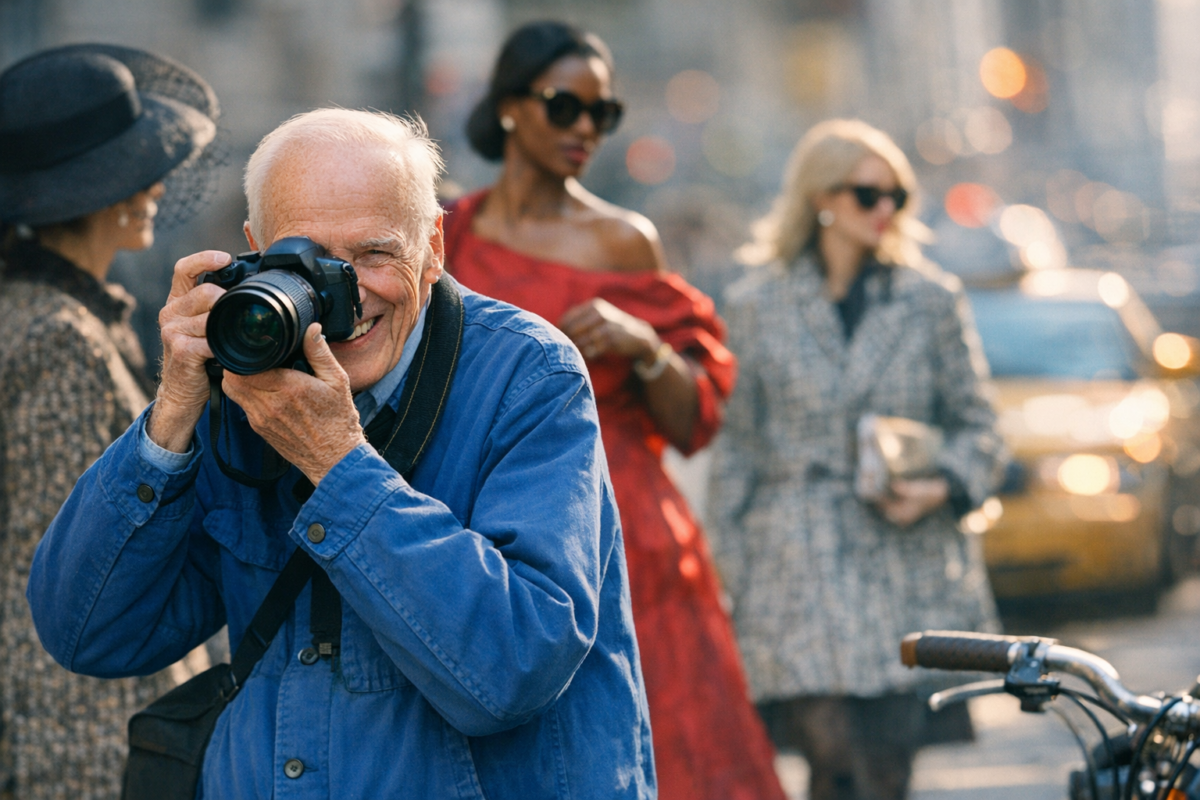
For decades, if you walked the streets of Manhattan, you might have spotted a slender man in a signature blue outfit, pedaling a bicycle with a camera slung over his shoulder. He didn’t seek the spotlight; in fact, he spent most of his life avoiding it. Yet, this man, Bill Cunningham, became one of the most influential figures in the history of fashion. He didn’t design clothes, nor did he run a fashion house. Instead, he looked at the world—specifically the sidewalks of New York City—and saw a living, breathing gallery of human expression.
Bill Cunningham was more than a photographer for The New York Times; he was a visual sociologist who understood that true style is not dictated by the elite in Parisian ateliers, but by the individuals who navigate the urban jungle. By shifting the lens from the runway to the pavement, Cunningham democratized fashion, proving that a perfectly paired vintage scarf or a bold choice of footwear on a random Tuesday could be as significant as a couture gown. His legacy is woven into every street-style blog and Instagram feed we scroll through today.
The Early Years and the New York Times
Bill Cunningham’s journey into the heart of New York fashion was not an overnight success. He joined The New York Times in 1978, but his vision was far ahead of the editorial standards of the time. At that point, fashion coverage was largely restricted to the high-society circles and the official runways of the major fashion houses. The idea of photographing strangers on the street and presenting their attire as a worthy subject of journalistic inquiry was unheard of.
For years, Cunningham fought an uphill battle to get his “On Street” photographs published. He spent his days cycling through the city, documenting the eclectic mix of residents, but the editors were often skeptical. They viewed fashion as something that descended from the top down—from the designer to the consumer. Cunningham argued the opposite: that style often rose from the bottom up. He believed that the people wearing the clothes were the ones who gave them meaning and life.
Eventually, his persistence paid off. The “On Street” column became a staple of the Times, and Cunningham became a legendary figure in his own right. He didn’t just capture clothes; he captured the essence of New York City. He documented the changing seasons not through weather reports, but through the appearance of the first cashmere coat or the emergence of bright summer sandals. His work became a historical record of the city’s evolving aesthetic, capturing the intersection of class, culture, and individuality.
The Philosophy of Street Style: Fashion for Everyone
At the core of Bill Cunningham’s work was a profound belief in the democracy of style. To Bill, fashion was not about the price tag or the brand name; it was about the way something was worn. He was famously indifferent to the prestige of a garment if it lacked a certain “spark” or a sense of personal narrative. He could be equally captivated by a billionaire in a bespoke suit and a street vendor with a uniquely draped shawl.
This philosophy challenged the gatekeeping of the fashion industry. For a long time, the “correct” way to dress was defined by a small group of editors and designers. Cunningham dismantled this hierarchy. He showed that a person’s intuition and creativity were the ultimate authorities on style. By documenting “real people,” he validated the idea that everyone has the potential to be a fashion icon if they have the courage to express themselves.
His approach was rooted in an intense respect for the individual. He didn’t just take a photo; he observed the relationship between the person and their clothing. He noticed how a particular hat framed a face or how a pair of boots changed a person’s gait. This focus on the human element is what separated his work from mere catalog photography. He wasn’t selling clothes; he was documenting the human condition through the medium of textile and silhouette.
The “Uniform” and the Disciplined Life
Ironically, the man who spent his life celebrating the diversity of others’ wardrobes lived a life of extreme minimalism and discipline. Bill Cunningham was famous for his own “uniform.” He almost always wore a blue French worker’s jacket, blue trousers, and comfortable sneakers. This was not a lack of interest in fashion, but rather a strategic choice. By wearing a consistent, unobtrusive outfit, he became invisible—a ghost in the machinery of the city.
Cunningham’s discipline extended far beyond his clothing. He lived in a small apartment that was essentially a meticulously organized archive of his photographs. He avoided the social whirl of the fashion world, rarely attending the parties and galas where the people he photographed spent their time. He preferred the solitude of his work and the purity of the observation. This detachment allowed him to maintain an objective eye; he was an observer, not a participant.
His primary tool was his bicycle, which served as his mobile studio. The bicycle allowed him to move quickly through traffic, pivot instantly when he saw something intriguing, and navigate the city with a fluidity that a car could never provide. His life was a masterclass in intentionality. Every element of his routine—from the route he cycled to the way he filed his negatives—was designed to maximize his ability to see and record the world around him.
The Art of Observation: How Bill Saw the World
What made Bill Cunningham truly exceptional was his eye. He possessed a rare ability to spot a trend long before it reached the mainstream. He didn’t look for what was currently popular; he looked for what was happening. He noticed the subtle shifts in color palettes, the gradual change in the width of a lapel, or the sudden emergence of a specific accessory among a certain demographic of New Yorkers.
His process was one of deep, patient observation. He would often spend hours in a single location, watching the flow of people. He looked for contradictions—a formal dress paired with rugged boots, or a vintage military jacket worn with modern jewelry. These contradictions were where the “style” lived. He understood that the most interesting fashion happens when rules are broken or blended in unexpected ways.
Cunningham’s work also taught us about the rhythm of the city. He documented the “seasonal transition,” a period he obsessed over. He would track the exact day the city shifted from autumn to winter, noting who was the first to embrace the cold and who clung to the warmth of the previous season. In doing so, he turned the act of dressing into a dialogue with nature and environment, showing that fashion is a response to the world we inhabit.
Breaking the Barrier: From Runways to Sidewalks
Before the rise of digital media, the runway was the only place where the public could see the “future” of fashion. The runway was a controlled environment, a fantasy world where clothes were presented in a vacuum. Bill Cunningham broke this barrier by bringing the fantasy into the reality of the street. He proved that the most exciting innovations in fashion often happen organically, driven by necessity, rebellion, or pure creativity, rather than by a corporate design calendar.
By elevating street style to the pages of a prestige publication like The New York Times, he shifted the power dynamic of the industry. He signaled to designers that they should look to the streets for inspiration, rather than the other way around. This shift paved the way for the contemporary fashion landscape, where “streetwear” has become a dominant force in luxury fashion. The blurring of lines between high fashion and everyday wear that we see today—where sneakers are worn with suits and hoodies are seen on runways—is a direct evolution of the world Bill Cunningham documented.
Furthermore, his work highlighted the diversity of the city. He didn’t stick to the wealthy neighborhoods of the Upper East Side; he ventured into every borough, documenting the style of diverse ethnic communities and subcultures. He recognized that style is a universal language, capable of crossing boundaries of race, age, and socioeconomic status. In his lens, the street was the ultimate equalizer.
Lessons in Curiosity and Persistence
The life of Bill Cunningham offers several profound lessons for anyone seeking to find their own voice or passion. First and foremost is the value of unwavering curiosity. Bill never stopped asking “Why is that person wearing that?” or “What does this choice say about them?” He treated every stranger as a potential story. In a world that often encourages us to stay in our bubbles, Bill’s life reminds us that there is an endless amount of beauty and interest to be found in the people around us if we simply choose to look.
Secondly, his career is a testament to persistence. He spent years being told that his work wasn’t “fashion” enough for the paper. He didn’t change his vision to fit the mold; he waited for the world to catch up to his vision. This kind of intellectual and artistic stamina is rare. He trusted his eye more than he trusted the prevailing opinions of his superiors, and that conviction is what eventually changed the industry.
Finally, Bill taught us the power of anonymity and humility. Despite his fame in his later years, he never sought the celebrity status that often accompanies fashion icons. He remained the man on the bike. He showed that you can have a massive impact on a culture without needing to be the center of attention. His work was always about the subject, never about the photographer. This humility allowed him to remain a pure observer, untainted by the ego that often clouds artistic judgment.
The Legacy of the “Street Style” Movement
It is impossible to imagine the modern fashion ecosystem without the influence of Bill Cunningham. Every time a photographer snaps a photo of a well-dressed person outside a fashion show, or a blogger posts a “Look of the Day,” they are operating in a tradition that Bill established. He transformed the act of people-watching into a legitimate form of cultural criticism.
The rise of social media, particularly Instagram and Pinterest, has essentially scaled Bill’s vision to a global level. We now have a constant, real-time stream of street style from Tokyo, London, Seoul, and New York. However, there is a key difference between the modern “influencer” era and the Cunningham era. While modern street style is often curated for the camera—designed to be photographed—Bill captured style in its natural habitat. He captured the unplanned, the authentic, and the accidental.
His legacy also lives on in the way we perceive personal identity. By celebrating the “misfits” and the bold dressers, he gave people permission to experiment. He taught us that clothes are not just coverings, but tools for storytelling. Whether it’s through the revival of vintage pieces or the mixing of disparate genres, the modern spirit of eclectic dressing owes a debt to the man who saw the poetry in a mismatched outfit on a rainy Manhattan afternoon.
How to Adopt a “Cunningham Eye” in Your Own Life
While few of us are professional photographers, we can all apply the principles of Bill Cunningham’s observation to our own lives to enhance our creativity and appreciation for the world. Adopting a “Cunningham Eye” is about shifting from passive seeing to active observing.
- Practice Mindful Observation: Next time you are in a public space—a cafe, a train station, or a park—put away your phone. Spend ten minutes simply observing the people around you. Look for the small details: the way a sleeve is rolled, the texture of a bag, or the color of a shoe. Ask yourself what these choices say about the person’s mood or personality.
- Embrace the “Wrong” Choice: Bill loved contradictions. Try experimenting with your own style by pairing two things that “shouldn’t” go together. Mix a formal piece with a casual one, or pair a vintage item with something ultra-modern. The goal isn’t to follow a rule, but to see how the contrast creates a new energy.
- Value Authenticity Over Trends: Instead of buying what is currently trending on social media, look for pieces that resonate with your personal history or identity. Ask yourself: “Do I like this because everyone else does, or because it feels like me?” True style, as Bill proved, is an internal conviction manifested externally.
- Document Your Surroundings: You don’t need a professional camera to be a historian of your own life. Keep a visual journal or a folder of images that inspire you—not because they are “perfect,” but because they are interesting. Notice the patterns of your city and how they change with the seasons.
- Cultivate Quiet Curiosity: Approach strangers with a sense of wonder. Recognize that every person you pass is the protagonist of their own complex story, and their outward appearance is often a clue to that narrative.
The Technical Alchemy of the Street Snap
While the world focused on the results of Bill Cunningham’s work, the process was a masterclass in technical agility and precision. He didn’t utilize the heavy lighting rigs or the controlled environments of studio photography; instead, he relied on a lean, rapid-response toolkit. For much of his career, Cunningham favored 35mm film cameras, specifically utilizing the portability of Nikon and Leica systems. His goal was never a perfectly staged portrait, but a “decisive moment”—a concept borrowed from Henri Cartier-Bresson but applied to the specific geometry of clothing.
The technical challenge of street photography is the unpredictability of light and movement. Cunningham mastered the art of the “snap,” capturing subjects in mid-stride or during a fleeting glance. He understood that a person’s style is most authentic when they are in motion—the way a coat swings during a brisk walk or the way a scarf flutters in the wind. To achieve this, he often shot with a wide aperture to isolate the subject from the chaotic New York backdrop, creating a shallow depth of field that made the clothing pop against the urban blur.
Perhaps the most critical, yet overlooked, part of his technical process was the crop. Cunningham was a meticulous editor of his own frames. He didn’t just take a photo; he sculpted it. He would often crop his images tightly to remove distracting street signage or pedestrians, focusing the viewer’s eye entirely on the silhouette and the textile. This editing process transformed a candid snapshot into a curated fashion study, stripping away the noise of the city to highlight the signal of the style. This discipline ensured that the garment remained the protagonist of every image, regardless of how cluttered the original scene had been.
The Social Contract of the Sidewalk
Photographing strangers in a city as guarded as New York requires a specific kind of social diplomacy. Cunningham developed a unique rapport with his subjects that was based on genuine admiration rather than professional entitlement. He didn’t approach people as a journalist seeking a story, but as a fan of their creativity. His approach was often a sudden, breathless compliment: “You look wonderful!” or “That color is magnificent!” This immediate validation broke the ice, turning a potential intrusion into a moment of shared appreciation.
There was a delicate psychological dance involved in his work. Some subjects were terrified of the camera, while others—especially those who dressed with intention—secretly hoped to be noticed by the man in the blue jacket. Over time, a “Cunningham Effect” emerged; people began to dress specifically in the hope of being captured by him. This created a fascinating feedback loop where the observer began to influence the observed. However, Bill remained discerning. He was not fooled by “costume”—clothing worn solely for the sake of attention. He looked for a harmony between the wearer’s personality and their attire, often ignoring those who were over-dressed for the sake of vanity.
An interesting edge case in his methodology was his treatment of the ultra-famous. When photographing celebrities or high-fashion designers on the street, he treated them with the same detached curiosity as he did a random passerby. He didn’t grant them special status; if their outfit lacked the “spark” he sought, he simply kept pedaling. This egalitarian approach reinforced his philosophy that the sidewalk was the ultimate equalizer, where the only currency that mattered was aesthetic intuition.
The Ritual of the Seasonal Shift
For Bill Cunningham, the changing of the seasons was not a meteorological event, but a textile one. He treated the transition from autumn to winter, or spring to summer, as a high-stakes cultural ritual. He obsessed over the “first day” of a season, tracking the exact moment the city’s collective wardrobe shifted. This wasn’t just about temperature; it was about the psychology of anticipation. He would document the first person to dare to wear a bright summer dress in a chilly April, or the first cashmere wrap to appear in a sudden October cold snap.
This obsession turned his work into a seasonal calendar for New Yorkers. His columns often served as a subtle guide on how to navigate the city’s volatile weather with grace. He looked for the “transitional piece”—the light trench coat, the versatile loafer, or the strategic layer—that allowed a person to bridge the gap between two climates. By documenting these shifts, he highlighted the resilience and adaptability of the urban dweller, showing that fashion is fundamentally a response to the environment.
Example of his seasonal observation: Bill would often spend entire days stationed at a single corner, watching for the emergence of specific colors. He noticed how the city’s palette shifted from the muted greys and browns of winter to the sudden, jarring pops of neon or pastel in the spring. He viewed these color shifts as a barometer for the city’s mood. To Bill, the first appearance of a yellow raincoat wasn’t just a practical choice for a rainy day; it was a signal of hope and a visual break from the monotony of the concrete jungle.
The Living Archive: A Study in Obsession
While Bill was a ghost on the streets, his home was a cathedral of order. His apartment was less of a living space and more of a meticulously curated museum of his life’s work. The contrast was stark: the chaos of Manhattan’s streets was distilled into a system of rigid, obsessive organization. Every photograph, every negative, and every scrap of note was filed with an intensity that bordered on the religious. He lived in a state of constant archival maintenance, ensuring that every moment he captured was preserved for posterity.
His filing system was legendary among those few who saw it. He didn’t just organize by date; he organized by theme, color, and garment type. He could retrieve a photo of a specific type of hat from 1984 almost instantly. This level of organization allowed him to spot long-term trends that other fashion historians missed. By looking back through his archives, he could see the cyclical nature of style—how a silhouette from the 1950s would subtly reappear in the late 1990s, often before the designers themselves realized they were reviving it.
This archival obsession speaks to his view of fashion as a historical record. He understood that a photograph of a woman in a specific coat in 1982 was not just a fashion statement, but a document of that era’s social class, economic status, and cultural aspirations. His apartment was a physical manifestation of his belief that the “ordinary” is actually the “extraordinary” when viewed through the lens of time. He didn’t just save photos; he saved the visual DNA of New York City.
Decoding the “Cunningham Subject”
To understand Bill’s eye, one must analyze who he chose to photograph. While he is often associated with the chic elite of the Upper East Side, his true passion lay in the “eccentrics.” He was drawn to the people who used clothing as a form of armor or a tool for rebellion. He sought out the individuals who blended disparate worlds: the elderly woman wearing a couture gown with sensible orthopedic shoes, or the young artist mixing high-end luxury labels with thrift-store finds.
He had a particular affinity for the “invisible stylish”—people who didn’t fit the conventional beauty standards of the fashion world but possessed an innate sense of proportion and color. He recognized that style is often a survival mechanism or a way of asserting identity in a city that can feel dehumanizing. By photographing these individuals, he expanded the definition of beauty, suggesting that true elegance comes from the confidence of the wearer rather than the cost of the garment.
p>One of the most compelling aspects of his subject selection was his interest in the intersection of culture and clothing. He documented the way different ethnic communities in New York integrated traditional garments with modern urban wear. Whether it was a beautifully draped sari paired with a leather jacket or a traditional West African headwrap worn with a business suit, Bill saw these blends as the most exciting form of fashion. He recognized that the street is where cultural dialogues happen, and clothing is the language they use to communicate.
The Dialogue Between the Street and the Atelier
Bill Cunningham’s work created a revolutionary feedback loop that fundamentally altered the design process. Traditionally, fashion followed a linear path: the designer created a vision, the runway presented it, and the consumer eventually adopted it. Bill introduced a circularity to this process. By publishing street style in The New York Times, he provided designers with a real-time mirror of how their clothes were actually being worn—and, more importantly, how people were modifying them.
Designers began to realize that the “wrong” way a customer wore a garment was often more interesting than the “right” way it was presented on a model. If Bill photographed ten different women wearing a specific skirt with a chunky sweater instead of the intended silk blouse, designers took note. This shift encouraged a move toward more functional, versatile clothing. The rise of “effortless” style—the idea that luxury should look lived-in and unstudied—is a direct result of the street-level authenticity that Bill championed.
Frequently Asked Questions
Who was Bill Cunningham?
Bill Cunningham was a legendary street style photographer for The New York Times. He is credited with pioneering the concept of street style photography, shifting the focus of fashion from high-end runways to the everyday people of New York City. He spent decades cycling through Manhattan, capturing the diverse and eclectic ways people dressed in the urban environment.
Why was Bill Cunningham’s work considered revolutionary?
His work was revolutionary because it democratized fashion. Before Cunningham, fashion was seen as a top-down industry where designers dictated trends. Cunningham showed that style often emerges from the streets and that ordinary people could be the primary innovators of fashion. He validated personal expression and individuality over brand prestige.
What was Bill Cunningham’s personal style?
Bill Cunningham famously wore a “uniform” consisting of a blue French worker’s jacket, blue trousers, and sneakers. This minimalist approach allowed him to blend into the background and remain an unobtrusive observer while he photographed others. His commitment to this simple attire contrasted sharply with the flamboyant styles he often documented.
How did Bill Cunningham influence modern fashion social media?
The current obsession with street style on platforms like Instagram and the existence of street-style blogs are direct descendants of Cunningham’s work. He established the idea that the sidewalk is a runway and that documenting real-world attire is a valuable form of fashion journalism. However, he focused on authentic, unplanned moments rather than the curated images common today.
What can we learn from Bill Cunningham’s approach to life?
Cunningham’s life teaches us the importance of curiosity, persistence, and authenticity. He remained true to his artistic vision despite initial rejection, lived a disciplined and intentional life, and found profound beauty in the mundane. His legacy encourages us to look closer at the world around us and to value individuality over conformity.
Related posts:
 Sustainable Fashion at the Oscars
 How to Apply Color Street Nails Like a Pro
 Green Fashion Face-Off: H&M’s Fall Collection vs. Truly Eco-Friendly Brands
 Inside Gregory’s Coffee Founder’s Surprisingly Healthy Fridge
 California Passes Landmark Recycling Bill to Combat Plastic Waste
 Vashti Cunningham’s Journey to the Tokyo Olympics
 NYC After-Hours Work Bill
 Prince Harry’s Pre-Wedding Wellness Journey