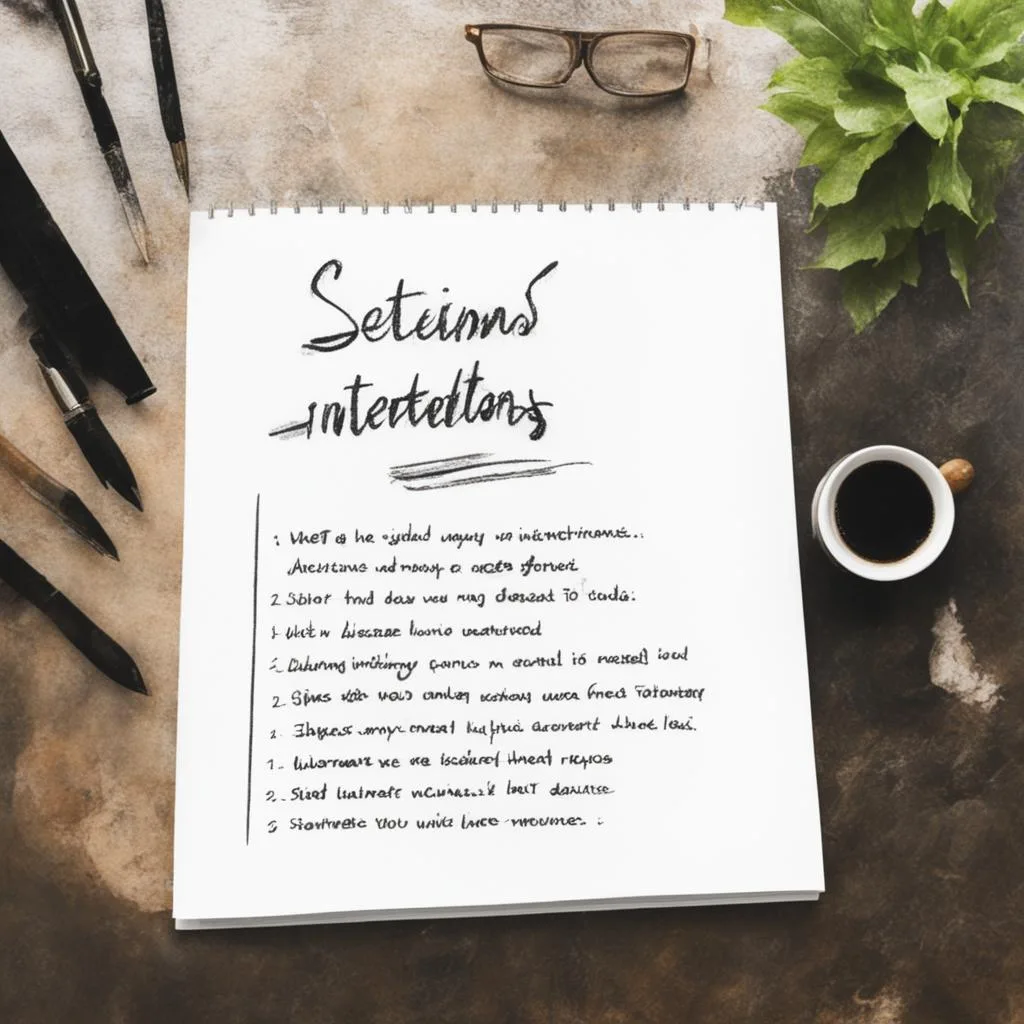
What Are Intentions and Why Set Them?
Setting an intention means deciding consciously how you would like to show up or what qualities you’d like to embody. Intentions serve as an internal compass to guide our thoughts, words and actions.
Research shows that setting intentions can help improve our well-being. Intentions help us focus on what matters most and how we’d like to move through the world. Pausing to clarify our intentions grounds us in purpose and meaning.
How to Set Intentions with Self-Compassion
- Start by getting centered and grounded through a few deep breaths.
- Check in on how you’re feeling emotionally and physically.
- Identify an intention that reflects a quality or way of being you’d like to embrace more fully.
- Phrase your intention in the positive (how you want to feel and act vs what you want to avoid).
- When crafting your intention, speak to yourself as you would a good friend.
Setting intentions isn’t about forcing ourselves to think or feel certain ways. It’s about gently guiding ourselves with wisdom, care and understanding when we stray off course.
Examples of Compassionate Intentions
- I intend to be patient with myself when challenges arise
- I intend to speak my truth while also considering others’ perspectives
- I intend to make decisions aligned with my values
By setting intentions rooted in self-compassion, we can nurture the qualities we wish to grow.
Revisiting Your Intentions
Checking in on your intentions periodically helps reinforce them. You might reflect on:
- How am I feeling in relation to this intention today?
- When did I embody this intention? When did I stray from it?
- Do I need to adjust this intention or my approach to setting it?
Adjust your process with care and compassion. Intentions aren’t commandments to be followed perfectly. They are guides to walk with gently on our ever-unfolding journey.
The Neurobiology of Conscious Priming
Setting an intention is more than a spiritual or psychological exercise; it is a neurological process known as priming. When you clearly articulate an intention, you are essentially programming your Reticular Activating System (RAS)—the bundle of nerves at our brainstem that filters out the millions of bits of data we encounter daily. By holding a specific quality, such as “presence” or “curiosity,” in your conscious mind, you are instructing your RAS to highlight opportunities in your environment that align with that state of being. For instance, if your intention is to practice active listening, your brain becomes more sensitive to subtle non-verbal cues from others that might have otherwise slipped past your awareness. This shifts your brain from reactive mode—where you are at the mercy of external stimuli—to proactive engagement, allowing you to curate your lived experience rather than merely enduring it.
Designing Micro-Rituals for Daily Integration
An intention often loses its potency when it remains a vague abstract thought. To transform an intention into a tangible reality, anchor it to existing habits through micro-rituals. If your intention is to cultivate gratitude, anchor this to the act of pouring your first cup of coffee. As the water hits the beans, use those sixty seconds to silently name three specific things you are grateful for. By stacking your intention onto a physical trigger, you eliminate the mental friction of remembering to “be intentional.” Other effective anchors include the moment you sit down at your desk, the act of putting on your seatbelt, or the second your feet touch the floor upon waking. These transition points serve as natural portals where you can pause, reset, and re-align your internal state with your stated purpose.
Navigating the Gap Between Intention and Action
It is common to feel a sense of failure when our external actions fail to match our internal intentions. This is the “intention-action gap.” When you find yourself acting in contradiction to your stated goal—for example, snapping at a colleague despite intending to be patient—it is vital to treat the discrepancy as data rather than a moral failing. Instead of spiraling into self-criticism, investigate the physiological state that preceded the lapse. Were you hungry, tired, or overwhelmed? Often, our intentions are sound, but our nervous system is dysregulated. Acknowledging this connection allows you to pivot from shame to strategy. You might adjust your intention to include the physical maintenance required to sustain your desired behavior, such as: “I intend to prioritize rest so that I have the capacity to be patient.”
The Power of Somatic Anchoring
We often treat intentions as purely cognitive, but they are most effective when they are felt in the body. Somatic anchoring involves assigning a specific physical sensation or posture to your intention. If your intention is to embody strength, notice how your posture changes when you feel strong—shoulders back, chest open, steady breathing. When you feel yourself slipping into a state of anxiety or avoidance, consciously return your body to that anchor. By physically mimicking the state you wish to embody, you tap into the feedback loop between the body and the mind. Your brain receives signals from your physiology that confirm you are, in fact, capable of the quality you have set. This is a powerful tool for self-regulation during high-pressure scenarios where your mind might otherwise be clouded by stress.
Distinguishing Intentions from Outcome-Based Goals
Confusion often arises when we treat intentions like to-do lists. A goal is a destination with a specific outcome (e.g., “Finish this project by Friday”), whereas an intention is the quality of the journey (e.g., “I intend to work with focus and integrity”). The danger of goal-fixation is that it often leads to burnout and a sense of defeat if the external result is delayed or changed by circumstances beyond our control. Intentions, by contrast, are always within your jurisdiction. You can be rejected for a job, but you can still succeed in your intention to be courageous in the interview. By decoupling your sense of self-worth from external outcomes and re-attaching it to the quality of your presence, you build a sustainable internal foundation that remains intact regardless of fluctuating external success.
The Role of Environmental Design
Your environment acts as a silent partner to your intentions. If you intend to be more mindful but your workspace is cluttered with digital notifications and physical distractions, you are setting yourself up for an uphill battle. Environmental design involves consciously shaping your space to act as a physical reminder of your intentions. This might mean placing a small stone on your desk as a tactile reminder of “groundedness,” setting an alarm for a midday check-in, or unsubscribing from newsletters that trigger feelings of inadequacy. By curating your surroundings, you reduce the willpower required to stay on track. When your environment supports your intention, you spend less energy resisting distractions and more energy flowing into the state of being you have chosen to cultivate.
Related posts:
 Setting Positive Intentions
 3 Intentions to Set Today
 Embodying Our Intentions: Guiding Principles for 2022 And Beyond
 Your Weekly Horoscope for New Moon Energy
 Beautiful Journals That Make Setting Intentions Feel Like Art
 This Wellness Consultant Says You Should Focus on Intentions, Not Just Resolutions
 Spring New Moon Reset Ritual: Connecting with Earth’s Energy
 How to Be Clear About Your Intentions