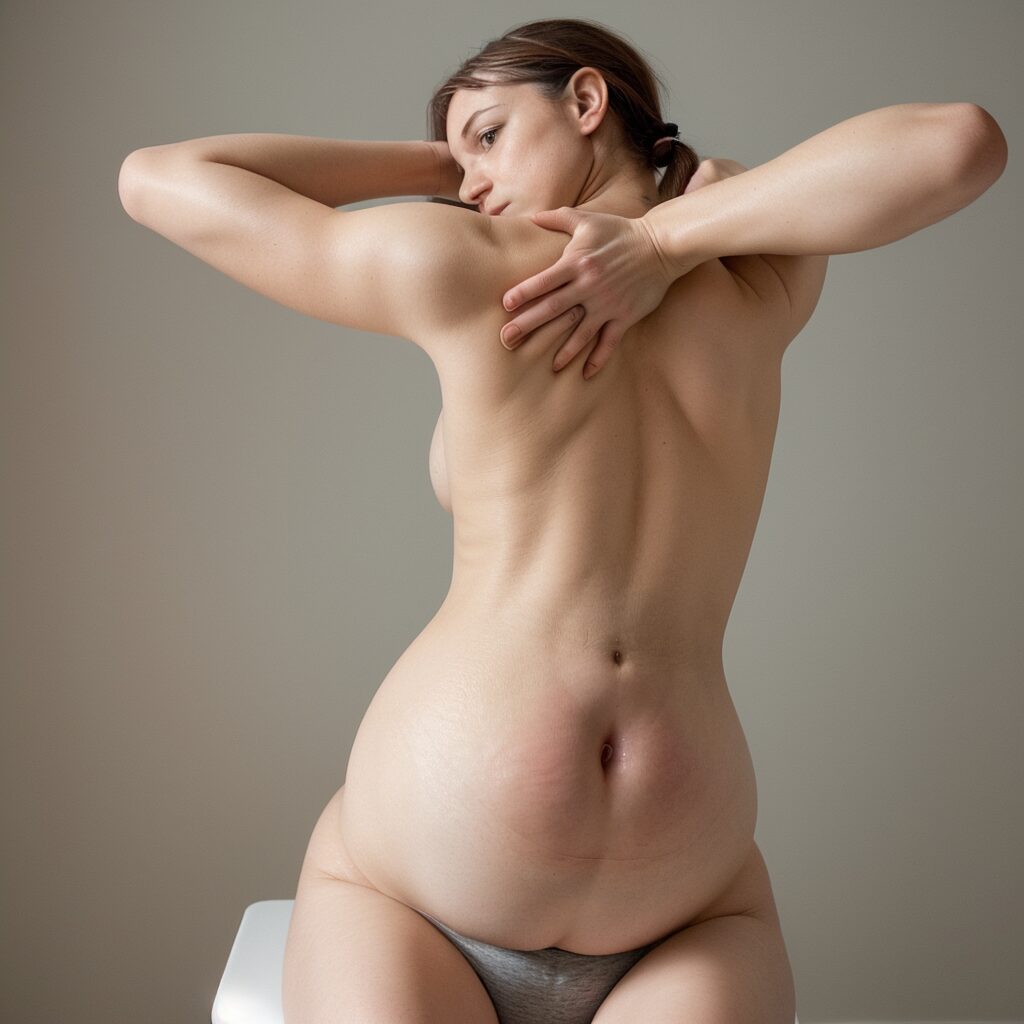
During pregnancy, many women experience lower back pain due to the extra weight and changes in their body. Incorporating targeted stretches into your daily routine can help alleviate this discomfort. Here are some effective stretches for lower back pain during pregnancy.
1. Cat-Cow Stretch
The cat-cow stretch is a gentle way to stretch your back and warm up your spine.
- Start on your hands and knees in a tabletop position.
- Inhale, arch your back, and lift your head and tailbone towards the ceiling (cow position).
- Exhale, round your back, and tuck your chin to your chest (cat position).
- Repeat 10-15 times, moving slowly and gently.
2. Child’s Pose
Child’s pose is a restorative yoga pose that can help relieve lower back pain.
- Kneel on the floor with your big toes touching and knees spread wide apart.
- Sit back on your heels and extend your arms forward, lowering your torso between your thighs.
- Rest your forehead on the ground and relax your shoulders.
- Hold this position for 30 seconds to a minute, breathing deeply.
3. Pelvic Tilts
Pelvic tilts can strengthen the abdominal muscles and relieve lower back pain.
- Lie on your back with your knees bent and feet flat on the floor.
- Flatten your back against the floor by tightening your abdominal muscles and tilting your pelvis up slightly.
- Hold for a few seconds, then release.
- Repeat 10-15 times, focusing on controlled movements.
4. Seated Forward Bend
The seated forward bend stretches the lower back and hamstrings.
- Sit on the floor with your legs extended straight in front of you.
- Inhale, lengthen your spine, and sit up tall.
- Exhale, hinge at your hips and reach for your toes, keeping your back straight.
- Hold for 20-30 seconds, breathing deeply.
5. Hip Flexor Stretch
Stretching the hip flexors can also help alleviate lower back pain.
- Kneel on one knee with the other foot in front of you, creating a 90-degree angle with both legs.
- Shift your weight forward slightly until you feel a stretch in the front of your hip.
- Hold for 20-30 seconds, then switch sides.
Deep Core Integration and the “Core Breath” for Lumbar Stability
While stretching provides immediate relief, the root of lower back pain during pregnancy often lies in the shifting relationship between your deep abdominal muscles and your pelvic floor. As your uterus expands, the transverse abdominis (the deepest layer of your core) stretches and weakens, placing a heavier load on the lumbar spine. To support your stretches, you must integrate the “Core Breath,” a foundational technique that stabilizes the spine from the inside out.
To perform the Core Breath, sit tall on a firm chair or a birthing ball. Inhale deeply through your nose, allowing your ribs to expand 360 degrees and your pelvic floor to relax downward. As you exhale through pursed lips, imagine you are gently drawing your belly button toward your spine—not by sucking in, but by “hugging” your baby with your muscles. Simultaneously, perform a gentle pelvic floor lift (Kegel). This coordination ensures that when you perform movements like the pelvic tilts mentioned earlier, you are protected by a functional internal corset. Practice this for 2 to 3 minutes before starting your stretching routine to prime the nervous system for stability.
In cases where the lower back feels “locked,” this breathing technique can be combined with a seated pelvic clock. Imagine you are sitting on a clock face; gently shift your weight to 12 o’clock (pubic bone drops), then 6 o’clock (tailbone drops), then 3 and 9 (side to side). This micro-movement, powered by the breath, lubricates the sacroiliac (SI) joints, which often become hypermobile and painful due to the hormone relaxin.
Standing Wall Stretches for Workplace and On-the-Go Relief
Many pregnant women find that getting down onto a yoga mat becomes increasingly difficult as they enter the third trimester. Standing stretches using a wall for support offer a practical alternative that can be done anywhere, from the office to the kitchen. The Standing Wall Downward Dog is particularly effective for lengthening the entire posterior chain without the intensity of a traditional floor-based inversion.
Stand about two feet away from a wall, facing it. Place your palms on the wall at chest height, then slowly walk your feet back while hinging at the hips. Keep your feet hip-width apart or wider to accommodate your belly. Continue walking back until your torso is parallel to the floor and your body forms an “L” shape. Press your palms firmly into the wall and reach your sit-bones toward the back of the room. This creates a traction-like effect on the lower back, gently decompressing the vertebrae. If you feel a pinch in your shoulders, widen your hand placement. Hold for 5 to 10 deep breaths, focusing on sending the air into the back of your ribcage.
Another excellent standing option is the Wall-Assisted Side Lean. Stand sideways to the wall, about an arm’s length away. Place the hand closest to the wall against it for balance. Reach the opposite arm up and over your head, leaning toward the wall. This stretches the quadratus lumborum (QL), a deep back muscle that often becomes chronically tight as it tries to stabilize the pelvis. By lengthening the side body, you create more vertical space for your internal organs and reduce the lateral pull on your lumbar spine.
Addressing the Glutes and Piriformis to Combat Sciatica
A significant portion of lower back pain in pregnancy is actually referred pain from the glutes and the piriformis muscle. As your center of gravity shifts forward, your glutes often “clench” to keep you upright, which can compress the sciatic nerve. This leads to sharp, shooting pains or a dull ache in the buttocks that radiates down the leg. The Seated Figure-Four stretch is a safer, more accessible version of the Pigeon Pose for pregnant bodies.
Sit on the edge of a stable chair with your feet flat on the floor. Lift your right ankle and rest it across your left thigh, just above the knee. If your belly allows, gently lean forward with a flat back until you feel a deep stretch in your right glute. If your belly is in the way, simply staying upright and gently pressing down on the right knee may be sufficient. Hold for 30 seconds, then switch sides. For an edge case where balance is an issue, this can also be performed lying on your back (if you are still comfortable in a supine position) by hugging the opposite thigh toward your chest, though the seated version is generally preferred for late-stage pregnancy to avoid vena cava compression.
To further release the glutes, consider a standing glute release using a tennis ball or massage ball. Lean against a wall and place the ball between the wall and the fleshy part of your buttock. Gently roll until you find a “trigger point” or a sore spot. Hold the pressure there for 20 seconds while breathing deeply. This myofascial release helps the muscle fibers relax, which in turn reduces the forward pull on the sacrum and eases lower back tension.
Thoracic Mobility: Relieving the Upper Back to Protect the Lower
It is a common misconception that lower back pain should only be treated at the site of the pain. During pregnancy, the increase in breast weight and the forward pull of the belly often cause the upper back (thoracic spine) to round excessively. When the thoracic spine becomes stiff, the lower back has to overcompensate by becoming too mobile, leading to instability and pain. Improving thoracic rotation and extension is vital for long-term back health.
The “Open Book” stretch is a gentle way to address this. Lie on your side with your knees bent and a pillow supporting your head. Stack your arms in front of you, palms touching. Inhale as you lift your top arm up and over to the other side, following your hand with your gaze. The goal is to reach your top shoulder toward the floor behind you without letting your knees separate or slide. This creates a beautiful rotation through the middle of the back. If your knees feel strained, place a pillow or yoga block between them to keep the pelvis neutral. Exhale as you bring the arm back to the starting position. Repeat 8 to 10 times on each side.
For those who prefer a seated option, try the “Seated Goalpost” stretch. Sit tall and bring your arms up to a 90-degree angle, like goalposts. On an inhale, pull your elbows back slightly and lift your chest toward the ceiling, looking up gently. On the exhale, bring your elbows and palms together in front of your face, rounding your upper back. This dynamic movement ensures the thoracic spine stays supple, preventing the “hunched” posture that cascades into lower back strain.
Lateral Body Lengthening and Rib Cage Expansion
As the baby grows, the rib cage actually expands outward to make room. This can cause the intercostal muscles (between the ribs) and the obliques to become tight, which indirectly pulls on the fascia of the lower back. Lateral stretches help maintain the elasticity of the torso, providing more “give” as the pregnancy progresses. The Gate Pose (modified for pregnancy) is an exceptional tool for this.
Kneel on a soft mat. Extend your right leg out to the side with your foot flat on the floor or toes pointing away. Keep your left knee directly under your hip. Place your right hand on your right thigh for support. Reach your left arm up toward the ceiling and then lean toward the right leg. Imagine you are breathing into the left side of your lungs, expanding the space between each rib. This stretch targets the latissimus dorsi and the obliques, which are often overlooked in back pain protocols. Hold for 5 breaths, then switch sides. If kneeling is uncomfortable for your knees, this can be done standing by simply stepping one foot out to the side and reaching over.
Another variation is the Seated Side Stretch on a birthing ball. Sitting on the ball provides a dynamic base that allows for small pelvic oscillations while you stretch. Reach one arm over your head and lean, while the other hand holds the side of the ball for stability. The slight bouncing or swaying motion on the ball can help the nervous system relax, making the stretch more effective than a static hold on a hard chair.
Navigating Joint Laxity and the Risks of Overstretching
One of the most critical aspects of stretching during pregnancy is understanding the influence of the hormone Relaxin. This hormone increases the flexibility of your ligaments to prepare the pelvis for birth, but it is not site-specific; it affects every joint in your body. This means it is very easy to overstretch and cause joint instability, particularly in the sacroiliac (SI) joints and the pubic symphysis. When performing any of the stretches mentioned, you should never push to your absolute maximum range of motion.
Instead, aim for about 70% of your maximum stretch. If you feel a sharp, stabbing pain in the center of your pubic bone or deep in the back of your pelvis, stop immediately. This may be a sign of Symphysis Pubis Dysfunction (SPD) or SI joint instability. In these cases, asymmetrical stretches (like the Hip Flexor Stretch or Gate Pose) might need to be modified. To keep the pelvis stable, focus more on “active” stretching—where you engage the muscles you are stretching slightly rather than just passively hanging into the joint. For example, in a hamstring stretch, gently press your heel into the floor to engage the muscle while it lengthens.
Additionally, be mindful of the “rebound effect.” Sometimes a stretch feels great while you are doing it, but the body responds by tightening up even further an hour later because the nervous system sensed instability. To prevent this, always follow a stretch with a stability exercise, such as a few repetitions of the Core Breath or a gentle glute squeeze. This tells your brain that the new range of motion you just created is supported by muscle strength, reducing the likelihood of protective muscle guarding.
Prop-Assisted Decompression for Late-Trimester Comfort
As you approach your due date, the weight of the baby can create significant compression on the lower spine and the pelvic floor. Using props like bolsters, pillows, and yoga blocks can help you achieve “passive decompression,” where gravity does the work for you without requiring muscular effort. A modified “Elevated Legs-up-the-Wall” pose is excellent for this, provided you use enough pillows to keep your torso at a 45-degree angle to avoid lying flat on your back.
Stack several pillows against the headboard of a bed or a wall. Sit sideways next to the stack, then swing your legs up onto the wall as you lean back onto the pillows. Your head and chest should be significantly higher than your belly. This position allows the baby to shift slightly away from the pelvis toward the ribcage, providing instant relief to the lower back and the bladder. It also encourages lymphatic drainage, reducing the swelling in the ankles that often accompanies late-pregnancy back pain. Stay here for 5 to 10 minutes, focusing on slow, diaphragmatic breathing.
FAQ
1. Is it safe to perform these stretches during pregnancy?
Yes, these stretches are generally safe for most pregnant women. However, it is always important to consult with your healthcare provider before starting any new exercise routine, especially during pregnancy.
2. How often should I do these stretches?
Incorporating these stretches into your daily routine can be beneficial. Aim to perform them at least once a day, or as needed to relieve discomfort.
3. Can these stretches help with other pregnancy-related pains?
Yes, many of these stretches can help alleviate other common pregnancy-related pains, such as hip pain and sciatica.
4. What should I do if a stretch causes discomfort?
If any stretch causes discomfort or pain, stop immediately and consult with your healthcare provider. It is important to listen to your body and avoid any movements that cause strain.
5. Are there any other exercises that can help with lower back pain during pregnancy?
In addition to these stretches, other exercises such as swimming, walking, and prenatal yoga can help alleviate lower back pain during pregnancy. Always consult with your healthcare provider before starting any new exercise routine.
Related posts:
 Desk Yoga for Back Pain Relief
 Bouncing Tennis Ball While Running: New Trend
 Medicine Ball Magic: Karlie Kloss’s Secret Weapon for Total-Body Toning
 The Safe Ab Exercises Every Pregnant Woman Should Know
 Transform Your Living Room Into a Stretch Studio With These Wall Moves
 Kate Hudson’s Safe Pilates Moves for Pregnancy
 Stretches to Relieve Foot Pain
 Stretch Your Way to a Pain-Free Upper Back: A Step-by-Step Guide