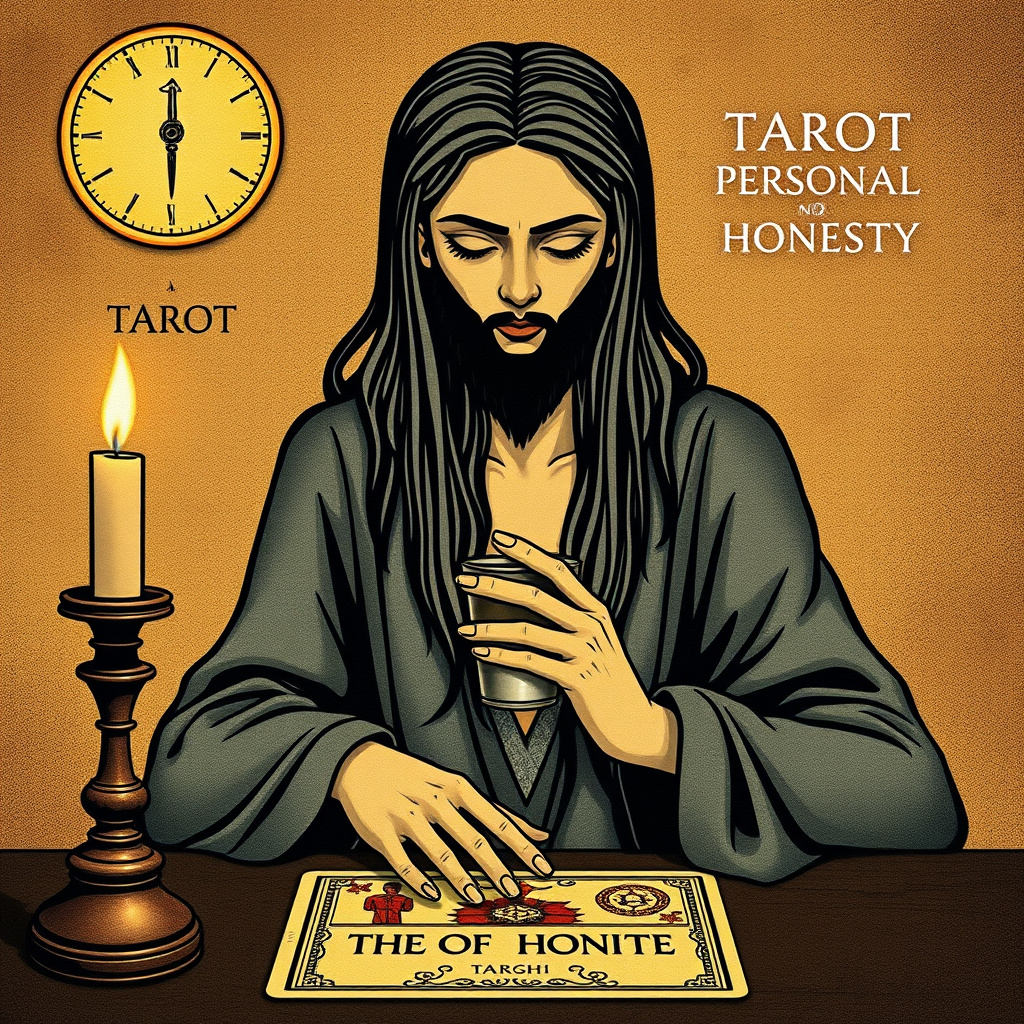
In the quiet moments of self-reflection, we often encounter a persistent barrier: the stories we tell ourselves to maintain comfort. We might convince ourselves that a stagnant job is actually “stable,” or that a draining relationship is merely “going through a rough patch.” This is where the intersection of tarot and personal honesty becomes a transformative tool. Far from being a mystical method for predicting the future, tarot serves as a profound psychological mirror, reflecting the nuances of our inner lives that we often prefer to ignore. By engaging with the archetypal imagery of the cards, we can bypass the ego’s defenses and confront the radical truth of our current circumstances.
Key takeaways
- Use tarot as a projective tool to identify hidden biases and the narratives you create to avoid uncomfortable truths.
- Practice radical transparency by grounding yourself before readings and accepting the first, often challenging, interpretation offered by the cards.
- Employ specific spreads, such as the Mirror or Reality Check, to contrast your current persona with your shadow and objective reality.
- Recognize spiritual bypassing by avoiding the tendency to use cards to justify passivity or ignore necessary, practical life changes.
The Tarot as a Psychological Mirror
At its core, tarot is a visual language. Each of the 78 cards in a standard deck represents a facet of the human experience, from the joyous heights of the Sun to the profound grief of the Three of Swords. When we pull a card, we aren’t just looking at ink on cardboard; we are looking at a projection of our subconscious. This is a phenomenon known as synchronicity, but from a psychological standpoint, it functions as a projective test, similar to a Rorschach inkblot.
Personal honesty requires us to look at our lives without the filter of our biases. However, the human brain is hardwired for self-preservation, which often manifests as self-deception. We rationalize our mistakes and minimize our desires to avoid the discomfort of change. Tarot disrupts this cycle. When you ask a question about your happiness and pull the Nine of Cups, you are forced to define what fulfillment actually looks like for you. Conversely, if you pull the Five of Pentacles, you must confront feelings of scarcity or isolation you may have been suppressing. The cards don’t tell us what to do; they show us what is already there, stripped of the narrative we’ve constructed to protect ourselves.
Breaking the Habit of Self-Deception
Self-deception is a subtle thief. It creeps into our daily routines, convincing us that we are satisfied when we are merely numb. To use tarot for personal honesty, one must first acknowledge that the deck will not always tell them what they want to hear. In fact, the most valuable readings are often the ones that feel like a cold splash of water.
Consider the Eight of Swords. This card typically depicts a woman bound and blindfolded, surrounded by swords. To the casual observer, she is a victim of her circumstances. However, a closer look reveals that the bonds are loose and her feet are free. The true message of the card is self-imposed limitation. When this card appears in a reading about personal honesty, it asks: “In what ways are you playing the victim to avoid taking responsibility for your freedom?” This level of inquiry is uncomfortable, but it is the foundation of genuine growth. By using the cards to identify these patterns, we begin to dismantle the cognitive dissonance that keeps us stuck.
The Role of the Shadow in Tarot Practice
In Jungian psychology, the “shadow” represents the parts of ourselves that we find unacceptable and thus hide from the world—and often from ourselves. These might be qualities like anger, ambition, or vulnerability. Personal honesty is impossible without shadow work, and tarot is perhaps one of the most effective tools for this process. The deck contains several cards that are frequently misunderstood as “bad,” such as The Devil, The Tower, and Death.
The Devil, for instance, rarely signifies literal evil. Instead, it represents our attachments, addictions, and the shadow side of our desires. When we pull The Devil, it is an invitation to be radically honest about what owns us. Are we addicted to external validation? Are we staying in a toxic situation because of a fear of being alone? By facing the shadow through the lens of the tarot, we take away its power. We stop running from the parts of ourselves we dislike and start integrating them into a more honest, whole identity. This integration is the ultimate goal of personal honesty: to be seen, by ourselves, in our entirety.
Creating a Space for Radical Transparency
To achieve a high level of honesty in a tarot reading, the environment and mindset must be intentional. If you approach the cards with a desperate need for a specific answer, you will likely find a way to twist the imagery to suit your desires. This is the opposite of personal honesty; it is a reinforcement of the ego.
To create a space for transparency, start with a grounding ritual. This doesn’t need to be elaborate. It could be three deep breaths or a moment of silence. State your intention clearly: “I am ready to see the truth, even if it is uncomfortable.” When you draw the cards, observe your physical reaction. Does your chest tighten? Do you feel a sense of relief? These somatic responses are often more honest than your initial thoughts. If you find yourself immediately dismissing a card or reaching for a guidebook to find a “better” meaning, stop. Sit with the discomfort. That resistance is exactly where the honesty is needed most.
Interpreting Reversed Cards as Internal Blocks
Many tarot practitioners use “reversals”—cards that appear upside down—to add depth to a reading. In the context of personal honesty, reversals are particularly potent. While an upright card often represents an external energy or a clear manifestation, a reversed card often points to something internal, hidden, or repressed.
For example, the Strength card upright represents courage and patience. Reversed, it might suggest a lack of self-belief or an internal struggle with one’s own power. If you are asking about your career and receive the Ace of Wands reversed, it might indicate that while you are telling everyone you are ready for a new project, you are actually feeling uninspired or fearful of failure. Reversals act as a nudge to look inward. They suggest that the answer isn’t out there in the world, but buried within your own psyche, waiting for you to be honest enough to acknowledge it.
Practical Spreads for Self-Honesty
While a single-card pull is effective for daily check-ins, specific spreads can help structure a deeper dive into personal honesty. Here are two spreads designed to bypass the ego and reveal the core truth of a situation.
The Mirror Spread (3 Cards)
- Card 1: The Persona. What am I currently showing the world? This represents the mask you wear and the story you are telling others.
- Card 2: The Shadow. What am I hiding from myself? This card reveals the truth you are currently avoiding or the emotion you are suppressing.
- Card 3: The Integration. How can I bring these two into alignment? This provides actionable advice on how to be more honest and authentic.
The Reality Check Spread (5 Cards)
- Card 1: My Current Perception. How I think things are going.
- Card 2: The Objective Reality. What is actually happening, regardless of my feelings.
- Card 3: The Narrative. The lie I am telling myself to stay comfortable.
- Card 4: The Uncomfortable Truth. The specific piece of honesty I am avoiding.
- Card 5: The Path Forward. The first step toward living in alignment with this truth.
Using these spreads requires a commitment to the process. It is helpful to journal your interpretations, specifically noting where your initial reaction conflicts with what the cards are suggesting. Over time, these journals become a map of your journey toward radical self-honesty.
Integrating Tarot Insights into Daily Life
The value of a tarot reading for personal honesty is lost if the insights are not integrated into daily life. Honesty is not a destination; it is a practice. Once the cards have revealed a truth—perhaps that you are staying in a job you hate out of a fear of financial instability—the next step is to act on that honesty.
This doesn’t always mean making a radical life change overnight. Often, the first step is simply acknowledging the truth to another person or writing it down in a place where it cannot be ignored. Use the imagery of the card that gave you the insight as a touchstone. If the Two of Swords showed you that you’ve been avoiding a difficult decision, keep that card on your altar or as a photo on your phone. When you feel yourself slipping back into avoidance, look at the card. Let it remind you of the clarity you found and the commitment you made to yourself to live truthfully. The tarot provides the map, but you must do the walking.
The Ethics of Reading for Yourself
Reading for oneself is notoriously difficult because we are the most biased toward our own outcomes. To maintain personal honesty, one must adopt the role of an objective observer. This is often called “reading for yourself as if you were a stranger.”
One common pitfall is the “clarifier trap.” This happens when you pull a card you don’t like and keep pulling more cards to “clarify” it, hoping for a more positive outcome. In reality, you are just looking for a loophole. True honesty in tarot means accepting the first answer. Another ethical consideration is the frequency of readings. Asking the same question repeatedly until you get the “right” answer is a form of self-deception. If you find yourself doing this, it’s a sign that you already know the truth but are not yet ready to accept it. In these moments, the most honest thing you can do is put the deck away and sit with your resistance.
Conclusion: The Freedom of the Truth
Living a life of personal honesty is not the easy path. It requires the courage to dismantle the false versions of ourselves and the resilience to sit with the discomfort of our own shadows. However, the rewards are immeasurable. When we stop lying to ourselves, we stop wasting energy on the maintenance of facades. We become more grounded, more decisive, and more deeply connected to our authentic desires.
Tarot is a companion on this journey. It doesn’t judge, and it doesn’t sugarcoat. It simply presents the archetypes of human experience and asks us where we fit within them. By using the cards as a tool for radical transparency, we turn a simple deck of cards into a key that unlocks the door to our most honest selves. In the end, the truth doesn’t just set us free; it gives us the foundation upon which to build a life that is truly worth living.
Navigating the Labyrinth of Confirmation Bias
One of the most significant hurdles in using tarot for personal honesty is the human tendency toward confirmation bias. We often approach the deck with a subconscious agenda, seeking validation for a path we have already chosen rather than an objective assessment of our reality. This is particularly prevalent in readings concerning love or career, where our emotional stakes are highest. For instance, if you are desperately hoping for a reconciliation with an ex-partner, you might see the Two of Cups and immediately interpret it as a sign of imminent reunion, conveniently ignoring the surrounding cards like the Three of Swords or the Ten of Swords that suggest the relationship has reached a painful but necessary conclusion.
To combat this, practitioners must develop the skill of “unbiased observation.” A practical technique for this is the “Third-Party Perspective.” Before interpreting your cards, imagine you are reading for a complete stranger who has the exact opposite desires of your own. If you were looking at this spread for someone you didn’t know, would you still give the same optimistic interpretation? Another edge case involves the “positive pull” in a negative context. If you ask, “Why is my current project failing?” and pull the Sun, personal honesty requires you to look beyond the card’s general meaning of success. In this context, the Sun might be pointing to over-exposure, a lack of privacy, or an arrogant belief that things would work out without effort. Honesty means allowing the cards to challenge your narrative, even when they seem to support it.
Minor Arcana and the Micro-Lies of Daily Life
While the Major Arcana deal with life’s grand themes and karmic shifts, the Minor Arcana are the masters of the mundane. It is in the small, daily interactions that we tell our most frequent lies. By breaking down the suits, we can identify specific areas where our personal honesty is faltering. The Suit of Swords, representing the mind and communication, often highlights the intellectualizations we use to justify our behavior. If the Seven of Swords appears, it isn’t always about someone else deceiving us; it often points to the ways we are cutting corners or being “sneaky” with our own integrity to avoid a difficult conversation.
The Suit of Cups, conversely, deals with emotional honesty. We often tell ourselves we are “fine” when we are actually grieving, or “happy for someone” when we are simmering with envy. The Four of Cups is a classic marker of this: it depicts a figure so focused on what they’ve lost or what they lack that they ignore the new opportunities being offered. In a reading about self-honesty, this card asks: “Are you nurturing your dissatisfaction as a way to avoid the vulnerability of trying something new?” The Pentacles address our physical and financial honesty—the excuses we make about our health or our spending habits—while the Wands challenge the stories we tell about our passions and energy levels. By focusing on the Minor Arcana, we can pin down the specific “micro-lies” that accumulate to create a life of inauthenticity.
Identifying Spiritual Bypassing through Archetypal Analysis
Spiritual bypassing is the tendency to use spiritual concepts and practices to avoid dealing with uncomfortable feelings, unresolved wounds, or fundamental emotional needs. In tarot practice, this often manifests as over-relying on “high-vibe” interpretations to escape the grit of reality. For example, someone might pull the High Priestess and use it to justify their passivity in a situation that actually requires assertive action, claiming they are simply “waiting for intuitive guidance” when they are actually paralyzed by fear. Personal honesty involves recognizing when we are using the deck to hide from the world rather than engage with it.
The Star is another card frequently used for spiritual bypassing. While it represents hope and healing, in a state of self-deception, it can become a tool for toxic positivity. If your life is currently in shambles due to poor decision-making, pulling the Star should be a call to quiet reflection and genuine healing, not a license to ignore the practical steps needed to fix the damage. To use tarot to catch spiritual bypassing, look for the “disconnect” between the card’s spiritual promise and your physical reality. If you are pulling cards about “divine timing” (like the Wheel of Fortune) but your bank account is empty because you refuse to look for work, the honest interpretation is that you are using the concept of fate to bypass the responsibility of self-sustenance. The cards serve as a grounding wire, pulling our loftiest spiritual aspirations back down to the reality of our lived experience.
The “Aversion Card” Technique for Uncovering Blind Spots
Most tarot readers have a “stalker card”—a card that follows them from reading to reading—but even more telling is the “aversion card.” This is the card you dread seeing, the one you find aesthetically displeasing, or the one whose traditional meaning you always try to argue with. These aversions are direct gateways to your blind spots. If you find yourself consistently annoyed by the Three of Pentacles, for example, you might need to be honest about your resistance to collaboration or your fear that your individual contributions won’t be recognized. The card itself is neutral; your reaction to it is the data point of honesty.
To practice the Aversion Card Technique, go through your deck and pull out the three cards you dislike the most. Set them in front of you and ask: “What about this card feels like a personal insult?” If the Hierophant bothers you, are you being honest about your relationship with authority and tradition? If the Nine of Pentacles feels “smug” to you, are you being honest about your own feelings of inadequacy regarding financial independence? By leaning into the cards that repel us, we bypass the ego’s curated selection of “relatable” imagery and force ourselves to engage with the parts of the human experience we have deemed “other” or “wrong.” This exercise is a radical act of self-transparency that reveals the boundaries of our self-acceptance.
Honesty in the Mirror of Relationships and Projections
We rarely see people as they are; we see them as we are. Tarot is an exceptional tool for identifying where we are projecting our own unowned qualities onto partners, friends, or colleagues. The Court Cards (Pages, Knights, Queens, and Kings) are particularly useful for this. When a Court Card appears in a reading about a conflict with another person, the first question of personal honesty should be: “In what way am I acting like this card, or in what way am I refusing to see this quality in myself?”
For instance, if you are frustrated with a partner you perceive as the King of Swords—cold, overly analytical, and emotionally detached—the tarot might be asking you to look at your own relationship with logic and boundaries. Are you being honest about your own need for structure, or are you projecting your “coldness” onto them so you can remain the “emotional one”? Conversely, if you are drawn to people who embody the Knight of Wands—charismatic, impulsive, and perhaps unreliable—you must be honest about your own suppressed desire for adventure and risk. Are you living vicariously through them to avoid the danger of being impulsive yourself? Using tarot to deconstruct projections prevents us from blaming others for the imbalances within our own psyche. It forces a level of relational honesty that moves beyond “he said, she said” and into the realm of “what am I contributing to this dynamic?”
Temporal Honesty: Deconstructing the “One Day” Narrative
One of the most common ways we lie to ourselves is through our perception of time. We live in the “one day” narrative: “One day I will start that business,” or “One day I will be ready for a real relationship.” Tarot can act as a temporal reality check. Cards like the Eight of Wands suggest rapid movement and the need for immediate action, while the Seven of Pentacles suggests a period of waiting and assessment. Personal honesty requires us to align our actions with the actual season we are in, rather than the one we are pretending to be in.
Consider the Knight of Pentacles. He is the slowest of the knights, moving with methodical care. If you pull this card while claiming you are “doing everything you can” to reach a goal, the card might be calling you out on your pace. Are you actually being methodical, or are you being honest about the fact that you are dragging your feet because you’re afraid of the finish line? On the flip side, if you pull the Knight of Swords, you might be forced to admit that your “careful planning” is actually just procrastination, and what you really need is a swift, sharp strike toward your objective. By using tarot to analyze our relationship with time and progress, we stop the cycle of perpetual preparation and start engaging with the present moment as it truly is, not as we wish it to be.
Somatic Resonance and the “Body Truth” Reading
Personal honesty isn’t just an intellectual exercise; it is a physical experience. The body often knows the truth long before the mind is willing to admit it. Integrating somatic resonance into your tarot practice can bypass the ego’s verbal defenses entirely. When you pull a card, before you look up its meaning or even name the card, notice where you feel it in your body. Does a specific image cause a knot in your stomach? Does another make your shoulders drop in relief? Does the Ten of Swords make your own back feel tight?
Frequently Asked Questions
What should I do if I get a ‘scary’ card like Death or The Tower?
First, take a deep breath. In tarot, these cards are rarely literal. Death signifies the end of a cycle and the necessity of letting go to make room for the new. The Tower represents a sudden change or the breakdown of a structure that was built on a weak foundation. When these cards appear in a reading about personal honesty, they are often pointing to a truth you’ve been avoiding that is finally coming to the surface. Instead of fearing them, ask: “What is falling away, and why was I trying to hold onto it?”
How can I tell if I’m being honest or just being hard on myself?
Personal honesty is not the same as self-criticism. Honesty is objective and neutral; it identifies a fact or a feeling without attaching a label of “bad” or “worthless” to it. If your interpretation of a card feels like an attack on your character, you are likely slipping into self-judgment. If the insight feels like a “click” of recognition—even if it’s uncomfortable—that is usually the voice of honesty. Honesty seeks to reveal; self-judgment seeks to punish.
Can tarot really know things about me that I don’t know?
The tarot doesn’t possess sentient knowledge, but it acts as a bridge to your subconscious. Your subconscious mind processes thousands of bits of information that your conscious mind filters out. When you look at a card, your brain makes connections based on those subconscious observations. In that sense, the tarot isn’t telling you anything “new”; it is bringing what you already know from the back of your mind to the front.
Is it okay to use a guidebook, or does that interfere with honesty?
Guidebooks are excellent tools, especially for beginners. However, to foster personal honesty, try to look at the card for at least two minutes before reaching for the book. Note your immediate emotional reaction and what symbols stand out to you. After you’ve formed your own impression, use the guidebook to add context. If the guidebook’s definition feels like a “stretch” to fit your situation, trust your intuition over the printed word.
How often should I use tarot for self-reflection?
There is no hard rule, but for the purpose of personal honesty, quality is better than quantity. A daily one-card pull is a great way to stay in tune with yourself. For deeper, more intense readings, once a month or during significant life transitions is usually sufficient. Over-reading can lead to confusion and “analysis paralysis,” which actually makes it harder to be honest with yourself. Give yourself time to integrate the truths you discover before asking the cards for more.
Related posts:
 PHA Bodyweight Workout: Efficient Fitness Anywhere, Anytime
 Tarot and Personal Honesty
 Mystical Matchmaking: Your Beginner’s Guide to Reading Tarot Cards
 Discover the Best Tarot Deck for Your Zodiac Sign
 Justice Tarot Card Interpretation
 The Moon Tarot Card: Intuition and Emotional Depth
 Page of Swords Reversed Meaning
 Birthdate Co.’s Tarot Trio: A Personalized Guide to Self-Discovery