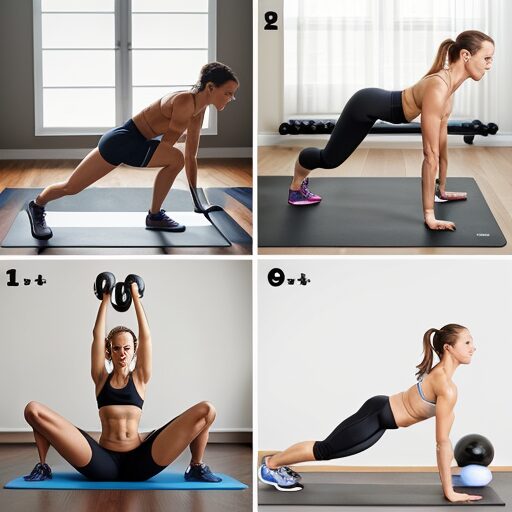
Staying active is so important for our health and wellbeing. With busy schedules, it can be difficult to find time for exercise. That’s why 10-minute workouts you can do at home are such a great option!
1. Yoga With Adriene
Yoga With Adriene offers free 10-minute yoga videos that are perfect for beginners. Her calm and cheerful personality makes yoga fun and accessible for everyone. Try her short morning yoga flow to start your day centered and energized.
2. The Fitness Marshall
Love to dance? The Fitness Marshall’s 10-minute dance cardio videos set routines to upbeat popular music. His infectious energy will having you moving and smiling through intervals of easy and more intense choreography.
3. PopSugar Fitness
PopSugar has 10-minute HIIT, barre, Pilates and strength training workout videos. Their trainers demonstrate modifier exercises so you can go at your own pace. Get in a quick full body burn!
4. HASfit
HASfit offers free 10-minute workouts for all levels focusing on strength, HIIT cardio, stretching and more. Their trainers provide form cues and modification options while emphasizing the importance of working at your own ability.
5. Daily Burn
Daily Burn has a collection of free 10-minute total body conditioning workouts. Their trainers coach you through circuits working various muscle groups to get your heart rate up. The workouts feature timer displays to help you track your progress.
6. Blogilates
Blogilates 10-minute PILOXING videos are a fusion of Pilates and boxing moves to simultaneously tone and cardio train. The fusion format keeps the pace up for a worthwhile quick sweat.
7. Tone It Up
The Tone It Up girls have 10-minute workouts that hit your total body using minimal equipment. Some feature circuits, others focus on specific areas like legs, booty, core or arms. Their energy is infectious!
No matter your fitness level, there are free 10-minute online workouts you can do at home to benefit your health. Choose videos you enjoy so exercise feels more like a celebration of what your body can do rather than another item on your to-do list. Be compassionate with yourself, work at your own pace, and have fun!
Optimizing Your Environment for Micro-Workouts
The success of a 10-minute session often hinges on the friction between you and the start button. To make your home workout space effective, treat it like a dedicated training zone, even if it is just a corner of your living room. Clear a 6-by-4-foot area of any tripping hazards, such as stray charging cables or rug edges. If you are working on a hard floor, invest in a high-density yoga mat to protect your joints during floor-based movements like mountain climbers or planks. Lighting also plays a psychological role; keep your space bright to signal to your brain that it is time for activity, rather than relaxation. By keeping your mat rolled out or your sneakers by the door, you eliminate the mental hurdle of ‘setting up,’ turning a 10-minute goal into a 10-minute reality.
Mastering the Art of Progressive Overload in Short Intervals
You might wonder how 10 minutes can lead to tangible strength gains. The answer is intensity manipulation. Because the duration is short, you have the luxury of pushing your anaerobic threshold higher than you could during a 60-minute steady-state session. To ensure you do not plateau, track your “reps per interval.” For example, if a video features 45 seconds of squats, write down how many repetitions you completed. Next time, aim for one or two more. This micro-progression ensures that even without heavy gym equipment, your muscles are continuously challenged. If you find yourself breezing through a routine, shorten your rest periods by 5 seconds or increase your range of motion—such as squatting deeper or extending your arms fully during shadowboxing—to maintain a high stimulus-to-time ratio.
The Role of Active Recovery and Mobility
Not every 10-minute session should be a high-intensity blood-pumper. Incorporating mobility-focused workouts is essential for preventing the ‘stiff-desk’ syndrome that plagues many remote workers. Seek out 10-minute sessions that focus on thoracic spine mobility, hip openers, or shoulder girdle stability. These sessions act as a ‘reset’ for your nervous system. If you have been sitting for six hours, a quick 10-minute flow focusing on cat-cow stretches, child’s pose, and pigeon pose can reverse postural rounding. Think of these as a down payment on your future movement health; the more mobile your joints are, the more effectively you can perform the high-intensity workouts on your ‘go-hard’ days.
Structuring Your Weekly Micro-Routine
Consistency is often sabotaged by decision fatigue. Instead of waking up and asking ‘What should I do today?’, create a simple rotation. For instance: Monday (Cardio Dance), Tuesday (Strength/Bodyweight), Wednesday (Active Recovery/Mobility), Thursday (HIIT), and Friday (Pilates/Core). By having a pre-assigned theme for each day, you remove the barrier of choice. If you miss a day, do not try to ‘make it up’ by doing 20 minutes the next day; simply return to your schedule. The psychological benefit of checking off a consistent, predictable routine is far more powerful for habit formation than the physiological impact of one extra-long session.
Overcoming Plateaus with Compound Movements
When time is limited, prioritize compound movements—exercises that recruit multiple muscle groups simultaneously—over isolation exercises. A 10-minute workout consisting of burpees, lunges, and push-ups will always yield a higher caloric burn and greater muscle recruitment than a session focusing solely on bicep curls or crunches. Look for videos that emphasize ‘functional’ movements: squats, hinges, pushes, pulls, and carries. Even if a video doesn’t explicitly use weights, you can increase the difficulty of these compound moves by slowing down the eccentric (lowering) phase of the movement. Taking three full seconds to lower into a squat increases time-under-tension, forcing your muscles to work harder without needing a single piece of equipment.
Listening to Your Body: The ‘Pain vs. Discomfort’ Spectrum
It is vital to distinguish between the ‘good’ burn of muscular fatigue and the ‘bad’ sharp pain of injury. If you feel a dull, rhythmic ache in your muscles during a high-rep set, that is the metabolic byproduct of effort—lean into it. However, if you feel a sharp, stabbing sensation in a joint (like your knee, lower back, or shoulder), stop immediately. In a 10-minute window, there is no time to ‘push through’ an injury. If a specific move causes discomfort, swap it for a regression. For example, if jump squats irritate your ankles, replace them with regular air squats or box squats. Your goal is to keep your movement practice sustainable for years, not just for the next 10 minutes.
FAQ
What equipment do I need?
Little to no equipment is needed for most 10-minute workouts. Options like yoga, Pilates, cardio dance and bodyweight exercises use just your own body weight. Some workouts incorporate basic equipment like resistance bands, light hand weights or a mat for cushioning.
How often should I do a 10-minute workout?
Aim for at least 3-4 days a week of 10-minute exercise sessions. Consistency is key to see results over time. Listen to your body day-to-day and take a rest when needed.
How hard should I push myself?
Work at an intensity where you can maintain good form but feel challenged. Scale back moves that are too difficult or pause and rest when needed. Don’t worry about keeping up—focus on proper technique to avoid injury.
What results can I expect to see?
It depends on factors like nutrition, genetics, sleep, stress levels and hormones. But over time, you can expect to build strength and muscle tone, increase cardiovascular endurance, reduce body fat and simply feel better!
How do I stay motivated?
Working out at home allows you to exercise on your own schedule in a private, comfortable setting. Pick uplifting music and focus on how great it feels to do something positive for your health. Remind yourself of how proud you feel after each workout!
Related posts:
 15-Minute No-Equipment HIIT
 The Genius Travel Workout You Can Do With Just Your Luggage
 Audio Workout Apps Taking Over the Gym Scene
 Peloton Partners with Hilton
 PHA Bodyweight Workout: Efficient Fitness Anywhere, Anytime
 Understanding Gym Equipment
 Body by Simone Goes Digital: The New App Revolution
 Quick Cardio Fix: Tracy Anderson’s 7-Minute Heart-Pumping Workout Video