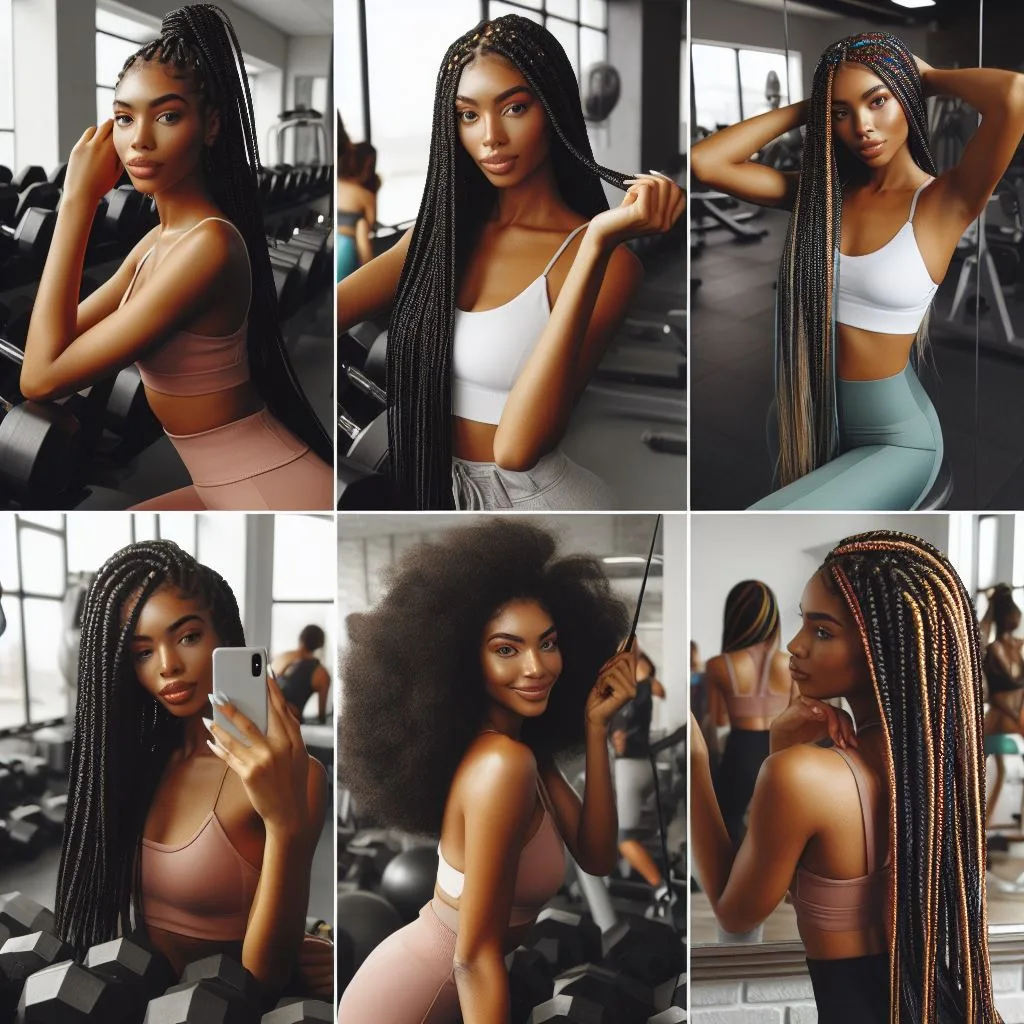
Staying Active While Protecting Your Braids
Working out with braided hair requires some extra care and planning. The good news is that with the right gym hairstyles, you can exercise comfortably while keeping your braids neat and protecting your edges.
Low Manipulation Styles
Opt for low manipulation styles that keep your braids flat against your scalp. This prevents excessive pulling and friction that can lead to breakage:
- Slick high ponytails or buns
- Single braids pulled back
- Headwraps or silk scarves
- Braid crowns
Moisturizing Tips
It’s important to keep your braids conditioned while working out. Try these tips:
- Apply a moisturizing but lightweight leave-in conditioner before your workout
- Mist braids with water or a braid spray as needed
- Shampoo only 1-2 times per week
- Deep condition weekly
Optimizing Weight Distribution for High-Impact Training
When engaging in high-impact interval training (HIIT), plyometrics, or long-distance running, the primary challenge for those with braids—especially long box braids or heavy faux locs—is the centrifugal force. As you jump or run, the weight of the braids creates a pendulum effect, pulling aggressively at your hairline and causing the braids to whip against your back or face. To mitigate this, you must move beyond the standard ponytail and focus on weight distribution.
The “Triple-Tiered Bun” is an exceptional solution for high-impact movement. Instead of gathering all braids into one heavy mass at the crown, divide your hair into three horizontal sections: top, middle, and nape. Secure each section into its own compact bun. This prevents the entire weight of the hair from hanging off a single point on the scalp. By anchoring the hair in three distinct zones, you significantly reduce the leverage the braids have against your edges, and the hair remains stationary even during burpees or box jumps.
For those with shorter braids that cannot be easily bunned, the “Braid-in-Braid” technique is effective. Gather your individual braids and weave them into two or three large, thick French braids that hug the scalp tightly. This minimizes the individual movement of each braid, which is the leading cause of friction-induced frizz and scalp soreness after a vigorous cardio session. Secure the ends with snag-free silicone bands or a soft scrunchie to ensure they don’t unravel mid-sprint.
Managing Scalp Microbiome and Sweat Crystallization
While the existing advice covers basic moisturizing, the biological reality of sweating in braids requires a more technical approach to hygiene. Sweat is composed of water, minerals, and lactic acid. When the water evaporates during a workout, the salts and minerals remain on the scalp, forming crystals that can clog pores and cause intense itching or “braid burn.” Furthermore, the warm, damp environment created by sweat trapped under synthetic hair is a breeding ground for Malassezia, a yeast-like fungus that can lead to dandruff or seborrheic dermatitis.
To combat this without the mechanical stress of a full wash, implement a “Scalp Neutralization” routine immediately after your workout. Use a pointed-tip applicator bottle filled with a mixture of one part witch hazel and three parts distilled water, perhaps infused with a few drops of tea tree oil for its antifungal properties. Apply this directly to the exposed scalp between the parts. The witch hazel acts as an astringent to remove excess oil and salt, while the tea tree oil addresses microbial growth. Use a soft microfiber cloth to gently dab the scalp along the parts; never rub, as this will lift the hair fibers and create frizz.
If you find that your scalp feels particularly tight or inflamed after a heavy sweat, consider a pH-balancing rinse. Sweat is slightly acidic, and as it dries, it can shift the scalp’s natural pH. A very diluted apple cider vinegar spray (one tablespoon per cup of water) can help restore the acid mantle of the scalp. Ensure you focus the application on the skin rather than the synthetic hair, as the goal is scalp health rather than hair conditioning.
The Strategic Use of Compression and Friction Barriers
Protecting the perimeter of your hair—the edges—is the most critical aspect of gym hair care for braided styles. The friction from cotton headbands or the constant movement of braids can cause thinning at the temples. To prevent this, you should employ a dual-layer barrier system during any workout that involves significant head movement or floor work (like yoga or Pilates).
The first layer should be a thin, silk or satin scarf tied specifically over the hairline. This creates a smooth surface that allows any secondary headgear to glide over the hair rather than pulling it. Over this silk layer, apply a wide, moisture-wicking compression headband. The compression serves a functional purpose: it holds the roots of the braids flat against the scalp, preventing the “tugging” sensation that occurs when you change positions. This is particularly useful during inverted poses in yoga or when lying on a weight bench.
When selecting a headband, avoid those with rubberized “grip” strips on the inside. While these are designed to stay in place, they can adhere to your natural hair at the hairline and cause breakage when the headband shifts. Instead, look for “tubular” headbands made of polyester-spandex blends. These provide enough tension to stay secure without the need for high-friction coatings. If you are performing floor exercises, ensure your gym mat is covered with a microfiber towel; the texture of many yoga mats is high-friction and can snag individual braids or roughen the hair’s surface during floor-based core work.
Post-Workout Drying: The “Cool Shot” Technique
One of the biggest mistakes made after a workout is allowing braids to air-dry while they are still tied up. Moisture trapped in the center of a bun or at the base of the braids can lead to a musty odor and weaken the natural hair over time. You must prioritize drying the “core” of your style as soon as your heart rate has returned to a resting state.
Unravel your workout style immediately after your session. Using a blow dryer on the “cool” or “low heat” setting, focus the airflow directly at the roots. Moving the dryer constantly, work your way through the parts to ensure the scalp is bone-dry. The cool air helps to “set” the hair and reduce the frizz that warm, moist air encourages. If you use high heat, you risk melting synthetic fibers or causing heat damage to your natural hair tucked inside the braids.
For those with very thick or long braids, a hooded dryer attachment for a handheld blow dryer can be a game-changer. This allows for even airflow throughout the entire mass of hair without you having to manually aim the dryer for 20 minutes. Once the scalp and the first few inches of the braids are dry, you can apply a lightweight anti-itch serum containing peppermint or menthol. This provides a cooling sensation that soothes the scalp after the physical stress of the workout and the drying process.
Advanced Accessory Selection for Braided Athletes
Standard hair elastics are often the enemy of a long-lasting braided style. They are usually too small to wrap around a full head of box braids without excessive tension, and the metal joiners or exposed rubber can snag the hair. For the gym, you should transition to specialized tools designed for high-volume hair.
“Bungee” hair ties—hooks on either end of an elastic cord—are superior for securing braided ponytails. They allow you to control the exact amount of tension. You hook one end into the base of the ponytail, wrap the cord until the desired tightness is achieved, and hook the other end. This eliminates the need to pull the entire weight of your braids through a loop multiple times, which is when most friction damage occurs.
Another excellent tool is the “Spiral” or “Phone Cord” hair tie. These distribute pressure unevenly around the circumference of the ponytail, which sounds counterintuitive but actually prevents the “dent” or localized tension that leads to breakage. For heavy braids, look for the extra-large, heavy-duty versions. Additionally, consider the “Braid Sock” for cardio. This is a long, mesh tube that you slide your braids into before tying them back. It keeps the braids contained in a single unit, preventing them from swaying or tangling, and the mesh material allows for maximum airflow so sweat doesn’t become trapped against the hair.
Managing Weight and Tension in Strength Training
In strength training, particularly during exercises like squats, overhead presses, or lat pulldowns, the position of your braids can actually interfere with your form or cause sudden, sharp tension on the scalp. For example, a low ponytail can get caught between your upper back and a barbell during back squats, leading to a dangerous distraction and a painful tug on your roots.
For lifting, the “High Crown Nest” is the safest configuration. Coil your braids into a flat, wide disk on the very top of your head, rather than a vertical bun. Secure this disk with large U-shaped hair pins (often called Amish pins or crinkled pins) rather than elastics. These pins slide through the braids and anchor them to each other, distributing the weight across the entire top of the head. This keeps the nape of your neck and your upper back completely clear for barbell placement and ensures that when you lie back for a bench press, your head can remain flat on the bench without a bulky bun forcing your neck into a strained, flexed position.
If you are performing exercises that require a high range of motion in the neck, such as cleans or snatches, ensure that no braids are left loose. Even one or two stray braids can catch on the bar or your clothing, causing a sudden jerk that can damage the follicle. Use a small amount of edge control or a firm-hold mousse to smooth down any new growth before you start your lifting set; this creates a cohesive “shield” of hair that is less likely to be disturbed by the mechanical movements of the gym.
Longevity Strategies for Frequent Exercisers
If you work out 5-6 days a week, your braids will naturally age faster due to the constant cycle of sweating, drying, and manipulation. To extend the life of your style by several weeks, you must implement a “rotation” strategy for your gym hairstyles. Avoid wearing the exact same ponytail or bun every day. Shifting the point of tension—even by an inch—prevents the same hair follicles from being stressed repeatedly.
On cardio days, prioritize security with the Triple-Tiered Bun. On lifting days, prioritize clearance with the High Crown Nest. On lower-intensity days, such as mobility work or walking, use a simple silk-lined scrunchie for a loose low braid. This rotation allows different areas of your scalp to “rest.”
Furthermore, consider the “Mousse Reset” every three days. Apply a generous amount of a firm-hold, alcohol-free foaming mousse over the entire surface of your braids. Wrap your head tightly with a silk scarf for 30 minutes. The mousse helps to re-adhere flyaways to the main braid and provides a protective coating that resists moisture. This is especially effective after the hair has been dried following a workout. By “shrink-wrapping” the braids back into place with mousse and a scarf, you maintain that fresh-from-the-salon look despite the rigors of a daily fitness routine. Finally, always inspect your edges weekly for signs of “tenting” (when the skin is being pulled up by the braid). If you see this, it is a sign that your gym style is too tight and you must adjust your tension immediately to avoid traction alopecia.
FAQ
What hairstyles protect braids during workouts?
Low manipulation styles like slicked back ponytails, headwraps, braid crowns, and single braids pulled back are best for protecting braids during workouts.
How often should you wash braids when working out?
Only shampoo your braids 1-2 times per week when working out to prevent over-manipulation. Use conditioning and moisturizing products in between washes.
Should you wear a durag or bonnet to the gym?
Wearing a silk bonnet or durag can help control frizz and friction during workouts. Choose breathable fabrics, and opt for a style that fits smoothly against your braids.
What products help moisturize braids?
Look for lightweight, non-greasy leave-in conditioners, braid sprays, and oils to moisturize braids before and after workouts without weighing them down.
How can you prevent braids from slipping during exercise?
Secure braids with silk scarves and headwraps or pull them back tightly in a high ponytail or bun. Bobby pin any loose braids in place. Setting braids with holding spray can also prevent slipping.
Related posts:
 Silk Hair Ties: Gentle on Hair, Tough on Tangles
 The Half-Ponytail Updo Celebrities Can’t Stop Wearing This Season
 Easy Summer Updos for Every Hair Type
 The Return of Silk Scrunchies
 Should You Wash Your Hair After Every Gym Session?
 PHA Bodyweight Workout: Efficient Fitness Anywhere, Anytime
 Step-by-Step Braided Hairstyle Videos That Anyone Can Master
 The Messy Bun Tutorial That Actually Looks Effortlessly Chic