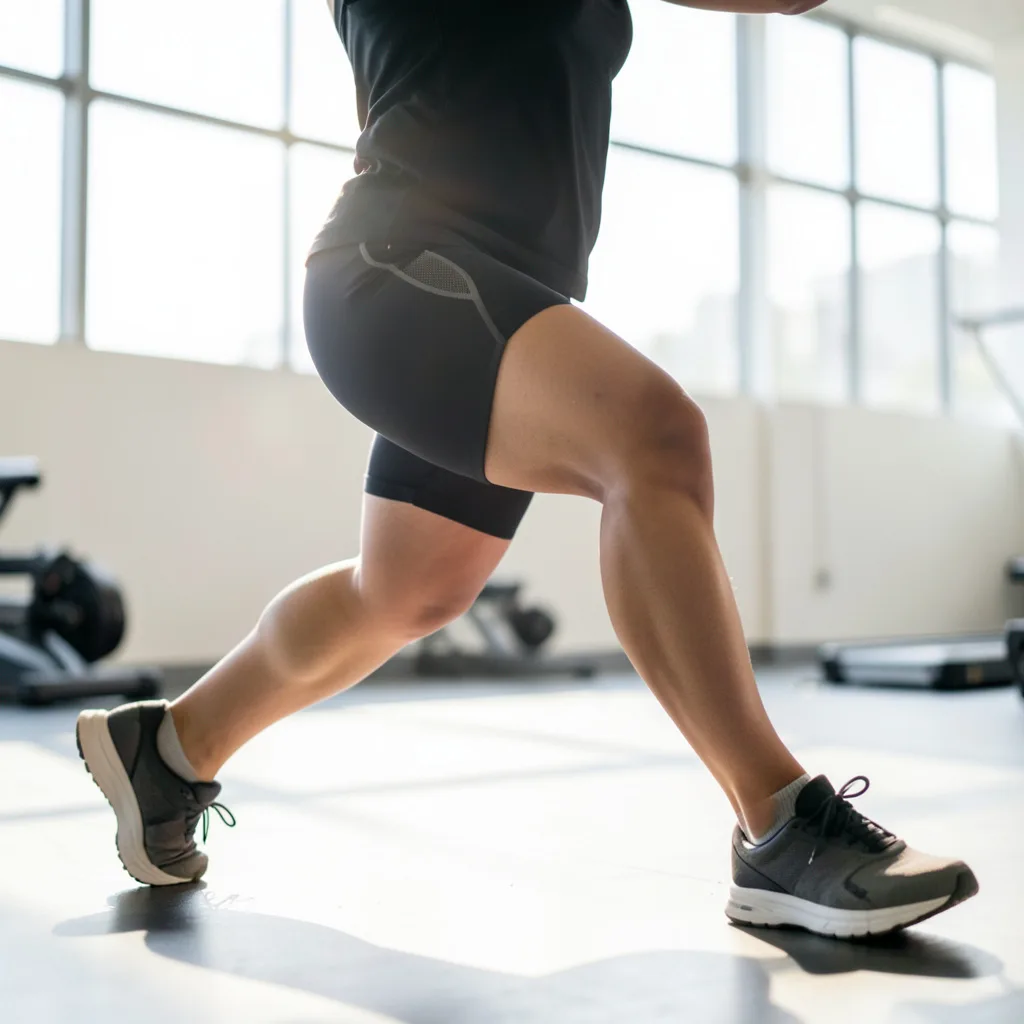
When people set out to improve the appearance and strength of their glutes, the conversation almost always centers on the glutes themselves. From endless sets of hip thrusts to the popularity of glute-specific bands, the focus is often narrow. However, there is a critical, often overlooked partner in this equation: the hamstrings. To achieve a truly lifted, strong, and well-rounded posterior, you cannot ignore the muscles running down the back of your thighs. The relationship between the hamstrings and the glutes is not just helpful; it is symbiotic.
Key takeaways
- Strengthen hamstrings to create a stable base that allows glutes to contract more forcefully and grow.
- Combine hip-hinge movements like Romanian Deadlifts with knee-flexion exercises like leg curls for full development.
- Master the hip hinge by moving hips horizontally backward rather than bending knees vertically like a squat.
- Support muscle growth with lean protein, complex carbohydrates, and 7-9 hours of quality sleep per night.
- Use dynamic stretching before workouts and static stretching after to maintain pelvic alignment and prevent stiffness.
p>
Understanding the connection between these two muscle groups is the key to breaking through plateaus and avoiding common injuries. Many fitness enthusiasts find that despite spending hours on glute isolation exercises, they aren’t seeing the “lift” or the definition they desire. Often, the culprit is a weakness in the hamstrings. When the hamstrings are underdeveloped or overly tight, the glutes cannot operate at their full potential, and the body often compensates by putting undue stress on the lower back. By shifting the focus toward a holistic approach to the posterior chain, you can unlock a level of strength and aesthetic balance that isolation training alone cannot provide.
Understanding the Posterior Chain: The Power Duo
To understand why hamstrings are essential for a better butt, we first need to discuss the concept of the “posterior chain.” This term refers to the entire group of muscles on the backside of your body, stretching from the calves up through the hamstrings, glutes, lower back, and traps. These muscles work together as a functional unit to produce power, maintain upright posture, and stabilize the pelvis.
The glutes (composed of the gluteus maximus, medius, and minimus) and the hamstrings (comprising the biceps femoris, semitendinosus, and semimembranosus) are the primary drivers of the lower posterior chain. While they are distinct muscle groups, they share a common goal: hip extension. Hip extension is the movement of moving your thigh backward, whether you are walking, running, jumping, or standing up from a squat. Because they share this function, they are known as synergistic muscles.
When your hamstrings are strong, they provide a stable base of support that allows the gluteus maximus to contract more forcefully. Imagine trying to push a heavy object while standing on a slippery floor; you wouldn’t be able to apply maximum force because your base is unstable. In a similar way, weak hamstrings act as a “slippery floor” for your glutes. By strengthening the hamstrings, you create a rigid, supportive foundation that allows the glutes to fire with maximum efficiency, leading to better muscle growth and a more pronounced shape.
Why Hamstrings are the Secret Weapon for Glute Growth
The “secret” to a better butt isn’t actually a secret—it’s biomechanics. One of the most common reasons people struggle to grow their glutes is that they suffer from “gluteal amnesia,” a term used to describe the inability to consciously activate the glute muscles. Often, this happens because the hamstrings or the lower back are taking over the movement. However, the inverse is also true: if the hamstrings are too weak, the glutes may never be challenged enough to grow because the body reaches its limit of stability before the glute muscle is fully fatigued.
Hamstrings play a vital role in controlling the tilt of the pelvis. A posterior pelvic tilt or an excessive anterior pelvic tilt can change how the glutes look and function. When hamstrings are strong and flexible, they help maintain a neutral pelvic position. This alignment ensures that when you perform a squat or a lunge, the tension is placed directly on the gluteal fibers rather than being absorbed by the lumbar spine. This shift in tension is what allows for hypertrophy—the actual growth of the muscle fibers.
Furthermore, the hamstrings provide the necessary deceleration during movement. Whether you are slowing down a descent in a squat or stopping a sprint, the hamstrings act as the brakes. This eccentric strength (the ability to control a muscle as it lengthens) is what protects the knee joint and allows you to handle heavier loads in your glute exercises. The more weight you can safely move through a full range of motion, the more stimulus your glutes receive, leading to a more developed and lifted appearance.
The Biomechanics of the “Lift”: How Synergy Works
When people talk about a “lifted” look, they are usually referring to the upper portion of the gluteus maximus and the transition area where the glutes meet the hamstrings (the glute-ham tie-in). This area is where the synergy between the two muscle groups is most visible. If you only train your glutes, you might develop volume, but you won’t necessarily achieve that crisp, defined transition.
The “lift” is created when both the glutes and the hamstrings are developed proportionally. Strong hamstrings pull the pelvic structure into a position that accentuates the curvature of the glutes. Additionally, exercises that target both groups simultaneously—such as the Romanian Deadlift—create a cohesive strength profile. When the hamstrings are developed, they fill out the back of the leg, which visually pushes the glutes upward and outward, creating a more three-dimensional look.
It is also important to consider the role of the gluteus medius and minimus, which sit on the side of the hip. While the hamstrings primarily assist the gluteus maximus, a strong posterior chain as a whole improves hip stability. This prevents the knees from caving inward (valgus collapse) during heavy lifts. When your hips are stable, you can drive through your heels more effectively, which is the primary mechanism for engaging the glutes during compound movements.
Top Hamstring Exercises for Maximum Posterior Development
To harness the connection between your hamstrings and glutes, you need a mix of hip-hinge movements and knee-flexion movements. While the glutes are primarily activated during hip extension, the hamstrings are unique because they cross two joints: the hip and the knee. To fully develop them, you must train them in both capacities.
The Romanian Deadlift (RDL)
The RDL is perhaps the gold standard for the glute-ham tie-in. Unlike a traditional deadlift, the RDL focuses on the eccentric phase (the lowering) and emphasizes the stretch of the hamstrings. To perform this correctly, hinge at the hips, pushing your glutes back as if you are trying to touch a wall behind you. Keep a slight bend in the knees and lower the weight until you feel a deep stretch in your hamstrings, then squeeze your glutes to return to a standing position. This movement teaches the glutes and hamstrings to work in tandem to stabilize the torso.
Leg Curls (Lying or Seated)
While RDLs handle the hip-extension side of the hamstrings, leg curls target the knee-flexion side. This isolation is crucial because it ensures the hamstrings are strong throughout their entire range of motion. By isolating the hamstrings, you remove the glutes from the equation momentarily, forcing the hamstrings to grow. This prevents the glutes from “stealing” all the work during your compound lifts, ultimately making the glutes more effective when they are called upon.
Nordic Hamstring Curls
For those looking for advanced strength, Nordic curls are incredibly effective. By kneeling and slowly lowering your torso toward the floor while keeping your back straight, you put the hamstrings under intense eccentric load. This not only builds significant muscle mass but also strengthens the tendons, reducing the risk of hamstring strains and providing a rock-solid foundation for glute training.
Walking Lunges with a Forward Lean
To turn a standard lunge into a glute and hamstring powerhouse, incorporate a slight forward lean of the torso. By leaning forward, you increase the stretch on the glutes and the demand on the hamstrings to stabilize the hip. This functional movement mimics real-world activity and ensures that your muscle growth translates into actual athletic performance.
Balancing Your Routine: Integrating Hamstrings and Glutes
The mistake many make is creating a “Glute Day” and a “Leg Day” that are too disconnected. To maximize the synergy, your programming should reflect the way these muscles naturally work together. A balanced approach involves a combination of heavy compound movements, targeted isolation, and functional stability work.
A sample structure for a posterior-focused workout might look like this:
- Primary Compound (Heavy): Romanian Deadlifts or Barbell Hip Thrusts (3-4 sets of 6-8 reps). This builds raw strength and overall mass.
- Secondary Compound (Moderate): Walking Lunges or Bulgarian Split Squats (3 sets of 10-12 reps). This addresses imbalances between the left and right sides.
- Hamstring Isolation: Lying Leg Curls or Glute-Ham Raises (3 sets of 12-15 reps). This ensures the hamstrings are fully fatigued.
- Glute Isolation: Cable Kickbacks or Abductions (3 sets of 15-20 reps). This polishes the shape and targets the gluteus medius.
Consistency is more important than intensity in the beginning. Aim to target the posterior chain two to three times per week, allowing at least 48 hours of recovery between sessions. Remember that muscle growth happens during rest, not during the workout. If you train your hamstrings and glutes every single day, you risk overtraining and injury, which will set your progress back.
Avoiding Common Pitfalls: Form, Fatigue, and Overuse
One of the most frequent errors in hamstring and glute training is “ego lifting.” Because these are large, powerful muscles, it is tempting to load the bar with as much weight as possible. However, if the weight is too heavy, the body will naturally shift the load to the strongest available muscle—which is often the lower back. If you feel your lower back arching or straining during RDLs or hip thrusts, you have likely exceeded your current strength capacity.
Another common pitfall is neglecting the “mind-muscle connection.” It is very easy to move a weight from point A to point B without actually engaging the target muscle. To fix this, incorporate a “primer” or warm-up. Spend five minutes doing glute bridges and bodyweight leg curls to wake up the nerves in those muscles before you add weight. Focus on the sensation of the muscle stretching and contracting rather than just the number of reps.
Lastly, be wary of over-reliance on machines. While leg curl machines are great for isolation, they don’t teach the stabilizing muscles how to work together. Balance your machine work with free weights and bodyweight exercises to ensure your strength is functional and your joints remain healthy. A body that is only strong in a machine is a body that is prone to injury in the real world.
The Role of Mobility and Active Recovery
Strength without mobility is a recipe for stiffness and pain. Tight hamstrings can pull on the pelvis, creating a chronic tilt that makes it nearly impossible to engage the glutes properly. This is why stretching and mobility work are not “optional extras”—they are fundamental to the process of building a better posterior.
Dynamic stretching is best performed before a workout. Incorporate leg swings, cat-cow stretches, and deep bodyweight squats to increase blood flow and joint lubrication. Static stretching, where you hold a position for 30 seconds or more, is best reserved for after the workout. Focus on the pigeon pose for the glutes and a seated forward fold for the hamstrings to help the muscles recover and maintain their length.
Active recovery is also essential. On your off days, engage in low-impact activities like walking, swimming, or yoga. These activities increase circulation to the muscle tissues, delivering oxygen and nutrients that speed up the repair process. Foam rolling the hamstrings and glutes can also help break up adhesions in the fascia, reducing soreness and improving the range of motion for your next heavy session.
Nutrition and Recovery for a Stronger Lower Body
You cannot build muscle out of thin air. To grow your glutes and hamstrings, your nutrition must support hypertrophy. This means consuming enough calories to fuel your workouts and enough protein to repair the muscle fibers you break down during training. Protein is the building block of muscle; aim for a source of lean protein (like chicken, fish, tofu, or legumes) with every meal.
Complex carbohydrates, such as sweet potatoes, quinoa, and oats, are equally important. They provide the glycogen necessary for the high-intensity effort required by compound posterior chain movements. If you are training hard but eating in a severe calorie deficit, your body may actually break down muscle tissue for energy, defeating the purpose of your workouts.
Hydration and sleep are the final pieces of the puzzle. Water is essential for joint lubrication and nutrient transport. Sleep is when the majority of growth hormone is released, facilitating the repair of muscle tissue. Aim for 7-9 hours of quality sleep per night. Without adequate recovery, your muscles will remain inflamed, your strength will plateau, and the risk of injury will increase.
The Hip Hinge Masterclass: Refining the Foundation
While the existing discussion touched upon the Romanian Deadlift, the true secret to unlocking the glute-ham connection lies in mastering the “hip hinge” as a fundamental movement pattern. Many trainees confuse a hinge with a squat, leading to quad-dominant movements that leave the posterior chain under-stimulated. A squat is a vertical displacement where the knees and hips bend simultaneously; a hinge is a horizontal displacement where the hips move backward while the shins remain relatively vertical.
To truly isolate the hamstrings and glutes, you must cultivate a “horizontal” mindset. A practical drill to master this is the “Wall Touch.” Stand about six inches away from a wall with your back to it. Instead of bending your knees first, imagine there is a string attached to your tailbone pulling you straight back. The goal is to touch the wall with your glutes without letting your knees travel forward. Once you can do this with bodyweight, you can introduce a light resistance band around your knees, which forces the gluteus medius to engage, further stabilizing the pelvis for the hamstring stretch.
An edge case often encountered is the “butt wink,” or posterior pelvic tilt at the bottom of a hinge. This occurs when a lifter tries to go deeper than their hamstring flexibility allows, causing the lower spine to round. To avoid this, you must establish a “hard stop” based on your current mobility. Lower the weight only until your hips stop moving backward. If you continue to lower the weight by rounding your back, you are no longer training the glute-ham tie-in; you are simply stressing your lumbar discs. As your hamstring flexibility increases through consistent training and stretching, your range of motion will naturally expand, allowing for a deeper, more effective hinge.
Beyond the Big Two: Integrating Adductors and Abductors
To achieve a truly well-rounded posterior, we must look beyond just the gluteus maximus and the hamstrings. The adductors (inner thighs) and abductors (outer hips) play a supporting role that can either hinder or accelerate your progress. The adductors, particularly the adductor magnus, act as powerful hip extenders, meaning they assist the glutes and hamstrings in driving the body upward during heavy lifts. If the adductors are weak or overly tight, they can pull the knees inward, creating a mechanical inefficiency that reduces the load the glutes can handle.
Conversely, the abductors—led by the gluteus medius and minimus—provide the lateral stability necessary to keep the femur aligned. When these muscles are underactive, the pelvis can tilt or shift during single-leg movements like Bulgarian split squats, causing the load to shift away from the glutes and onto the lower back or the knee joint. This is why incorporating “lateral” work is essential. Exercises such as cable hip abductions or seated abduction machines shouldn’t be viewed as mere “finishing” moves, but as stability anchors that allow the primary posterior muscles to fire with more intensity.
For those struggling with the “hollow” look on the sides of the hips, focusing on the relationship between the adductors and the posterior chain is key. Try incorporating “Sumo” variations of your deadlifts or squats. By widening the stance and pointing the toes outward, you engage the adductors more heavily, which in turn provides a more stable base for the glutes to exert maximum force. This multi-planar approach ensures that the “lift” is supported from all angles, creating a more structural, three-dimensional appearance rather than just adding volume to one area.
Footwear and Stability: The Ground-Up Approach
A frequently ignored variable in posterior chain development is the interface between the foot and the floor. Many people perform their glute and hamstring workouts in running shoes, which are designed for forward motion and shock absorption. However, the thick, squishy foam of a running shoe creates an unstable surface, similar to trying to lift weights on a mattress. This instability reduces the amount of force you can transmit from your legs into the ground, which directly limits the activation of the hamstrings and glutes.
For maximum posterior engagement, the goal is to maximize “ground feel” and stability. Flat-soled shoes, such as Converse or specialized lifting shoes, are superior because they provide a hard, stable platform. This allows you to drive through your heels more effectively. When you can feel the floor, your nervous system can better coordinate the recruitment of the posterior chain. In some cases, training barefoot (where gym rules allow) is the gold standard, as it allows the toes to splay and the arch to engage, which naturally rotates the hip into a more optimal position for glute firing.
An interesting edge case is the use of “heel-elevated” squats. While elevating the heels can help those with poor ankle mobility reach a deeper squat, it often shifts the center of gravity forward, increasing the load on the quadriceps and decreasing the demand on the hamstrings. If your goal is purely glute and hamstring growth, avoid excessive heel elevation during your hinge movements. Keep the foot flat and focus on “rooting” your big toe, pinky toe, and heel into the ground, creating a tripod of stability that ensures every ounce of effort is directed into the posterior chain.
Progressive Overload Strategies for the Posterior Chain
Simply doing the same sets and reps every week will eventually lead to a plateau. To continue growing the glutes and hamstrings, you must employ strategic progressive overload. While increasing weight is the most obvious method, it is not the only one—and for the posterior chain, it is often not the safest one. Because the lower back is so easily compromised in these movements, you should explore “intensity multipliers” that increase muscle tension without necessarily adding more plates to the bar.
One highly effective method is “Tempo Training.” Instead of moving the weight at a consistent speed, manipulate the phases of the lift. For example, during a Romanian Deadlift, use a 3-1-1-0 tempo: three seconds on the way down (eccentric), a one-second pause at the bottom to eliminate momentum, one second to drive up (concentric), and zero seconds at the top. This increases the “time under tension,” forcing the muscle fibers to work harder and triggering more hypertrophy without requiring massive jumps in weight.
Another advanced technique is the “Pause Rep.” By holding the bottom position of a leg curl or a hip thrust for two seconds, you remove the elastic energy stored in the tendons. This forces the muscle belly to do 100% of the work to initiate the movement. For those who find they “lose” the feeling of their glutes at the top of a movement, try “1.5 reps.” Perform a full rep, go halfway back up, return to the bottom, and then complete the full rep again. This keeps the muscle under constant tension and maximizes the metabolic stress required for growth.
The Core-Pelvis Connection: Stabilizing for Maximum Growth
The glutes and hamstrings do not exist in a vacuum; they are anchored to the pelvis, which is stabilized by the core. A common mistake is treating the “core” as just the six-pack muscles (rectus abdominis). For posterior chain growth, the focus must be on the “deep core,” specifically the transverse abdominis and the pelvic floor. These muscles act as a natural weight belt, creating intra-abdominal pressure that stabilizes the spine and allows the hips to move freely.
To optimize this, implement “bracing” rather than “sucking in.” Before beginning a heavy set of RDLs or hip thrusts, imagine someone is about to punch you in the stomach. Breathe deeply into your belly—not your chest—and tighten your midsection in all directions. This creates a rigid cylinder of support. When the core is properly braced, the pelvis remains neutral, which prevents the lower back from taking over the movement. If you feel your lower back arching, it is often a sign that your core has “leaked” pressure, causing the pelvis to tilt anteriorly and shifting the load away from the glutes.
An overlooked aspect of this connection is the role of the diaphragm. Shallow chest breathing inhibits the ability to brace the core, which in turn limits the power output of the glutes. By practicing diaphragmatic breathing—where the ribs expand laterally and the belly pushes outward—you create a more stable foundation. This not only protects the spine but also allows for a more aggressive contraction of the gluteus maximus, as the muscle has a stable anchor point from which to pull.
Adapting for Different Goals: Performance vs. Hypertrophy
Depending on your goals, the way you train your hamstrings and glutes should shift. If your primary objective is aesthetic hypertrophy (the “better butt” look), the focus should be on controlled movements, higher volume, and a variety of rep ranges. This involves a mix of heavy compound lifts to build the base and high-rep isolation work to create metabolic stress and “pump” the muscle with blood, which aids in nutrient delivery and growth.
However, if your goal is athletic performance—such as increasing your sprinting speed or jumping height—the approach must change. The hamstrings are the primary decelerators of the leg during a sprint; they act as the “brakes” that prevent the knee from overextending. For performance, you need to incorporate “explosive” or plyometric movements. Exercises like kettlebell swings, broad jumps, and sprint intervals train the posterior chain to produce force rapidly. This develops “fast-twitch” muscle fibers, which are larger and more powerful than slow-twitch fibers, contributing to a firmer, more athletic appearance.
Frequently Asked Questions
1. Can I get a better butt without doing any squats?
Yes. While squats are a great exercise, they are not the only way to build glutes. In fact, for some people, squats target the quads more than the glutes. Exercises like hip thrusts, Romanian deadlifts, and glute bridges can be more effective for specifically targeting the glutes and hamstrings without putting as much emphasis on the front of the legs.
2. Why do I feel my hamstrings more than my glutes during RDLs?
This is common and often depends on your individual anatomy and flexibility. If your hamstrings are tight, they will reach their limit of stretch before your glutes are fully engaged. To shift more focus to the glutes, ensure you are pushing your hips as far back as possible and focusing on the “squeeze” at the top of the movement. Over time, as your hamstring flexibility improves, you will likely feel a more balanced engagement.
3. How often should I train my hamstrings and glutes for the best results?
For most people, 2 to 3 times per week is ideal. Training them more often can lead to overtraining, while training them once a week may not provide enough stimulus for significant growth. The key is to vary the intensity—have one “heavy” day with lower reps and one “volume” day with higher reps and more isolation work.
4. Will training my hamstrings make my legs look “bulky”?
“Bulk” is largely a result of overall body fat percentage and genetic predisposition. Training your hamstrings creates shape, firmness, and a lifted appearance. Most people find that adding muscle to the hamstrings actually makes their legs look more toned and athletic rather than bulky, as it creates a more balanced silhouette.
5. What is the best way to stop my lower back from hurting during glute workouts?
The first step is to check your form; ensure you aren’t arching your back during hip thrusts or rounding it during deadlifts. Second, focus on core bracing—imagine someone is about to punch you in the stomach and tighten those muscles before you lift. Finally, strengthen your deep core and improve your hip mobility, as lower back pain is often a sign that the back is compensating for weak glutes or tight hips.
Related posts:
 Dealing with Tight Hamstrings
 The Victoria’s Secret Fashion Show Glutes Workout Revealed
 Fitness Trainers Say This Move Beats Squats Every Time
 Transform Your Living Room Into a Booty-Building Powerhouse
 Managing Hip Pain from Sitting
 Perfect Your Glute Bridge
 Master the Kettlebell Swing in 5 Simple Steps
 Resistance Band Glute Workouts