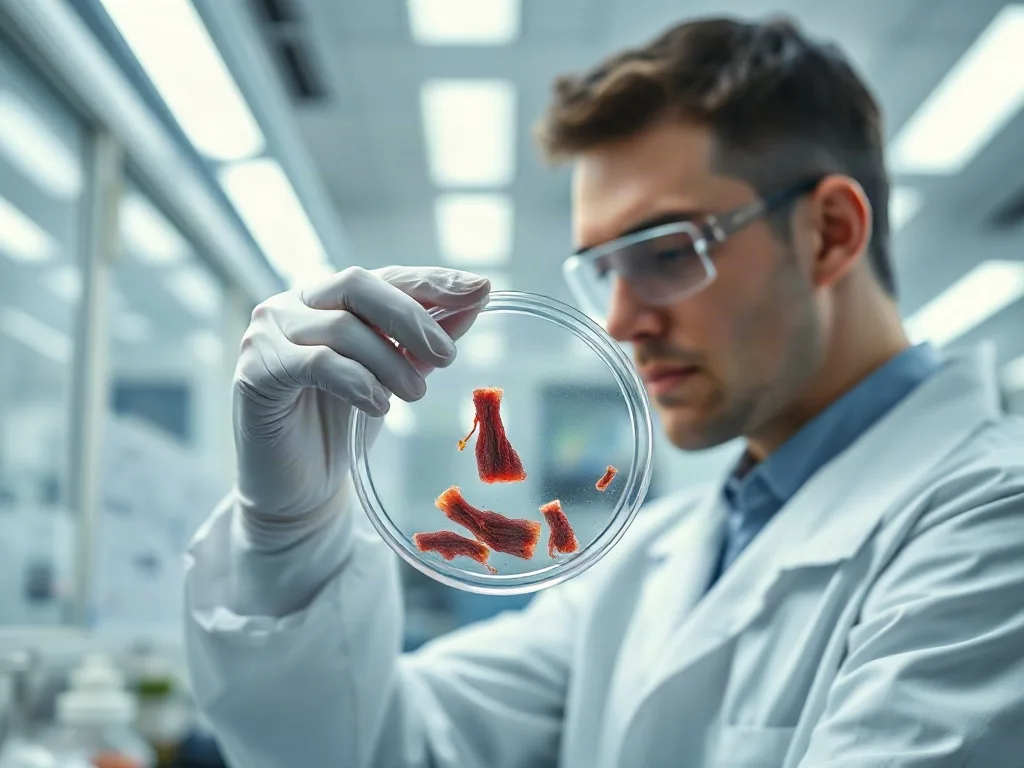
As global populations rise and the demand for protein increases, the agricultural sector faces a significant challenge: how to feed the world without exhausting our natural resources. Cultured meat, often referred to as lab-grown or cultivated meat, has emerged as a potential solution. This technology allows for the production of genuine animal muscle tissue without the need for large-scale livestock farming. By understanding how this process works, its potential benefits, and the current hurdles it faces, we can better evaluate its role in the future of our food systems.
Key takeaways
- Cultured meat is biologically identical to conventional meat but produced in a sterile environment without large-scale livestock slaughter.
- The process significantly reduces land and water use while eliminating the need for antibiotics and manure management.
- Current challenges include high production costs, complex tissue engineering for texture, and the need for scalable bioreactor technology.
- Future food systems will likely feature a hybrid model, combining cultivated proteins with plant-based and sustainably raised conventional meat.
The Science Behind Cultivated Proteins
At its core, cultured meat is real animal meat produced through cellular agriculture. The process begins with a small sample of cells, usually harvested through a painless biopsy from a healthy donor animal. These cells, typically stem cells that have the capacity to differentiate into muscle or fat, are placed into a nutrient-rich growth medium. This medium mimics the environment inside an animal’s body, providing the necessary amino acids, sugars, and vitamins for the cells to proliferate.
Once the cell population has grown sufficiently, they are transferred to a bioreactor—a large vessel that carefully controls temperature, oxygen, and nutrient circulation. To create a structured product like a steak, scientists often use scaffolds, which act as a framework for the cells to grow into specific shapes and textures. The result is a biological product that is chemically and nutritionally identical to conventional meat but produced in a controlled, sterile environment.
Environmental Implications and Resource Efficiency
One of the primary drivers behind the research into cultured meat is its potential to significantly reduce the environmental footprint of protein production. Conventional livestock farming is a major contributor to greenhouse gas emissions, particularly methane, and requires vast amounts of land and water. Cultivated meat production aims to decouple protein generation from the intensive land use required for grazing and feed crop production.
Preliminary life-cycle assessments suggest that once scaled, cultured meat could use up to 99 percent less land and significantly less water than traditional beef production. Furthermore, because the process occurs in a closed system, it eliminates the need for manure management and reduces the runoff that often leads to water pollution. While the energy intensity of bioreactors remains a topic of study, proponents argue that running these facilities on renewable energy could make the process substantially more sustainable than factory farming.
Public Health and Food Safety
The transition to cultivated meat could have profound implications for public health. Traditional animal agriculture is frequently linked to the spread of zoonotic diseases and the overuse of antibiotics, which contributes to the global crisis of antimicrobial resistance. Because cultivated meat is grown in a sterile, controlled environment, the risk of contamination by common foodborne pathogens like Salmonella or E. coli is theoretically much lower.
Additionally, the process allows for a level of nutritional customization that is impossible with conventional livestock. For example, producers could theoretically adjust the fatty acid profiles of the meat to increase levels of heart-healthy omega-3 fats while reducing saturated fats. This precision could make meat a more customizable component of a healthy diet, though these advancements depend on ongoing research and regulatory approval.
Overcoming Manufacturing and Scalability Challenges
Despite the promise, the industry faces significant technical hurdles before cultured meat can become a staple in the average kitchen. Currently, the cost of production remains high, largely due to the expense of growth media and the difficulty of scaling bioreactors to industrial sizes. In the early days of the industry, a single burger cost thousands of dollars to produce; while that price has dropped dramatically, it is not yet competitive with mass-produced animal meat.
Engineering challenges also persist regarding the texture and “mouthfeel” of the final product. While producing ground meat products like nuggets or burgers is relatively straightforward, replicating the complex architecture of a marbled steak requires advanced tissue engineering. Companies are currently investing heavily in developing cost-effective, food-grade scaffolds and optimizing nutrient-rich media that do not rely on fetal bovine serum, which is both expensive and ethically controversial.
The Regulatory Landscape
For cultured meat to reach the consumer market, it must navigate a complex web of food safety regulations. Different countries are taking different approaches to oversight. In some regions, cultivated meat is treated as a novel food, requiring rigorous testing and proof of safety before it can be sold. Regulators are focused on ensuring that the cell lines are stable, the growth media are food-safe, and the final product is nutritionally equivalent to its conventional counterpart.
Singapore was the first country to approve the sale of cultured meat, signaling a global shift in how regulatory bodies view these products. As more countries develop frameworks for approval, the industry will need to demonstrate transparency regarding their production methods and supply chains. Clear labeling standards will also be essential to ensure consumers can make informed choices about the products they purchase.
Ethical Considerations and Animal Welfare
A major ethical advantage of cultured meat is the potential to drastically reduce the number of animals slaughtered for food. For many, this is the primary motivation for supporting the technology. By relying on a small number of donor animals that live out their lives in comfortable conditions, the industry could effectively remove the need for concentrated animal feeding operations (CAFOs) and the associated welfare concerns inherent in large-scale livestock rearing.
However, the shift also raises questions about the future of farming communities. If the demand for conventional meat drops significantly, what happens to the farmers and rural economies that rely on the livestock industry? A just transition would require thoughtful policy interventions to support those whose livelihoods are tied to traditional animal agriculture, potentially by integrating them into the new supply chain or helping them pivot to sustainable plant-based or regenerative farming practices.
Consumer Perception and Cultural Connection
The success of cultured meat will ultimately depend on consumer acceptance. Meat is deeply ingrained in cultures and culinary traditions worldwide, and the idea of “lab-grown” food can feel alienating to some. Marketing and public education will play a crucial role in framing cultivated meat not as a synthetic replacement, but as a technological evolution of the food we already know and love.
Research shows that consumers are generally more open to trying cultivated meat if they understand the benefits to the environment and animal welfare. Transparency about the production process—moving away from the “mad scientist” imagery—will be vital. Culinary applications will also matter; if cultured meat can be prepared, cooked, and enjoyed in the same way as traditional meat, it is far more likely to be adopted by the general public as a standard dietary choice.
Future Outlook: A Hybrid Food System
It is unlikely that cultured meat will completely replace conventional farming in the near future. Instead, we are likely moving toward a hybrid food system where cultivated meat, plant-based proteins, and sustainably raised conventional meat coexist. Each protein source has its place, and the goal should be to create a more resilient, diverse, and efficient food supply.
As technology matures, the synergy between these different methods could lead to significant improvements in global food security. Cultured meat offers a powerful tool to complement existing efforts in regenerative agriculture and plant-based innovation, ensuring that we can continue to meet the world’s nutritional needs while respecting the limits of our planet.
The Chemistry of Bio-Fabrication and Media Optimization
The transition from small-scale laboratory experiments to industrial production hinges on the chemistry of the growth medium. Historically, researchers relied on Fetal Bovine Serum (FBS) to provide the complex cocktail of growth factors, hormones, and proteins necessary for cell proliferation. However, FBS is not only prohibitively expensive and ethically problematic but also introduces significant variability in batch consistency. Current innovation centers on the development of chemically defined, serum-free media. These synthetic alternatives utilize recombinant proteins and plant-derived compounds to trigger cellular growth. Achieving a cost-effective, food-grade media formulation is the “holy grail” of the industry, as the liquid environment accounts for a substantial portion of the final product’s price. Scientists are now exploring upcycling agricultural side streams—such as corn steep liquor or wheat gluten hydrolysates—to create nutrient-dense “broths” that can sustain cellular metabolism at a fraction of the cost of current pharmaceutical-grade supplies.
Bioreactor Engineering and the Challenge of Mass Transfer
Scaling up production requires a departure from traditional stirring-tank bioreactors used in the pharmaceutical industry. When growing animal cells in large volumes, the primary engineering constraint is oxygen diffusion and metabolite removal. Unlike microorganisms, mammalian cells are sensitive to shear stress; if the mixing process is too aggressive, the cells suffer mechanical damage, yet insufficient mixing leads to stagnant “dead zones” where cells starve. Engineers are currently designing custom bioreactors featuring specialized impellers and perfusion systems that mimic the circulatory efficiency of an animal’s vascular system. Innovations in “hollow-fiber” bioreactors and fluidized bed designs are allowing for higher cell densities, which is essential for reaching the economies of scale needed to compete with commodity livestock prices.
The Role of Scaffolding in Culinary Structural Integrity
While ground meat products represent the “low-hanging fruit” of the industry, the challenge of replicating the complex architecture of a steak requires sophisticated scaffolding technology. A scaffold is a 3D structure that provides the physical “template” for cells to attach, migrate, and differentiate. Edible hydrogels, cellulose-based matrices, and even decellularized plant materials (like spinach leaves or fungal mycelium) are being tested as structural frameworks. The goal is to create a scaffold that is not only biocompatible but also contributes to the final product’s flavor, texture, and nutritional profile. For example, a scaffold derived from mushroom mycelium might provide the necessary structural support for muscle cells while simultaneously adding a savory, umami-rich flavor component that enhances the overall eating experience.
Genomic Stability and Cell Line Immortalization
To produce consistent meat products over years of operation, producers must rely on cell lines that can divide indefinitely without losing their identity or accumulating mutations. This involves the process of immortalization, where cells are adapted to bypass the “Hayflick limit”—the finite number of times a cell can divide before it senesces. While this is standard practice in medical research, applying it to food requires extreme vigilance regarding genomic stability. Regulators require proof that the immortalized cell lines do not exhibit oncogenic (cancerous) characteristics. Companies are utilizing advanced CRISPR-Cas9 gene editing and high-throughput screening to ensure that the cell lines remain robust, healthy, and genetically stable over thousands of generations, ensuring the safety and uniformity of the meat produced in every batch.
Supply Chain Integration and the “Cellular Factory”
The logistics of a future protein supply chain will look radically different from today’s feedlot-to-slaughterhouse model. Instead of sprawling rural operations, cultivated meat facilities—or “cellular factories”—can be strategically located near urban centers to minimize the carbon footprint associated with cold-chain logistics and transportation. This decentralization would allow for “just-in-time” production, where fresh meat is cultured and processed in localized hubs. Furthermore, the integration of these facilities into the existing food industry requires a new class of specialized labor: bioprocess engineers, cell biologists, and food scientists who can operate these high-tech systems. As the industry matures, we may see a transition where conventional meat processing plants are repurposed into hubs that blend cultivated cells with plant-based ingredients to create high-quality, hybrid consumer products.
Navigating Intellectual Property and Open-Source Innovation
The rapid growth of the cultivated meat sector has triggered a “patent gold rush,” with companies aggressively securing intellectual property rights for proprietary media formulations, bioreactor designs, and scaffold materials. While this protects the massive investments made by venture capital, it also creates potential bottlenecks for industry-wide progress. To counter this, a movement toward pre-competitive collaboration has emerged. Organizations like the Good Food Institute facilitate open-access research to solve foundational hurdles—such as lowering the price of growth factors—that benefit every player in the space. Balancing the need for proprietary innovation with the necessity of shared technological standards will be critical for the industry to reach the critical mass required for global food security.
Frequently Asked Questions
Is cultured meat technically vegan? The answer depends on your definition of veganism. While cultured meat does not require the slaughter of animals, it is derived from animal cells. Some vegans may choose to consume it because it eliminates animal suffering, while others may avoid it due to the original animal source. It is currently categorized as a novel animal product.
Does it taste the same as traditional meat? Because cultured meat is biologically identical to conventional meat, it carries the same flavor profile. However, the exact taste depends on the specific cell lines used and the nutrient composition of the growth medium. As the technology advances, producers are becoming increasingly adept at replicating the specific textures and fat marbling that define premium meat products.
Are there any hidden health risks? Cultured meat is subject to the same rigorous food safety standards as any other meat product. Because it is grown in a sterile environment, it is arguably safer regarding bacterial contamination than conventional meat. There is no evidence to suggest that consuming lab-grown tissue poses unique health risks compared to conventional protein sources.
How long until it is available in grocery stores? Cultured meat is already being served in select restaurants in specific markets. Widespread availability in grocery stores is expected to grow over the next decade as production costs continue to fall and regulatory pathways become more streamlined in various countries.
What is the biggest barrier to widespread adoption? The primary barrier is cost-effective scalability. Producing meat at an industrial scale that is affordable for the average consumer requires significant infrastructure investment and the development of cheaper, plant-based growth media that can support large-scale cellular growth in bioreactors.
Related posts:
 Leonardo DiCaprio Backs Beyond Meat
 The Meat Blend Trend That’s Taking Over Grocery Stores
 Beyond Breakfast: The Plant-Based Sausage That’s Changing the Morning Game
 Understanding Meat Extenders
 The Plant-Based Revolution Is Just Getting Started
 Vegan vs Plant-Based: Which is Healthier?
 TGI Friday’s Just Started Serving Beyond Meat and Everything Has Changed
 Wait, Are You Vegan—Or Are You Plant-Based? Learn the Difference…