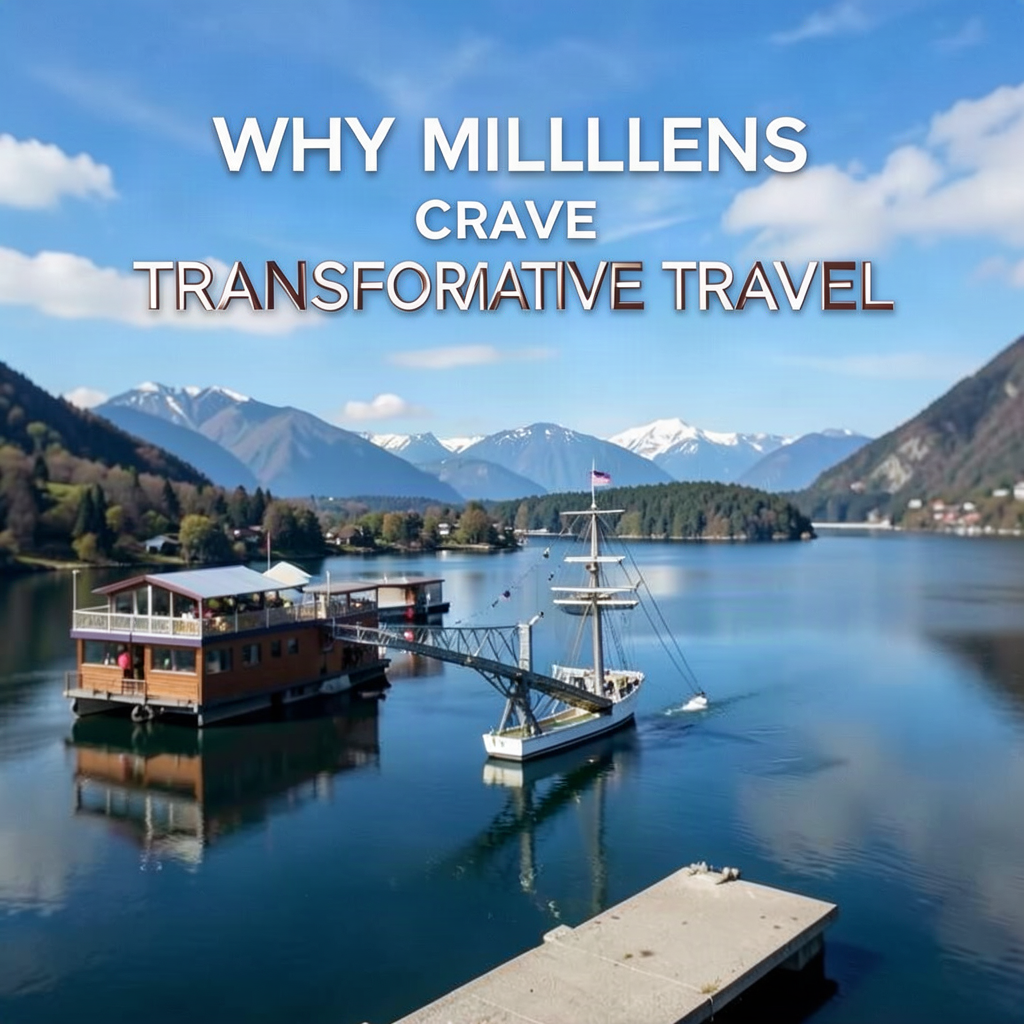
For decades, the standard definition of a vacation was simple: a temporary escape from the pressures of daily life. It involved a flight to a sunny destination, a curated itinerary of famous landmarks, and a return home with a suitcase full of souvenirs and a camera roll full of photos. However, for the Millennial generation, this model of “sightseeing” is increasingly feeling hollow. There is a growing movement away from passive consumption and toward something far more profound: transformative travel.
Transformative travel is not about where you go, but who you become as a result of the journey. It is a conscious shift from being a tourist to becoming a traveler, prioritizing internal growth, authentic connection, and a deeper understanding of the world over the mere checking of boxes on a bucket list. This craving for transformation is not an accidental trend; it is a response to the unique socio-economic and psychological pressures that have shaped the Millennial experience.
The Shift from Consumption to Experience
Millennials were the first generation to fully transition into the “experience economy.” While previous generations may have measured success by the accumulation of material goods—the bigger house, the newer car—Millennials have largely shifted their value system toward the accumulation of memories and personal growth. This shift is partly a reaction to the instability of the early 21st century, where traditional markers of stability felt precarious.
When the goal is no longer to possess, but to experience, the nature of travel changes. A luxury resort with an all-inclusive buffet no longer satisfies the itch for adventure because it offers a sanitized version of reality. Transformative travel seeks the opposite: the raw, the unexpected, and the challenging. Millennials are seeking journeys that demand something of them—their patience, their empathy, and their willingness to be uncomfortable. By engaging with environments that are vastly different from their own, they are able to strip away the social masks they wear in their professional and social lives, allowing a more authentic version of themselves to emerge.
Escaping the Digital Grind and Chronic Burnout
The Millennial generation is perhaps the most connected in human history, yet many report feeling an unprecedented sense of isolation and exhaustion. The rise of the “always-on” culture, fueled by smartphones and the normalization of remote work, has blurred the boundaries between professional obligations and personal sanctuary. Burnout has become a systemic issue rather than an individual failure.
In this context, transformative travel serves as a critical mechanism for mental health recovery. It is not merely a “break” from work, but a “hard reset” for the nervous system. Many Millennials are opting for digital detoxes—trips where connectivity is limited or nonexistent—to silence the noise of notifications and the pressure of social comparison. When the digital tether is cut, the traveler is forced to reconnect with their immediate physical surroundings and their own internal dialogue.
This process of unplugging often leads to a state of mindfulness that is impossible to achieve in a city environment. Whether it is through a silent retreat in the mountains of Bhutan or a hiking expedition through the Patagonian wilderness, the goal is to move from a state of constant reaction to a state of intentional presence. This mental space is where transformation happens, as it allows individuals to process suppressed emotions and re-evaluate their life priorities without the interference of an algorithm.
Seeking Authenticity in a Curated World
We live in an era of the “curated life.” From Instagram filters to LinkedIn profiles, Millennials have spent a significant portion of their adult lives managing a digital persona. This constant curation creates a psychological tension—a longing for something that is genuine, unpolished, and real. Transformative travel is the antidote to this curation.
The craving for authenticity manifests as a desire for “deep travel.” Instead of visiting five European capitals in ten days, a transformative traveler might spend a month in a single village in Tuscany or a neighborhood in Kyoto. They seek out interactions that cannot be scripted: sharing a meal with a local family, learning a traditional craft from an artisan, or navigating a language barrier through gestures and laughter.
These authentic encounters challenge the traveler’s preconceived notions about other cultures and, by extension, their own. When you move beyond the tourist zones, you encounter the complexities of human existence—the struggles, the triumphs, and the shared values that transcend borders. This realization—that we are more alike than we are different—is a cornerstone of the transformative experience, fostering a sense of global empathy that a standard tour package simply cannot provide.
The Pursuit of Personal Growth and Self-Discovery
For many Millennials, travel has become a primary tool for identity exploration. In a world where career paths are non-linear and traditional milestones (like home ownership) are often delayed, the journey outward becomes a journey inward. Transformative travel is often used as a catalyst for solving internal crises or navigating major life transitions, such as a career change, the end of a relationship, or a quarter-life crisis.
The magic of transformation lies in the “discomfort zone.” When a person is stripped of their usual support systems and familiar routines, they are forced to rely on their own resourcefulness. Navigating a foreign transit system, managing a budget in an unfamiliar currency, or overcoming a fear of heights while trekking in the Andes builds a specific kind of confidence known as self-efficacy. This is the belief in one’s ability to succeed in specific situations or accomplish a task.
As Millennials conquer these small, tangible challenges, they realize that the limitations they felt at home were often psychological rather than physical. The resilience developed on the road translates back into their professional and personal lives, giving them the courage to take risks and the perspective to handle failure with grace.
Ethical Travel and the Rise of Global Citizenship
Millennials are increasingly conscious of the footprint they leave behind. There is a growing rejection of “extractive tourism”—the practice of taking photos and experiences from a place without giving anything back. This has led to the rise of regenerative travel, which aims not just to minimize harm (sustainability) but to actively improve the destination.
Transformative travel often incorporates elements of service and learning. This might include participating in community-led conservation projects, supporting fair-trade cooperatives, or engaging in educational exchanges. However, the focus has shifted away from the “savior complex” of early voluntourism toward a model of mutual exchange. The goal is no longer to “save” a community, but to learn from it.
By positioning themselves as students of the world, Millennial travelers develop a sense of global citizenship. They begin to see the interconnectedness of global economics, climate change, and social justice. This expanded consciousness transforms the traveler’s worldview, leading to more ethical consumption habits and a more compassionate approach to diversity and inclusion upon their return home.
The Psychology of the “Aha!” Moment
From a psychological perspective, transformative travel leverages the power of novelty to trigger cognitive flexibility. When we are in a familiar environment, our brains operate on autopilot, following established neural pathways. We see what we expect to see. However, when we are immersed in a completely foreign environment, the brain is forced to wake up. Every sight, sound, and smell is new, requiring the brain to process information more deeply.
This state of heightened awareness often leads to “aha!” moments—sudden realizations or shifts in perspective that can alter a person’s life trajectory. For example, a traveler might realize that their obsession with corporate success is a projection of parental expectations after seeing the contentment of a slower-paced agrarian society. Or, they might discover a latent passion for art after spending a week in a ceramics workshop in Morocco.
These insights are powerful because they are experiential rather than intellectual. You don’t just *know* that life can be lived differently; you have *felt* it. This emotional anchoring makes the transformation more permanent, providing a mental touchstone that the traveler can return to during times of stress or uncertainty in their daily life.
Practical Ways to Plan a Transformative Journey
Transformative travel doesn’t require a massive budget or a year-long sabbatical; it requires a shift in intention. If you are looking to move beyond traditional tourism, consider these actionable strategies:
- Practice Slow Travel: Instead of a multi-city itinerary, pick one location and stay for at least two weeks. Rent an apartment in a residential neighborhood rather than staying in a hotel in the city center. Shop at the local market, find a favorite coffee shop, and observe the rhythm of daily life.
- Engage in Skill-Based Learning: Rather than just visiting a museum, take a course. Whether it’s a language immersion program in Spain, a cooking school in Thailand, or a meditation retreat in India, learning a new skill forces you to engage with the culture on a deeper level.
- Seek Out “Uncomfortable” Experiences: Challenge yourself to do one thing that scares you on every trip. This could be eating something unfamiliar, starting a conversation with a stranger, or taking a solo trip for the first time.
- Prioritize Local Connection: Use platforms that connect travelers with locals for authentic experiences, or simply ask a local for their favorite non-tourist spot. Listen more than you speak.
- Set an Intention: Before you leave, ask yourself: “What part of myself am I looking to grow?” or “What question am I trying to answer?” Having a guiding intention helps you make choices that align with transformation rather than distraction.
Overcoming the Barriers to Transformative Travel
The primary obstacles to this style of travel are typically time, money, and fear. However, these can be managed with a shift in perspective. For those with limited budgets, consider “work-exchange” programs like WWOOF (World Wide Opportunities on Organic Farms) or Worldpackers, where you provide a few hours of labor in exchange for food and lodging. This naturally embeds you in a local community and removes the sterile barrier of a hotel.
For those struggling with time, remember that transformation can happen in a long weekend if the intention is right. A mindful solo retreat in a nearby nature preserve can be more transformative than a rushed trip to an overseas destination. The key is the quality of presence, not the distance traveled.
Fear is perhaps the most significant barrier. The fear of the unknown is what keeps most people in the “tourist bubble.” However, it is precisely this fear that signals the opportunity for growth. By acknowledging the fear and stepping through it, the traveler proves to themselves that they are capable of handling uncertainty—a skill that is invaluable in every area of modern life.
The Philosophy of Solitude: Moving from Loneliness to Aloneness
While the existing discussion on personal growth touches upon the discomfort of solo travel, there is a deeper psychological distinction to be made between loneliness and solitude. For many Millennials, the craving for transformative travel is actually a craving for *solitude*—the state of being alone without being lonely. In a world of constant social accessibility, the ability to be alone with one’s own thoughts has become a rare and precious commodity. When a traveler chooses to navigate a foreign landscape without the buffer of a companion, they encounter the “mirror effect.” Without a partner to validate their perceptions or distract them from their internal monologue, the traveler is forced to confront their own unfiltered reactions to the world.
This process often begins with a period of acute anxiety. The first few days of a solo journey are frequently characterized by a hyper-awareness of one’s vulnerability. However, once the initial panic subsides, a profound shift occurs. The traveler begins to notice details they would have ignored in a group: the specific scent of a rain-drenched alley in Lisbon, the subtle cadence of a stranger’s laughter, or the precise moment a feeling of inadequacy shifts into a feeling of capability. This is where the transformation happens—not in the destination, but in the reclamation of the self. By mastering the art of aloneness, the traveler develops an internal locus of control, realizing that their happiness and security are not dependent on external validation but are generated from within.
An edge case in this experience is the “social paradox” of solo travel. Ironically, those who travel alone often find it easier to form deep, spontaneous connections with locals and other travelers. Because they lack the protective bubble of a pre-existing social group, they are more approachable and more open to the vulnerability required for genuine connection. The transformative element here is the realization that solitude does not mean isolation; rather, it is the prerequisite for the most authentic forms of social engagement.
Modern Pilgrimages: Seeking the Sacred in a Secular Age
Beyond the pursuit of mental health and authenticity lies a more spiritual dimension of transformative travel. While many Millennials identify as secular or “spiritual but not religious,” there is a palpable longing for the sacred—a sense of connection to something larger than the individual self. This has led to a resurgence of the modern pilgrimage. Unlike traditional religious pilgrimages, these journeys are often driven by an existential quest for meaning rather than a desire for divine intervention. The goal is not necessarily to reach a holy site, but to engage in the *peregrinatio*—the act of wandering as a form of prayer or meditation.
Consider the surge of young adults embarking on the Camino de Santiago in Spain. While some walk for religious reasons, many do so to process grief, navigate a career transition, or simply to experience the rhythmic simplicity of walking for weeks on end. The transformation occurs through the combination of physical exertion and mental vacancy. As the body tires, the ego weakens, allowing deeper insights to surface. This is similar to the Japanese practice of *Shinrin-yoku* (forest bathing), where the intention is to immerse oneself in nature to heal the spirit. In these contexts, the landscape becomes a catalyst for a spiritual awakening that is grounded in the physical world rather than a theological dogma.
The challenge for the transformative traveler in this space is avoiding the trap of “spiritual tourism,” where the goal becomes the acquisition of a spiritual aesthetic (e.g., taking photos in a meditation pose) rather than the actual internal work. True transformation in a spiritual journey requires a willingness to sit with the void—to accept the silence and the boredom that often precede a breakthrough. When the traveler stops seeking a specific “revelation” and instead accepts the journey as the destination, they often find the peace they were searching for in the very act of seeking.
Navigating Climate Grief through Conscious Exploration
A critical, often unspoken driver of Millennial travel is the psychological weight of climate anxiety. There is a profound tension between the desire to witness the beauty of the planet and the guilt associated with the carbon footprint of travel. This has given rise to a complex emotional state known as “last-chance tourism,” where travelers rush to see melting glaciers in Patagonia or bleaching coral reefs in the Great Barrier Reef before they disappear. While this can feel like a morbid pursuit, for many, it is a transformative process of mourning and awakening.
The transformation occurs when the traveler moves from the role of a passive observer of decay to an active participant in preservation. This shift is characterized by a move toward “climate-positive” travel, where the itinerary is designed to offset its impact through direct ecological contribution. For example, instead of a standard safari, a traveler might engage in a citizen-science project tracking wildlife migrations or participate in a reforestation effort in the Amazon. The psychological shift here is from *consumption* (seeing the sight) to *stewardship* (protecting the sight). This transition helps alleviate the paralysis of climate grief by replacing helplessness with agency.
The edge case here is the “eco-guilt spiral,” where the anxiety over travel emissions prevents the traveler from experiencing the very connections to nature that would inspire them to be an environmental advocate. The transformative resolution is the realization that the empathy fostered by seeing a fragile ecosystem firsthand is often a more powerful catalyst for long-term activism than the marginal carbon saving of staying home. By consciously choosing slower, lower-impact modes of transport—such as trains over short-haul flights—the traveler integrates their ethics into their exploration, turning the journey itself into a statement of value.
The Digital Nomad Paradox: Integration vs. Escape
While the existing article discusses escaping the digital grind, there is a burgeoning movement of Millennials who seek transformation not through a temporary break, but through the permanent integration of work and travel. Digital nomadism, when approached as a transformative practice rather than a lifestyle aesthetic, offers a unique psychological trajectory. The transformation here is not a “hard reset” but a “continuous flow.” By decoupling their identity from a fixed geographic location and a corporate office, the nomad is forced to redefine what “home” and “stability” actually mean.
However, this lifestyle introduces a specific set of challenges, most notably the “novelty fatigue.” When every environment is new and every interaction is transient, the brain can enter a state of chronic overstimulation. The transformative lesson in this phase is the discovery that external variety cannot substitute for internal stability. Many nomads eventually hit a wall where the excitement of a new city in Southeast Asia or a beach in Portugal no longer provides the same dopamine hit. This plateau is a critical turning point; it forces the traveler to stop looking outward for stimulation and start building an internal architecture of contentment.
The most successful transformative nomads are those who transition from “hopping” to “nesting.” They might spend three to six months in one location, building deeper community ties and engaging in local civic life. This hybrid approach allows them to maintain the freedom of the road while satisfying the human need for belonging. The transformation is the realization that true freedom is not the absence of ties, but the ability to choose which ties to form and where to plant oneself, regardless of the coordinates on a map.
Ancestral Journeys and the Quest for Rootedness
In an era of unprecedented mobility and digital fragmentation, many Millennials are experiencing a sense of “rootlessness.” This has sparked a trend of ancestral travel—journeys specifically designed to visit the homelands of one’s ancestors. This is not mere genealogy or family history research; it is a psychological quest for identity. For those who grew up in diaspora or in multicultural environments, visiting the village where a grandparent was born can be a profound act of reclamation. It is an attempt to bridge the gap between the stories told in childhood and the physical reality of the land.
The transformative power of ancestral travel lies in the reconciliation of disparate identities. When a traveler stands in a place that shaped their lineage, they often experience a visceral sense of belonging that transcends their current social or professional status. They begin to see themselves not as isolated individuals, but as a single link in a long chain of human experience. This perspective provides a powerful antidote to the loneliness and instability of modern life, offering a sense of historical continuity and grounding.
An edge case occurs when the ancestral reality conflicts with the family myth. A traveler might discover that their ancestors were not the idealized figures they were portrayed as, or they may find that the homeland is now a place of political or social turmoil. Rather than being a disappointment, this dissonance is often the most transformative part of the journey. It forces the traveler to confront the complexities of history, the nature of memory, and the reality of human imperfection. The transformation is the movement from a curated family narrative to a complex, honest understanding of one’s heritage.
The Architecture of Reverse Culture Shock: Sustaining the Shift
The most difficult phase of transformative travel is not the journey itself, but the return. Reverse culture shock is the cognitive dissonance that occurs when a traveler returns home with a shifted perspective, only to find that their environment and social circles remain exactly as they left them. The “new self” created in the mountains of Peru or the temples of Kyoto often clashes violently with the “old self” required to navigate a corporate boardroom or family expectations. Without a deliberate strategy, the insights gained during travel can quickly evaporate, replaced by the crushing gravity of routine.
To sustain the transformation, the traveler must engage in what can be called “lifestyle redesign.” This involves auditing the habits and beliefs that felt suffocating before the trip and consciously deciding which ones to discard. For example, a traveler who discovered the joy of a slower pace of life in rural Italy might implement a “slow morning” ritual at home, dedicating the first hour of the day to reflection rather than emails. Or, someone who developed a deep sense of global empathy might shift their professional focus toward social impact or sustainable business practices. The goal is to translate the *feeling* of the journey into the *structure* of daily life.
The danger here is the “nostalgia trap,” where the traveler spends their time longing for the trip rather than integrating its lessons. This occurs when the journey is viewed as a peak experience that is separate from “real life.” The transformative shift happens when the traveler realizes that the qualities they admired in their travel self—the courage, the curiosity, the openness—were not products of the destination, but latent capacities within themselves. By recognizing that the “traveler’s mindset” is a portable skill, they can apply the same curiosity and resilience to their hometown that they applied to a foreign city, effectively turning their entire life into a transformative journey.
Frequently Asked Questions
A: Luxury travel focuses on comfort, exclusivity, and the fulfillment of desires. It is often about being pampered and avoiding stress. Transformative travel, while it can occasionally be luxurious, focuses on growth, challenge, and the fulfillment of needs—specifically the need for meaning and connection. While luxury travel seeks to avoid discomfort, transformative travel often embraces it as a catalyst for change.
A: Absolutely. Transformation is about the shift in perspective, not the stamps in your passport. Visiting a different region of your own country, engaging with a community different from your own, or embarking on a wilderness trek in a local national park can all be transformative if you approach the journey with curiosity, humility, and an open mind.
A: The key is to move from a “helping” mindset to a “learning” mindset. Avoid organizations that promise you can “change lives” in a week; instead, look for community-led initiatives where the local population defines the needs and manages the projects. Prioritize transparency, fair wages for local guides, and experiences that support the local economy directly rather than through large international corporations.
A: Start small. Try a “solo date” in your own city, then a weekend trip to a nearby town. When you go abroad, book your first few nights in a highly-rated hostel or a guesthouse with a social atmosphere. This provides a safety net of other travelers while still allowing you the independence of solo exploration. Remember that feeling nervous is a sign that you are expanding your boundaries.
A: The “re-entry” phase is the most critical part of transformative travel. To prevent the insights from fading, keep a journal during your trip and review it upon your return. Identify one or two specific habits or perspectives you gained—such as a slower pace of life or a new way of communicating—and consciously integrate them into your daily routine. Create a “ritual of return” to honor the person you became on the journey.
Related posts:
 What is Travel Insurance and Do You Need It?
 Smart Tips for Traveling on a Budget
 Millennial Career Changes
 This Dream Job Will Pay You and Your Friends to Explore Europe
 Solo Travel as the Ultimate Self-Love Practice
 Millennial Fertility Perspectives
 Transformative Travel Experiences
 How to Fly Safely After Lifted Mask Mandate