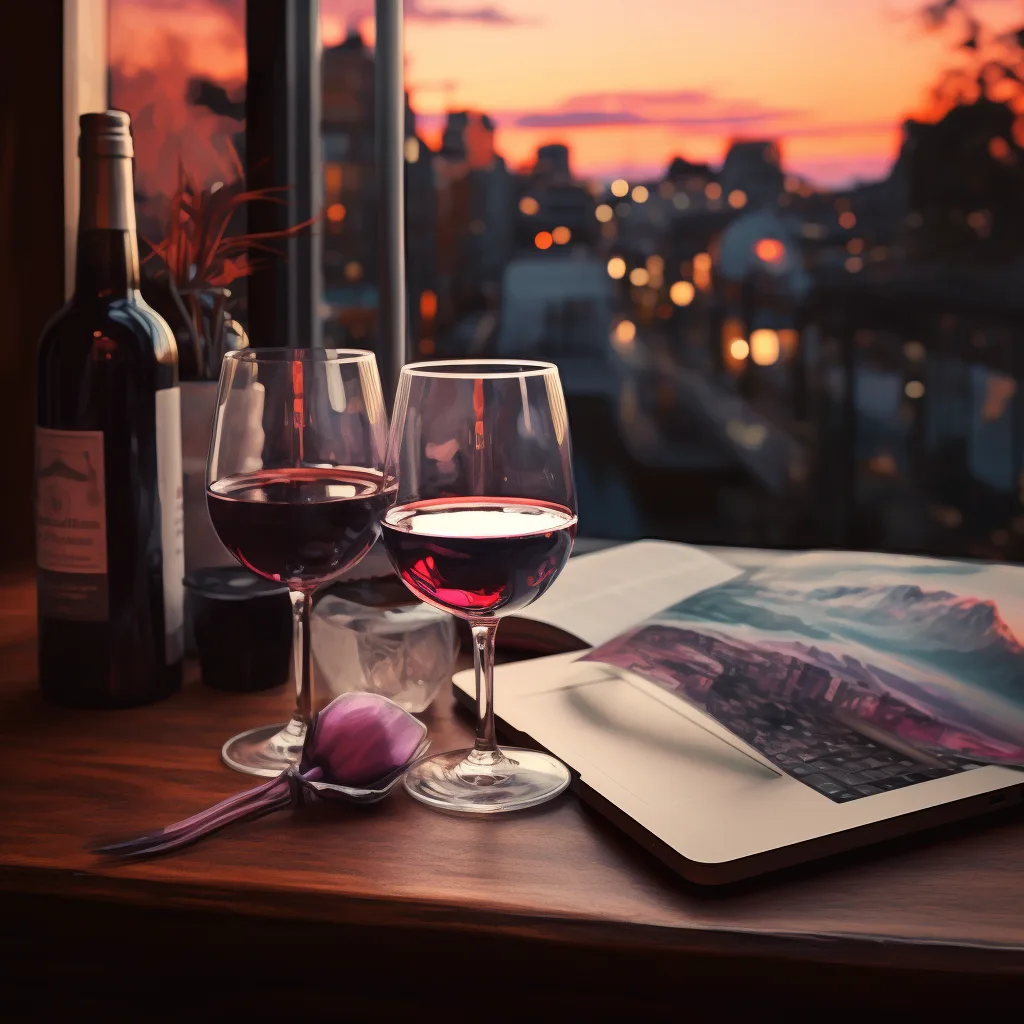
Decompress with a Virtual Wine Tasting
After a stressful day of back-to-back Zoom meetings at our makeshift home offices, it’s understandable to feel drained. Let’s face it – remote work can take its toll, even for the biggest extroverts among us. When cabin fever sets in, it’s time to log off and unwind. We could all use a little self-care right about now.
Key takeaways
- Practice the Five S’s—See, Swirl, Sniff, Sip, and Savor—to move from work stress into a mindful, meditative state.
- Organize Horizontal or Vertical tastings to compare winemakers, regions, or the historical evolution of specific vintages across different years.
- Use chemical pairing principles, such as matching high-acid wines with tart foods and high-tannin reds with proteins or fats.
- Enhance digital connection with warm, indirect lighting and external microphones to improve visual and audio fidelity for all participants.
- Preserve opened bottles using vacuum pumps or inert gas sprays to maintain wine quality for several days after the event.
If your regular happy hour crew can’t meet at the usual watering hole, bring the fun online instead. A virtual wine tasting invites connection, even from a social distance. This could be just the antidote we need for the isolation blues.
How to Host a Virtual Wine Tasting
A virtual wine tasting allows us to come together and celebrate life’s simple pleasures. Follow these tips to lift your spirits:
- Choose a theme – Italian reds or biodynamic whites work nicely.
- Select 3-5 reasonably priced wines readily available in your area.
- Set a date/time and invite friends via Zoom or Skype.
- Encourage guests to have tasting sheets on hand to record flavors.
- Take turns describing aroma and taste profiles bottle by bottle.
- Share your favorite food pairings as you sample side by side.
Making Connections from Afar
Though physically apart, a virtual happy hour allows us to come together. Here are some ideas to foster meaningful connections during your online gathering:
- Share when, where and with whom you last enjoyed each wine selection in person. Reminisce.
- Ask thoughtful questions that bring out stories: What drew you to this wine? When did you discover your love of Barolo?
- Discuss the vision, values or history behind each wine or vineyard.
- Debate organic vs. biodynamic practices and the implications of natural winemaking.
Self-Care While Social Distancing
In troubled times like these, self-care matters more than ever. A virtual wine tasting allows us to nourish our bodies and our connections. Be sure to:
- Check in about how everyone is holding up and what would help them feel supported right now.
- Infuse your virtual gathering with lighthearted laughter – share a funny meme or story.
- Lift your glasses in a heartfelt, hopeful toast – to health, family, friendship and new beginnings.
Stay centered in this moment together, even across the miles. Allow the wine, conversation and camaraderie to unwind your worries, at least for now. The rest can wait.
The Art of the Professional Pour: Sensory Evaluation Techniques
To truly transition from a standard work-from-home afternoon to an elevated tasting experience, one must move beyond mere consumption and into the realm of sensory evaluation. This process, often referred to by sommeliers as the “Five S’s,” provides a structured framework that slows down the pace of the evening, allowing the brain to switch from the high-frequency demands of Slack notifications to a more mindful, meditative state.
Start with the See phase. Hold your glass against a neutral white background—perhaps a clean sheet of printer paper from your home office. Observe the color at the core versus the rim. A young Cabernet Sauvignon might display a deep, opaque purple, while an aged Pinot Noir leans toward a translucent brick or garnet. This visual cue tells a story of age and grape skin thickness before you even take a sip. Next is the Swirl. This isn’t just for show; it is a mechanical process of aeration. By increasing the surface area of the wine and coating the sides of the glass, you release volatile aromatic compounds. If you are worried about spills on your keyboard, keep the base of the glass firmly on the desk and move it in small, tight circles.
The Sniff is perhaps the most critical stage. Instead of one long inhalation, try three short, sharp sniffs. This prevents olfactory fatigue and allows your brain to categorize different layers of scent. Look for primary aromas (fruit and floral), secondary aromas (derived from fermentation and oak, like brioche or vanilla), and tertiary aromas (notes of leather, tobacco, or dried leaves found in older wines). When you finally Sip, do not swallow immediately. Let the wine coat your entire tongue to engage all your taste buds. Notice the structural elements: the acidity that makes your mouth water, the tannins that create a drying sensation on your gums, and the alcohol that provides a sense of weight or heat. Finally, the Savor phase involves evaluating the finish. How long do the flavors linger after you swallow? A long, evolving finish is often the hallmark of a high-quality wine.
Strategic Curation: Vertical, Horizontal, and Blind Tasting Structures
While the existing article suggests choosing a theme like “Italian reds,” you can deepen the educational value of your happy hour by employing specific curation strategies used by professionals. One such method is the Horizontal Tasting. In this setup, you select wines from the same vintage (year) and the same region, but from different producers. For instance, you might compare three different 2019 Malbecs from the Uco Valley in Argentina. This highlights the “hand of the winemaker” and the subtle differences in micro-climates and soil compositions, even when the grape and weather conditions are largely the same.
Alternatively, a Vertical Tasting offers a historical perspective. Here, you choose the exact same wine from the same producer but across different years—for example, a 2015, 2017, and 2019 Napa Valley Chardonnay. This is a fascinating way to witness how a wine evolves over time and how different weather patterns (a hot, dry year versus a cool, rainy one) manifest in the bottle. It is a masterclass in the concept of vintage variation, providing a tangible link to the passage of time that often feels blurred during long periods of remote work.
For those seeking a more interactive and competitive edge, the Blind Tasting is the gold standard. Have all participants wrap their bottles in aluminum foil or place them in identical brown paper bags, secured with a rubber band. Assign each bottle a letter or number. As you taste through the lineup, everyone must guess the grape variety, the region of origin, and the price point. This removes brand bias and forces guests to rely entirely on their palates. It often leads to surprising revelations, such as a budget-friendly “grocery store gem” outperforming a prestigious, expensive label in a blind lineup.
Molecular Gastronomy at Home: The Science of Flavor Synergy
Pairing wine with food is often treated as a matter of subjective preference, but there is a significant amount of chemical science involved that can transform your virtual happy hour into a culinary workshop. Understanding how basic taste elements interact can help you avoid common pairing pitfalls. For example, acid loves acid. If you are serving a salad with a tart vinaigrette, you need a high-acid wine like a Sauvignon Blanc or a Dry Riesling. If the wine has lower acidity than the food, it will taste flat and flabby.
Consider the role of tannins and protein. Tannins are polyphenols found in red wine skins that bind to proteins. When you sip a high-tannin Cabernet Sauvignon, the tannins bind to the proteins in your saliva, creating that dry, astringent feeling. However, when you pair that wine with a fatty ribeye steak or a piece of aged cheddar, the tannins bind to the food’s proteins and fats instead, softening the wine and making it taste fruitier and smoother. This is the scientific reason why “steak and Cab” is a classic pairing.
Edge cases often arise with spicy foods or sweets. Heat and alcohol are a dangerous combination; high-alcohol wines (14.5% ABV and above) will actually amplify the burn of capsaicin in spicy Thai or Mexican dishes, making the experience unpleasantly hot. Instead, reach for a low-alcohol, slightly sweet wine like a Moscato d’Asti or an off-dry Chenin Blanc. The sugar acts as a cooling agent on the palate. For dessert pairings, the golden rule is that the wine must be sweeter than the food. If you pair a dry sparkling wine with a piece of wedding cake, the wine will taste bitter and metallic. Match the sugar levels to ensure the wine retains its character.
Technical Production for the Virtual Host: Lighting, Audio, and Visual Fidelity
Since the primary medium of this gathering is digital, the quality of your “production” significantly impacts the mood. To move away from the “work meeting” vibe, start by adjusting your environment. Avoid the overhead fluorescent lights that characterize most home offices. Instead, use warm, indirect lamp lighting to create an intimate, lounge-like atmosphere. If you want to showcase the wine’s color to your guests, place a small, cool-toned LED light or even a smartphone flashlight behind the glass (pointing away from the camera) to illuminate the liquid from within.
Audio clarity is equally vital. While your laptop’s built-in microphone might suffice for a quick status update, a virtual tasting involves a lot of nuanced descriptions. If possible, use an external microphone or a high-quality headset to minimize background noise like whirring refrigerator fans or distant traffic. This ensures that when someone describes the “faint hint of wet slate” in their Riesling, the message isn’t lost in a sea of digital static. Furthermore, encourage guests to use “Gallery View” rather than “Speaker View.” This mimics the feeling of sitting around a table, allowing for non-verbal cues and shared reactions to be visible to everyone simultaneously.
Consider the camera angle. Most webcams are positioned to capture your face, but for a wine tasting, you may want to occasionally tilt the screen down to show the wine in the glass or the label of the bottle. Some advanced hosts use a secondary “top-down” camera (often a smartphone mounted on a tripod) to provide a clear view of the pouring process and the charcuterie board. This multi-angle approach adds a layer of professional polish that makes the event feel like a special occasion rather than another hour of screen time.
The Sommelier’s Toolkit: Essential Hardware and Preservation Methods
Hosting a tasting often means opening several bottles at once, which poses a practical problem: how to prevent the wine from oxidizing and spoiling before you can finish it. Investing in a few key tools can extend the life of your selections well beyond the happy hour. The most basic tool is the vacuum pump (such as a Vacu Vin), which extracts air from the bottle and seals it with a rubber stopper. While effective for 2–3 days, it isn’t a permanent solution as it never removes 100% of the oxygen.
For a more advanced approach, inert gas sprays (like Private Preserve) use a blend of nitrogen, carbon dioxide, and argon to create a protective layer on top of the wine, preventing oxygen from touching the surface. This can keep a bottle fresh for up to a week. The gold standard, however, is the Coravin system. This device uses a hollow needle to pierce the cork without removing it, pressurized with argon gas to pour the wine. Because the cork reseals itself naturally, the remaining wine never comes into contact with oxygen and can continue to age for months or even years. This is particularly useful if you want to sample a very expensive bottle as part of your tasting without feeling pressured to drink the whole thing that night.
Beyond preservation, the hardware of the pour matters. A decanter is not just a decorative centerpiece; it serves the dual purpose of aerating young, tight red wines and separating sediment from older, matured bottles. If you don’t have a formal decanter, a clean glass pitcher or even a large Mason jar can serve the same purpose. The goal is to let the wine “breathe,” which softens harsh tannins and opens up the aromatic profile. For white wines, ensure you have an insulated wine sleeve or a small bucket with a mix of ice and water (ice alone doesn’t cool as efficiently as an ice-water slurry) to maintain the proper serving temperature throughout the call.
Decoding the Bouquet: A Guide to Primary, Secondary, and Tertiary Aromas
One of the most rewarding aspects of a virtual tasting is developing the vocabulary to describe what you are smelling. Wine professionals categorize aromas into three tiers. Primary aromas come directly from the grape variety and the terroir. These are the most obvious notes: fruit (citrus, stone fruit, tropical fruit, red fruit, black fruit), flowers (honeysuckle, violet, rose), and herbs (mint, grass, bell pepper). If you are tasting a New Zealand Sauvignon Blanc, you will likely be hit with primary aromas of passionfruit and freshly cut grass.
Secondary aromas are the byproducts of the winemaking process. If a wine has undergone malolactic fermentation (common in Chardonnay), it might smell like butter or cream. If it was aged in oak, you might detect vanilla, baking spices (cinnamon, nutmeg), cedar, or even toasted bread. If the wine was aged on its “lees” (dead yeast cells), look for yeasty, biscuit-like qualities. Identifying these notes helps you understand the technical choices the winemaker made in the cellar.
Finally, tertiary aromas develop as a wine ages in the bottle. This is where wine gets truly complex and, for some, an acquired taste. Fresh fruit notes turn into dried fruit (raisins, prunes). You might find savory notes like leather, forest floor, mushroom, tobacco, or even gasoline (a classic tertiary note in aged Riesling). During your virtual session, challenge your friends to find at least one aroma from each category. This exercise transforms the tasting into a scavenger hunt for the senses, sparking much deeper conversation than a simple “I like this” or “I don’t like this.”
Gamification and Group Dynamics: Sustaining Engagement in a Digital Space
Maintaining high energy in a virtual setting requires more than just good wine; it requires active participation. To prevent the “Zoom stare,” introduce elements of gamification. One popular activity is “The Price is Right: Wine Edition.” After everyone has tasted a bottle, have them write down what they think the retail price is on a piece of paper and hold it up to the camera simultaneously. The person closest to the actual price wins a “point.” This often leads to hilarious discussions about perceived value versus actual cost.
Another engaging tactic is the Label Critique. Before opening the bottles, spend five minutes discussing the marketing and design. Is the label traditional and minimalist, or modern and funky? Does the branding match the liquid inside? This brings in elements of art and psychology, allowing guests who might feel less confident in their tasting abilities to contribute meaningfully to the conversation. You can also use digital tools like Mentimeter or Kahoot to run real-time polls on which wine was the group’s favorite, or to host a quick five-question trivia round about the region you are exploring.
Managing the social flow is the host’s most important job. In a physical setting, side conversations happen naturally. In a virtual room, only one person can speak at a time without it becoming chaotic. To manage this, use the “pass the mic” technique: once one person finishes their tasting notes, they choose the next person to speak. This ensures everyone is included and prevents the most extroverted person from dominating the entire hour. If the group is larger than eight people, consider using breakout rooms for 10 minutes to allow for more intimate, small-group discussion before reconvening to share final thoughts with the whole party.
FAQ
What wines should I buy for an online tasting?
Select 3-5 affordable, food-friendly wines readily available in your area, like Sauvignon Blanc, Pinot Noir, Malbec or Chianti. Choose a theme, like Italian varietals, biodynamic wines or Pacific Northwest blends.
How much wine should guests buy?
For a 1-1.5 hour virtual tasting with 3-5 wines, buy one bottle of each selection. Offer guests info on local wine shops and pricing.
Should we use fancy stemware?
By all means, bring out the Riedel glasses to elevate the experience! But drinking from a juice glass or mug works perfectly fine too.
What tech tools can make an online tasting special?
Create a playlist of songs or artists that pair nicely with your wine selections to set the mood. Display tasting notes digitally or sketch them on a sheet of paper to hold up to your webcam.
How long should our virtual gathering last?
A reasonable duration is 1-1.5 hours of guided tasting with extra time before and after for mingling. But stay connected for as long as you’re enjoying the conversation!
Related posts:
 Why I’m Sweet on Tasting Room
 A Guide to Clean Wine at Thrive Market
 Cold Brew Wine Innovation
 Science Says Wine Actually Improves Your Gut Health
 Food Pairing for Christmas Wines
 How to Preserve Wine Like a Pro: Tips for Maintaining Flavor and Quality
 Wine-Infused Coffee Is the Latest Beverage Trend You’ll Love
 Ultimate Summer Pool Party Planning