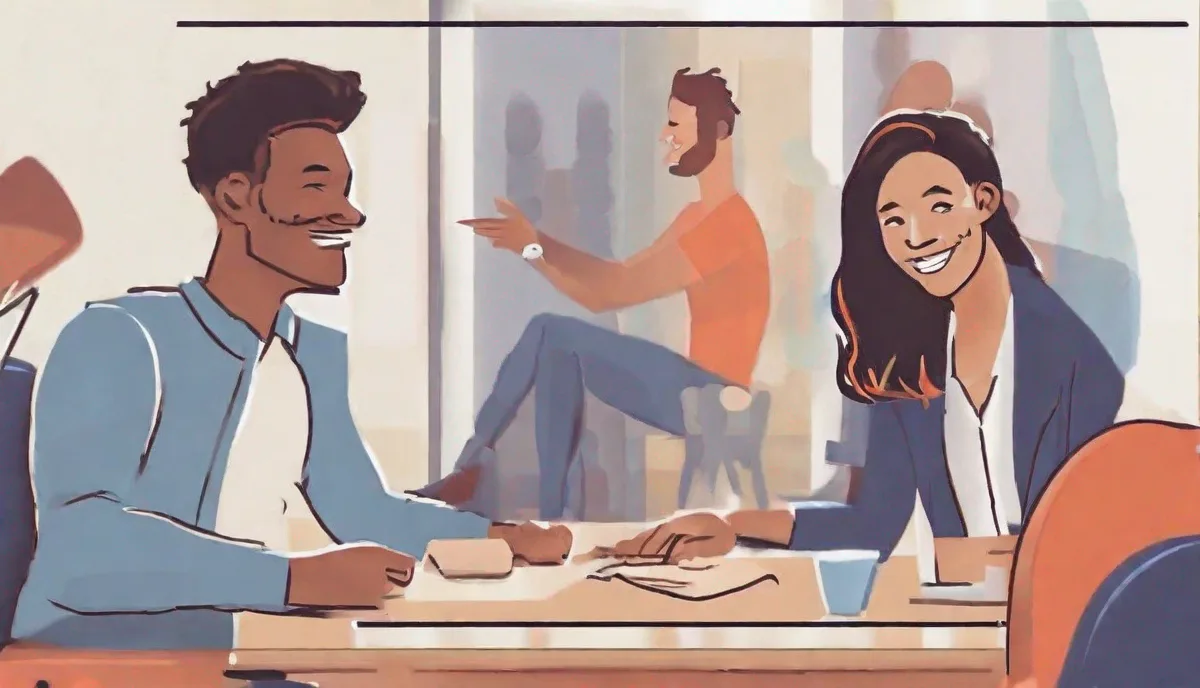
Approachability is an important trait that allows people to make connections with others easily. Some people seem to have an open and welcoming presence that draws people in. However, approachability is not necessarily an inherent quality – it often comes down to the signals you send through your body language and demeanor.
Make Eye Contact
Maintaining good eye contact is key to seeming approachable. When someone looks you in the eyes when you are interacting, you feel they are fully present and engaged. However, be careful not to stare too intensely or for too long. Friendly eye contact that connects briefly but repeatedly during conversations strikes the right balance of interest and consideration.
Smile Genuinely
Offering an authentic smile is one of the simplest ways to signal you are open to interactions. Smiles transcend language and cultural barriers. They put others at ease instantly and convey a sense of positivity. Just be sure your smile reaches your eyes – otherwise, it can come across as artificial.
Have an Open Posture
Your posture communicates a tremendous amount non-verbally. Standing or sitting up straight with your shoulders back projects confidence and self-assurance. Leaning in slightly and orienting your body toward others demonstrates your interest in connecting. Uncrossing your arms and legs eliminates physical barriers. These types of open postures invite people to approach you for conversation.
Listen Actively
When someone approaches you to talk, make an effort to actively listen without distractions. Maintain eye contact, ask questions, nod periodically, and avoid glancing at your phone. Give the other person your full attention so they feel comfortable continuing the dialogue. Listening may be the most important element of approachability.
Ask Good Questions
Naturally continuing conversations leads to connections. Prepare some open-ended questions you can default to so you always have something ready to ask. Questions about people’s interests, families, jobs or hobbies keep dialogue flowing. Just steer clear of anything too personal, sensitive or controversial, especially with strangers.
Frequently Asked Questions
How can I seem more approachable at networking events?
Attending events specifically designed for making new contacts puts the responsibility on you to reach out. Combat nerves with an upbeat mindset, steady breathing and an understanding that most people there feel the same trepidation. Moving slowly through the venue with an open posture while briefly making eye contact can draw others to start conversations.
What if I’m introverted by nature?
You don’t need a boisterous personality to give off an approachable vibe. Even introverts can craft space for short, meaningful interactions using good body language and listening skills. Start small by briefly chatting up clerks or neighbors, then build up endurance for lengthier conversations.
How do I avoid seeming desperate or pushy?
There’s a difference between being approachable and overeager for attention. Learn to read social cues that indicate when your friendly overtures should wrap up or move on. Getting too personal too quickly or aggressively pursuing continued dialogue can inadvertently push people away.
What are signs someone may not want to talk?
Closed off body language like crossed arms, little eye contact, short responses or constantly checking a phone signal disinterest in conversing further. Don’t take it personally. Everyone has moments when they don’t feel like engaging. Back off politely so you don’t make the person uncomfortable.
How can I help a shy friend become more approachable?
Lead by example to show the upsides of putting yourself out there. Offer moral support and post-event debriefs to work through any discouraging experiences. Share tips privately so your friend doesn’t feel self-conscious about a perceived flaw. Most importantly, have patience providing encouragement over time rather than pushing too hard.
Strategic Positioning in Social Environments
Beyond your internal mindset, the physical space you occupy in a room significantly dictates how others perceive your availability. Many people inadvertently ‘wall’ themselves off by choosing the perimeter of a room or standing behind physical barriers like high-top tables, podiums, or large plants. To be truly approachable, you must consider the geometry of the space. Positioning yourself in high-traffic areas without blocking the flow of movement signals that you are part of the event’s energy rather than a spectator. When standing in a group, avoid forming a closed circle. Instead, adopt a ‘U’ shape or a ‘V’ shape, leaving an open side that metaphorically and literally invites a third or fourth person to join the conversation without having to physically force their way in.
Consider the ‘anchor’ effect of furniture. If you are seated deep in a plush sofa, you are physically lower than those standing, which can create a psychological barrier or make you seem too settled to be disturbed. Opting for a stool or standing near a communal area like a refreshment station or a literature table provides natural ‘props’ for starting a conversation. Edge cases, such as very crowded or very sparse environments, require different tactics. In a crowded room, maintaining a ‘compressed’ but upright posture prevents you from looking overwhelmed. In a sparse room, avoid the temptation to hide in a corner; instead, occupy a central ‘island’ of space, which projects a sense of calm confidence that others will naturally gravitate toward for social safety.
Removing Invisible Digital and Physical Walls
In the modern era, the most significant barrier to approachability is often the technology we carry. While the existing advice to put your phone away is foundational, it is important to understand the nuance of ‘digital body language.’ Even having a phone resting face-up on a table during a meal or meeting creates a ‘split attention’ environment. It signals to everyone in the vicinity that something more important could happen at any second on that screen, making you seem mentally unavailable. To be truly approachable, the phone should be entirely out of sight. Furthermore, noise-canceling headphones have become the universal ‘Do Not Disturb’ sign of the 21st century. If you are wearing them in a public or semi-public space, you are signaling a total shutdown of external communication. If you must use them, consider wearing only one earbud or choosing transparent mode, but recognize that the visual cue alone will still deter 90% of potential interactions.
Physical ‘clutter’ also plays a role. If you are at a conference or a cafe and have your laptop, notebook, coffee, and bag spread across three seats, you are effectively claiming a private territory that screams ‘keep out.’ By condensing your footprint and keeping your hands free, you appear more ready to engage. Even the way you hold a drink matters; holding a glass high against your chest creates a literal shield between your heart and the person you are talking to. Lowering your drink to waist level opens up your torso, which is a subconscious signal of trust and vulnerability that makes others feel safer approaching you.
The Power of the ‘Eyebrow Flash’ and Micro-Acknowledgements
While a smile is a powerful tool, the ‘eyebrow flash’ is a nearly universal biological signal of recognition and non-threat. This involves a split-second raising of the eyebrows when you first make eye contact with someone. It is a subtle ‘pre-approval’ that tells the other person, ‘I see you, and I am friendly.’ This micro-expression is often processed subconsciously and can break the ice before a single word is spoken. Integrating this with a slight head tilt—which exposes the carotid artery—signals a lack of aggression and a high level of curiosity. These biological cues are particularly effective in high-stress environments like airports or busy offices where people are on high alert.
Micro-acknowledgements also extend to how you react to people entering your peripheral vision. Instead of waiting for someone to speak to you, a small nod or a brief shift in your body orientation toward a newcomer signals that you have noticed them and are open to their presence. This ‘soft entry’ technique reduces the social ‘cost’ for the other person to start a conversation. If you notice someone hovering on the edge of a group, a simple step back to widen the circle or a quick ‘Hello’ can be the bridge they need. This proactive approachability transforms you from a passive participant into a social facilitator, a role that is highly attractive to others.
Cultivating an Aura of Relatability Through Vulnerability
One of the most common reasons people avoid approaching someone is the ‘perfection barrier.’ If you appear too polished, too successful, or too ‘put together,’ you can inadvertently become intimidating. To counter this, utilize small-scale vulnerability. This doesn’t mean sharing your deepest secrets with a stranger; rather, it involves admitting to small, relatable human experiences. Mentioning that you’re a bit nervous about a presentation, struggling to find the right room, or even laughing at a minor clumsy moment (the ‘Pratfall Effect’) makes you infinitely more approachable. People are much more likely to approach someone who seems ‘human’ and ‘relatable’ than someone who seems like a flawless statue.
This principle also applies to your verbal cues. When asked ‘How are you?’, the standard ‘I’m fine’ is a conversation killer. A more approachable response might be, ‘I’m doing well, though I’m still trying to wake up after a long flight.’ This provides a ‘hook’ for the other person to engage with. It shows that you are willing to share a small piece of your reality, which invites them to do the same. In professional settings, being the first to admit you don’t know a specific acronym or asking for a simple piece of advice can bridge the gap between hierarchies, making subordinates or peers feel much more comfortable initiated a dialogue with you.
Managing ‘Resting’ Expressions and Emotional Leakage
Many people are unaware of their ‘resting’ face, which can often appear stern, bored, or even angry due to the natural tension held in the jaw and brow. This ’emotional leakage’ can project a mood you aren’t actually feeling. To combat this, practice ‘resting pleasant face.’ This isn’t a constant, wide-eyed grin, which can look manic, but rather a softening of the muscles around the eyes and a slight release of the jaw. Think of it as a ‘half-smile’—a look of internal contentment. This subtle shift changes the way light hits your face and significantly lowers the perceived ‘threat level’ to others.
Internal emotional regulation is also vital. If you are ruminating on a stressful email or a personal conflict, that tension will manifest in your shoulders and the way you move. Before entering a social situation where you want to be approachable, perform a ‘body scan.’ Consciously drop your shoulders, take three deep breaths, and try to find one thing in the environment to be genuinely curious about. Curiosity is the antidote to social anxiety; when you are genuinely interested in your surroundings or the people in them, your body language naturally becomes more open and ‘seeking’ rather than ‘defensive.’ This transition from an internal focus (your own stress) to an external focus (the room) is the key to shifting your aura from closed to open.
Adapting Approachability for Leadership and Power Dynamics
In a professional context, the higher your rank, the more ‘active’ your approachability must become. Because of the inherent power imbalance, others will rarely approach you first, regardless of how nice you are. As a leader, you must lower the ‘barrier to entry.’ This can be achieved through ‘physical leveling’—if your team is sitting, you should sit. If they are in a casual breakroom, don’t stand over them; join them at their level. This removes the subconscious cues of dominance that prevent honest interaction. Also, consider the ‘transparency of intent.’ If you are walking through the office with a focused, hurried stride, people will assume you are too busy to be bothered. Slowing your pace and looking up from your notes or phone as you walk creates ‘windows of opportunity’ for quick check-ins.
Furthermore, use ‘proactive invitations.’ Instead of saying ‘My door is always open’ (which puts the burden on the employee), try ‘I’ll be in the breakroom at 2:00 PM if anyone wants to grab a coffee and chat.’ This creates a specific, low-pressure time and place for interaction. When someone does approach you, the ‘pivot’ is crucial. Physically turn your entire body—not just your head—to face them. This ‘torso heart’ alignment communicates that they have your undivided attention and that their input is valued. For leaders, approachability isn’t just about being ‘nice’; it’s about being ‘safe’ to talk to, which requires a consistent, predictable, and open demeanor over time.
The ‘Soft-Start’ Conversation Technique
Once someone has approached you, or you have approached them, the first ten seconds are critical for establishing a continued ‘open’ channel. Avoid ‘interrogation style’ questions like ‘What do you do?’ or ‘Where are you from?’ which can feel like a demand for data. Instead, use ‘situational observations’ followed by a ‘feeling’ statement. For example, ‘The music is a bit louder than I expected, but I really like the vibe of this place. Have you been here before?’ This gives the other person multiple ‘handles’ to grab onto: the music volume, the atmosphere, or their history with the venue. It feels less like a test and more like a shared experience.
Another effective technique is the ‘compliment-plus-question’ formula. A genuine compliment on a choice someone has made (like a unique tie, a specific book they are carrying, or a point they made in a meeting) followed by an open-ended question is a high-speed way to build rapport. ‘That’s a fascinating watch; does it have a story behind it?’ is much more approachable than simply saying ‘Nice watch.’ This shows that you are paying attention to details and are interested in the person’s narrative, not just their surface-level appearance. By focusing on things people have *chosen* (accessories, books, ideas) rather than things they *are* (height, eye color), you validate their personality, which is the ultimate signal of an approachable and empathetic individual.
Related posts:
 Why Beauty Experts Are Using Eye Cream on Their Entire Face
 Eye Contact Communication Tips
 Desk Setup Game-Changer: The Perfect Phone Perch for Productivity
 Elements of Conversation: Mastering the Art of Communication
 Gym Flirt Guide: How to Slide Into Someone’s DMs at the Squat Rack
 The Power of Eye Contact
 $5 iPhone Ring Holder Health Hack
 PHA Bodyweight Workout: Efficient Fitness Anywhere, Anytime